Sabrent Rocket Nano 2TB Review (2026)
Quick answer
The Sabrent Rocket Nano 2TB is the best option for devices that require the M.2 2242 form factor and need high capacity.
Read: 2500 MB/s Write: 2100 MB/s Endurance: 1710 TBW Warranty: 5 years Interface: M.2 3.0 x 4
The Sabrent Rocket Nano 2TB packs a large capacity into a compact M.2 2242 form factor, offering high-density storage for devices with limited M.2 slot space.
Controller & Memory
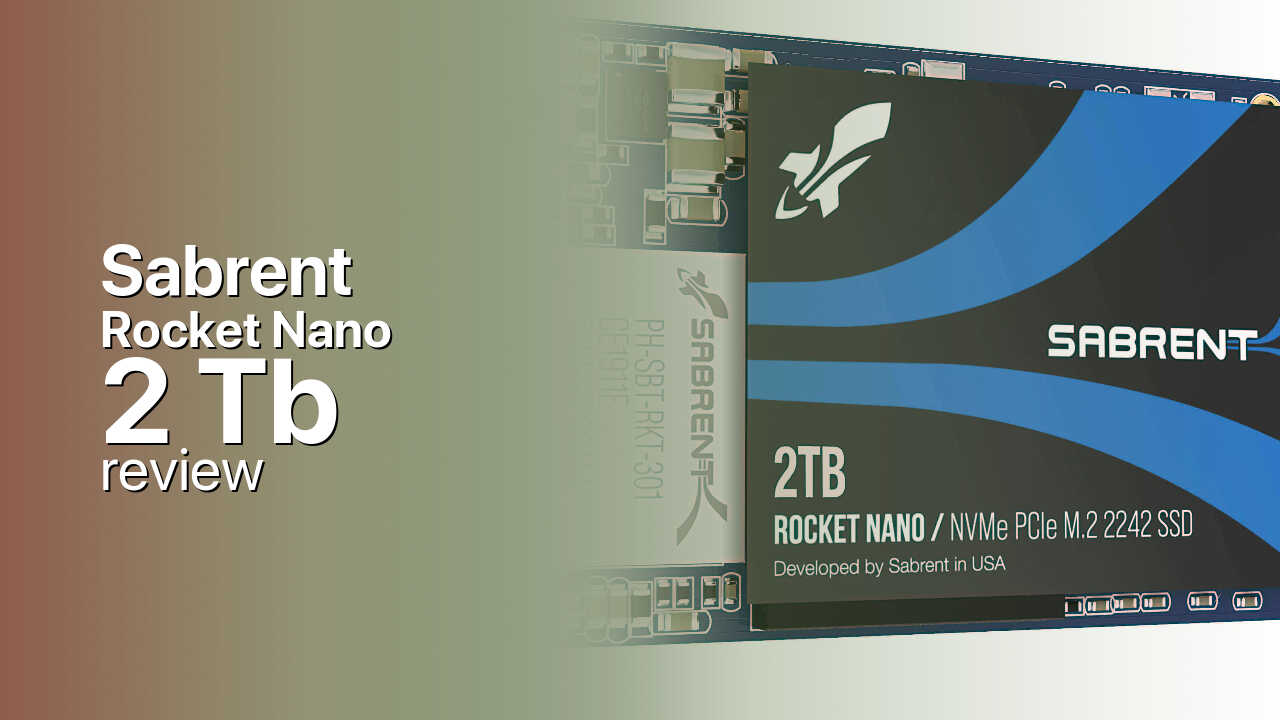
Sabrent designed the Rocket Nano for devices that require the shorter M.2 2242 form factor rather than the standard M.2 2280. Despite the compact size, the 2TB model uses the Phison PS5013-E13 controller with Toshiba TLC NAND, delivering 2,500 MB/s sequential reads and 2,100 MB/s writes.
The Rocket Nano is DRAM-less, relying on the NVMe Host Memory Buffer for mapping table management. This keeps the physical footprint small while maintaining acceptable performance. The M.2 2242 form factor is required by some mini PCs, handheld gaming devices, and ultrabooks that cannot accommodate the longer M.2 2280 modules.
The 2TB capacity is the largest available in the Rocket Nano lineup, offering enough storage for a full Windows installation, applications, and a moderate game library. The drive is rated at 1,710 TBW endurance with a 5-year warranty. Sabrent positions the Rocket Nano as a compact, high-capacity solution rather than a performance flagship.
Storage Comparisons:
Rocket Nano Performance & Benchmarks
The Sabrent Rocket Nano 2TB is rated at 2,500 MB/s sequential reads and 2,100 MB/s sequential writes. These speeds are mid-range for PCIe 3.0 NVMe, roughly 4-5x faster than SATA SSDs but below the 3,000-3,500 MB/s that full-size premium Gen3 drives achieve. The compact M.2 2242 form factor imposes thermal and space constraints that limit peak throughput.
Sabrent Rocket Nano 2 TB vs M.2 3.0 x 4 peers
Switch between sequential throughput and random IOPS to see how this drive stacks up against other M.2 3.0 x 4 SSDs in our database. The highlighted bar is the drive on this page — click any other bar to open that drive.
- ADATA SX 8800 Pro 512 GB: 3,500 MB/s read, 2,700 MB/s write
- ADATA SX 8800 Pro 1 TB: 3,500 MB/s read, 2,700 MB/s write
- ADATA XPG Spectrix S40G RGB 256 GB: 3,500 MB/s read, 3,000 MB/s write
- ADATA XPG Spectrix S40G RGB 512 GB: 3,500 MB/s read, 3,000 MB/s write
- Sabrent Rocket Nano 2 TB (this drive): 2,500 MB/s read, 2,100 MB/s write
The Phison E13T DRAM-less controller uses Host Memory Buffer for mapping tables. For sequential reads and writes, the controller delivers its rated speeds. Random 4K performance is modest compared to DRAM-equipped drives, which affects responsiveness under heavy multitasking. The 2TB capacity benefits from more NAND die for parallelization, helping to offset some of the DRAM-less limitations.
In real-world use, the Rocket Nano 2TB provides a substantial upgrade over SATA SSDs and eMMC storage found in many compact devices. Boot times, application launches, and file operations are noticeably faster. The SLC cache handles typical write bursts before transitioning to native TLC speeds. For the target devices like mini PCs and handhelds, the Rocket Nano delivers performance well beyond what these systems typically ship with.
Sabrent Rocket Nano vs Competitors
See how the Rocket Nano stacks up against other M.2 3.0 x 4 drives in our database:
Compare with rival drives:
Endurance, TBW & Warranty
Sabrent backs the Rocket Nano with a 5-year warranty. The 2TB model is rated at 1,710 TBW endurance, which is generous for a compact drive. Writing 50 GB per day would take over 93 years to reach 1,710 TBW. The endurance rating reflects the benefit of spreading writes across many NAND die in the 2TB capacity.
Sabrent handles warranty through its US-based support team. Registration on the Sabrent website is required to activate the full warranty period. The drive includes basic health monitoring via S.M.A.R.T. attributes. For a compact form factor drive, the endurance and warranty coverage exceed expectations.
Sabrent Rocket Nano 2 TB Specifications
| Category | Value |
|---|---|
| Capacity [?] | 2 TB |
| Interface [?] | M.2 3.0 x 4 |
| Controller [?] | Phison PS5013-E13 |
| Memory type [?] | Toshiba TLC |
| DRAM [?] | SLC Caching and Host Memory Buffer |
| Read speed (MB/s) [?] | 2500 |
| Write speed (MB/s) [?] | 2100 |
| Read IOPS [?] | 295000 |
| Write IOPS [?] | 430000 |
| Endurance (TBW) [?] | 1710 |
| MTBF (million hours) [?] | 1800000 |
| Warranty (years) [?] | 5 |
Verdict: Is the Rocket Nano Worth It in 2026?
The Sabrent Rocket Nano 2TB is the best option for devices that require the M.2 2242 form factor and need high capacity. The 2,500/2,100 MB/s speeds are competent for a compact drive, and the 2TB capacity eliminates storage anxiety in small devices. Buy it if your mini PC, handheld, or ultrabook requires M.2 2242 and you want maximum storage.
Skip it if your device supports M.2 2280, where you can get faster drives like the Sabrent Rocket 4.0 or Samsung 970 EVO Plus for similar or lower prices. The Rocket Nano is a form-factor-driven purchase, not a performance-driven one.
+ Pros
- 2TB capacity in compact M.2 2242 form factor
- 2,500/2,100 MB/s — 4-5x faster than SATA
- 1,710 TBW endurance generous for compact drive
- Fits mini PCs, handhelds, and ultrabooks
- 5-year warranty
- Cons
- M.2 2242 limits thermal performance
- DRAM-less design restricts random I/O
- 2,500 MB/s below full-size Gen3 ceiling
- Premium price for the compact form factor
- No IOPS ratings specified by manufacturer
Buy this or similar SSD Storage:



Video Review
Sabrent 2TB Rocket Nano Rugged NVMe unboxing - Fastest - Toughest SSD on the market