Crucial P5 2TB NVMe SSD Review (2026)
Quick answer
The Crucial P5 2 TB is the best value in the P5 lineup when measured in cost-per-GB and endurance-per-dollar.
Read: 3400 MB/s Write: 3000 MB/s Endurance: 1200 TBW Warranty: 5 years Interface: M.2 3.0 x 4
The Crucial P5 2 TB tops the lineup with 1,200 TBW endurance, 96-layer Micron TLC, and hardware encryption in a single-sided M.2 2280 module that fits almost any system.
Controller & Memory
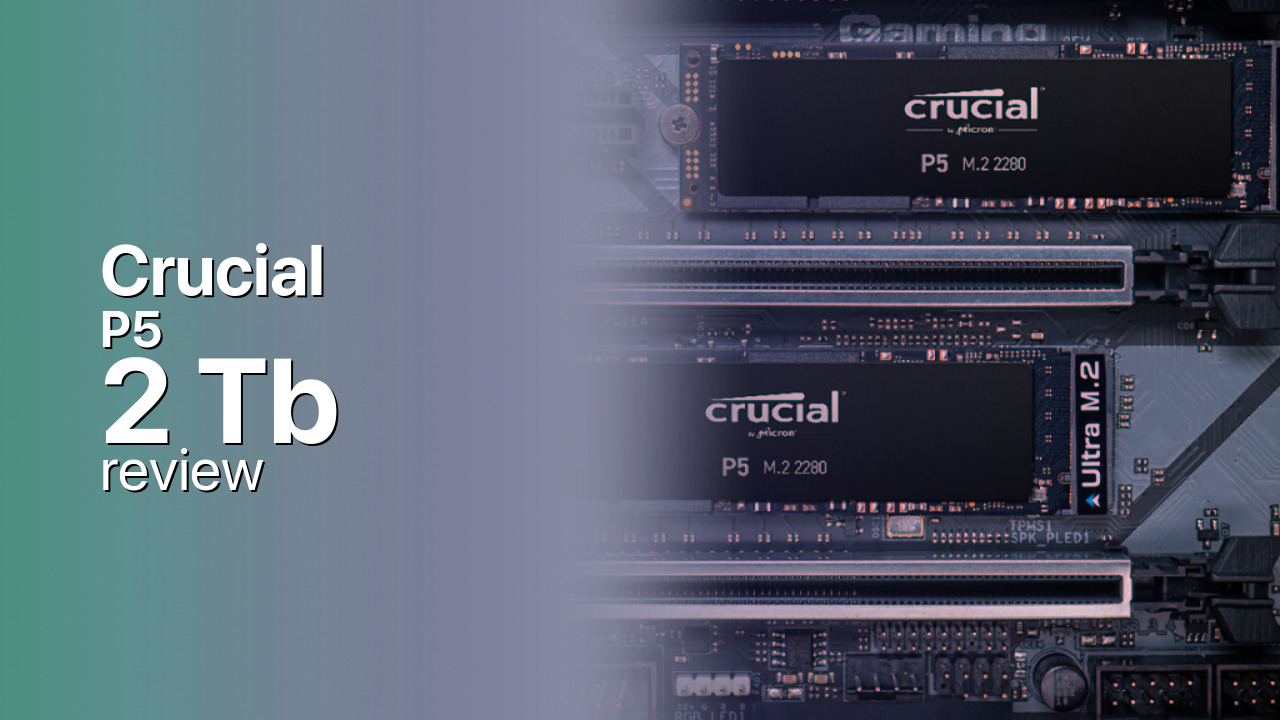
The 2 TB P5 uses Crucial's proprietary six-core NVMe controller (dual Cortex-R5 CPUs, four Cortex-M3 co-processors, eight NAND channels) with 96-layer Micron TLC NAND. The 2 TB model doubles the NAND packages compared to the 1 TB, using 32 dies of 512Gb density flash for optimal interleaving. The LPDDR4 DRAM chip doubles to 2 GB to manage the larger flash array.
Despite the high density, the 2 TB P5 remains a single-sided M.2 2280 module at all capacities, preserving compatibility with slim laptops and compact desktops. Its 1,200 TBW endurance is the highest in the P5 lineup and competitive with the Samsung 970 EVO Plus 2 TB.
The P5's signature feature is hardware AES 256-bit encryption (TCG Opal 2.0, IEEE 1667, eDrive), which enables BitLocker encryption with minimal performance overhead. The thermal issue that affects all P5 capacities is particularly relevant at 2 TB, where sustained writes push more NAND and generate more heat. A heatsink is essential at this capacity.
Storage Comparisons:
P5 Performance & Benchmarks
Crucial rates the 2 TB P5 for up to 3,400 MB/s sequential reads and 3,000 MB/s sequential writes over PCIe 3.0 x4. Random performance reaches up to 430,000 read IOPS and 500,000 write IOPS. The 2 TB model's 32 NAND dies provide excellent interleaving for random workloads.
Crucial P5 2 TB vs M.2 3.0 x 4 peers
Switch between sequential throughput and random IOPS to see how this drive stacks up against other M.2 3.0 x 4 SSDs in our database. The highlighted bar is the drive on this page — click any other bar to open that drive.
- ADATA SX 8800 Pro 512 GB: 3,500 MB/s read, 2,700 MB/s write
- ADATA SX 8800 Pro 1 TB: 3,500 MB/s read, 2,700 MB/s write
- ADATA XPG Spectrix S40G RGB 256 GB: 3,500 MB/s read, 3,000 MB/s write
- ADATA XPG Spectrix S40G RGB 512 GB: 3,500 MB/s read, 3,000 MB/s write
- Crucial P5 2 TB (this drive): 3,400 MB/s read, 3,000 MB/s write
The Dynamic Write Acceleration caching system scales with capacity, giving the 2 TB the largest SLC cache in the P5 family. The cache adjusts dynamically based on used capacity and workload, and can remap on the fly to maintain consistent performance. Tom's Hardware tested the 2 TB model in their updated review and noted it does not lead the PCIe 3.0 class in performance despite the robust hardware.
Thermal throttling remains the P5's weakness at 2 TB. Adaptive Thermal Protection kicks in at 70 degrees Celsius, and sustained write workloads will trigger this without adequate cooling. The 2 TB model's larger NAND array generates more heat than smaller capacities.
Crucial P5 vs Competitors
See how the P5 stacks up against other M.2 3.0 x 4 drives in our database:
Compare with rival drives:
Endurance, TBW & Warranty
Crucial rates the 2 TB P5 for 1,200 TBW of write endurance under a five-year limited warranty. At 50 GB of writes per day -- a heavy consumer workload -- 1,200 TBW translates to roughly 65 years of use. The P5 is overprovisioned by 9% and includes RAIN parity protection at a 128:1 ratio, multi-step LDPC error correction, and integrated power loss immunity. The 1,200 TBW endurance is competitive with the Samsung 970 EVO Plus 2 TB.
Crucial P5 2 TB Specifications
| Category | Value |
|---|---|
| Capacity [?] | 2 TB |
| Interface [?] | M.2 3.0 x 4 |
| Controller [?] | Micron DMO1B2 |
| Memory type [?] | Micron TLC |
| DRAM [?] | LPDDR4 DRAM |
| Read speed (MB/s) [?] | 3400 |
| Write speed (MB/s) [?] | 3000 |
| Read IOPS [?] | 430000 |
| Write IOPS [?] | 500000 |
| Endurance (TBW) [?] | 1200 |
| MTBF (million hours) [?] | 1.8 |
| Warranty (years) [?] | 5 |
Verdict: Is the P5 Worth It in 2026?
The Crucial P5 2 TB is the best value in the P5 lineup when measured in cost-per-GB and endurance-per-dollar. Its 1,200 TBW, hardware encryption, and 2 TB capacity make it well-suited for users who need secure, high-capacity storage on PCIe 3.0. The thermal issues require a heatsink, and the Samsung 970 EVO Plus outperforms it in most benchmarks. For users who prioritize hardware encryption or prefer the Micron brand, the P5 2 TB delivers where it counts.
+ Pros
- 1,200 TBW endurance rating
- 3,400 MB/s reads, 3,000 MB/s writes
- Hardware AES 256-bit encryption
- 96-layer Micron TLC NAND
- 2 GB LPDDR4 DRAM
- Single-sided M.2 2280 at 2 TB
- RAIN parity data protection
- Cons
- Runs hot, requires heatsink
- Lower performance than Samsung 970 EVO Plus
- Thermal throttling at 70 degrees Celsius
- Not competitive on raw performance for price
Buy this or similar SSD Storage:
Video Review
Crucial P5 1TB - NVMe M.2 SSD Review