ADATA XPG Gammix S5 512GB SSD — In-Depth Review & Specs (2026)
Quick answer
The ADATA XPG Gammix S5 512GB is a straightforward value proposition: it delivers genuine NVMe performance at a SATA-competitive price, trading the DRAM cache and higher throughput of mid-range drives for a lower bill of materials.
Read: 2100 MB/s Write: 1500 MB/s Endurance: 320 TBW Warranty: 5 years Interface: M.2 3.0 x 4
The ADATA XPG Gammix S5 512GB is the practical mid-capacity option in ADATA's budget Gammix NVMe line. Built on the Realtek RTS5763DL — a 4-channel DRAM-less PCIe 3.0 controller using Host Memory Buffer — it delivers 2,100 MB/s read and 1,500 MB/s write at a 512GB capacity that can serve as a single-drive solution for OS, applications, and a moderate game library. At roughly 4x the throughput of a SATA SSD, the Gammix S5 512GB makes a compelling case for builders who want NVMe responsiveness without paying for DRAM-equipped hardware. This review examines how the RTS5763DL handles real-world use at the 512GB capacity point.
Controller & Memory
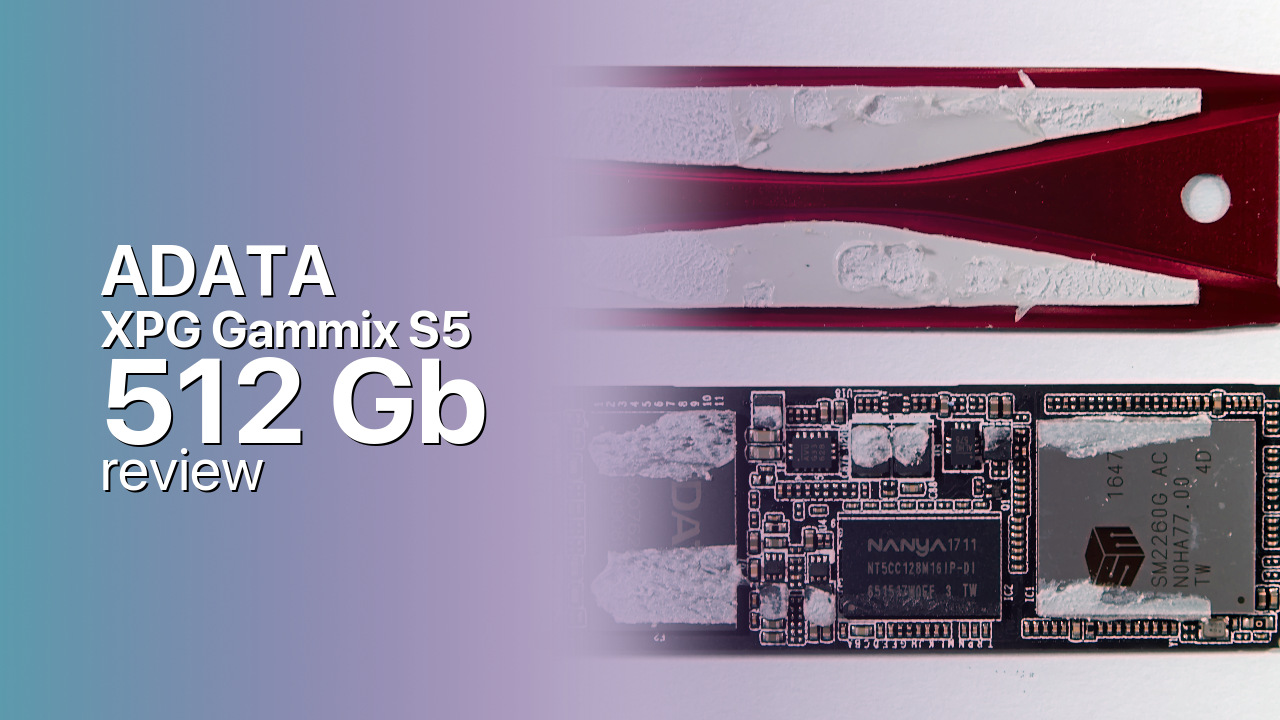
The Realtek RTS5763DL is a purpose-built DRAM-less NVMe controller with four NAND channels and a PCIe 3.0 x4 link. It relies on NVMe 1.3's Host Memory Buffer to borrow system RAM for the flash translation layer mapping table, eliminating the cost of a dedicated DRAM chip. At the 512GB capacity, the four NAND channels are populated with enough dies to hit the controller's rated ceiling of 2,100 MB/s read and 1,500 MB/s write — numbers that represent roughly 4x the sequential throughput of a SATA SSD.
ADATA pairs the controller with 3D TLC NAND behind an SLC write cache. At 512GB the dynamic SLC cache is proportionally larger than on the 256GB model — typically 60-100 GB — which means most everyday writes land in the fast cache and never expose the native TLC write speed. Only sustained transfers exceeding roughly 80 GB in a single operation will fold the cache and drop write throughput to native TLC rates around 400-500 MB/s.
The drive supports LDPC error correction, SLC caching with intelligent management, and NVMe autonomous power state transitions. The single-sided M.2 2280 form factor ensures universal fit, and the RTS5763DL's modest power draw keeps thermals in check even in passively cooled laptop M.2 slots. ADATA provides a 5-year limited warranty and the SSD Toolbox software for firmware updates, health monitoring, and secure erase. Endurance ratings are not publicly specified for the Gammix S5 series, which is typical for drives positioned in the entry-level budget segment.
Storage Comparisons:
XPG Gammix S5 Performance & Benchmarks
Rated sequential throughput of 2,100 MB/s read and 1,500 MB/s write is consistent across the Gammix S5 line from 256GB to 1TB — the RTS5763DL's 4-channel architecture means the controller, not the NAND, is the bottleneck at 512GB and above. Reads are roughly 4x faster than a SATA SSD, and writes are about 2.7x faster. For the mixed desktop workload that dominates consumer PC use — OS boots, application launches, game loads, browser sessions, and moderate file transfers — the real-world experience is significantly snappier than any SATA drive.
ADATA XPG Gammix S5 512 GB vs M.2 3.0 x 4 peers
Switch between sequential throughput and random IOPS to see how this drive stacks up against other M.2 3.0 x 4 SSDs in our database. The highlighted bar is the drive on this page — click any other bar to open that drive.
- ADATA SX 8800 Pro 512 GB: 3,500 MB/s read, 2,700 MB/s write
- ADATA SX 8800 Pro 1 TB: 3,500 MB/s read, 2,700 MB/s write
- ADATA XPG Spectrix S40G RGB 256 GB: 3,500 MB/s read, 3,000 MB/s write
- ADATA XPG Spectrix S40G RGB 512 GB: 3,500 MB/s read, 3,000 MB/s write
- ADATA XPG Gammix S5 512 GB (this drive): 2,100 MB/s read, 1,500 MB/s write
Random 4K performance at 250K/240K IOPS is adequate for a budget NVMe drive. The HMB-sourced FTL keeps lightly-threaded random operations responsive, and the 512GB capacity provides enough SLC cache headroom that the typical user will rarely encounter post-cache TLC write speeds. The DRAM-less architecture shows its limits under heavy mixed workloads — simultaneous application installs, file copies, and background tasks can push the HMB-based mapping table past its comfort zone, and latency spikes compared to a DRAM-equipped alternative. But for the single-task-at-a-time usage pattern that defines the target market, the RTS5763DL performs without obvious bottlenecks.
Thermally, the 512GB Gammix S5 is well-behaved. The RTS5763DL's low power envelope and the single-sided PCB mean the drive rarely if ever hits throttle temperatures, even in cramped laptop M.2 slots. No heatsink is required for typical consumer use.
ADATA XPG Gammix S5 vs Competitors
See how the XPG Gammix S5 stacks up against other M.2 3.0 x 4 drives in our database:
Compare with rival drives:
Endurance, TBW & Warranty
ADATA provides a 5-year limited warranty for the XPG Gammix S5 series. Endurance ratings are not publicly specified for the Gammix S5 models — typical for entry-level budget drives where TBW is not a primary marketing metric. The warranty is tied to the original purchaser. ADATA's SSD Toolbox software provides drive health monitoring and firmware update capability.
ADATA XPG Gammix S5 512 GB Specifications
| Category | Value |
|---|---|
| Capacity [?] | 512 GB |
| Interface [?] | M.2 3.0 x 4 |
| Controller [?] | Realtek RTS5763DL |
| Memory type [?] | Micron TLC |
| DRAM [?] | HMB |
| Read speed (MB/s) [?] | 2100 |
| Write speed (MB/s) [?] | 1500 |
| Read IOPS [?] | 250000 |
| Write IOPS [?] | 240000 |
| Endurance (TBW) [?] | 320 |
| MTBF (million hours) [?] | 2 |
| Warranty (years) [?] | 5 |
Verdict: Is the XPG Gammix S5 Worth It in 2026?
The ADATA XPG Gammix S5 512GB is a straightforward value proposition: it delivers genuine NVMe performance at a SATA-competitive price, trading the DRAM cache and higher throughput of mid-range drives for a lower bill of materials. The 2,100/1,500 MB/s speeds are more than adequate for the home/office PC, student laptop, or budget gaming rig that defines its target market, and the 512GB capacity is the practical minimum for a single-drive build that holds an OS, applications, and a reasonable game library. The Realtek RTS5763DL is a known quantity — it won't win benchmark races against 8-channel DRAM drives, but it doesn't need to. For buyers moving from a hard drive or SATA SSD and focused on price-per-gigabyte, the Gammix S5 512GB checks the right boxes: NVMe interface, 4x-SATA read speed, 5-year warranty, and a single-sided form factor that fits everything. Just understand that a DRAM-equipped alternative will serve you better if your workload involves heavy simultaneous I/O.
+ Pros
- 2,100/1,500 MB/s — 4x SATA read speed, genuine NVMe experience
- 512GB — practical single-drive capacity for OS, apps, and games
- Single-sided M.2 2280 — universal compatibility including thin laptops
- 5-year warranty — longer than many budget alternatives
- Cool and efficient — no heatsink required for typical use
- Aggressive pricing — often the cheapest NVMe option at 512GB
- Cons
- DRAM-less HMB design — latency penalty under heavy mixed workloads
- Realtek RTS5763DL is 4-channel — cannot match 8-channel Gen3 drives
- Endurance not publicly specified — typical for budget tier
- Post-cache TLC write speed drops to ~400-500 MB/s
- 2,100 MB/s read is well below PCIe 3.0 x4 ceiling of ~3,500 MB/s
- No hardware encryption support (TCG Opal / Pyrite)
Buy this or similar SSD Storage:



Video Review
Unboxing ADATA XPG Gammix S5 512GB NVMe SSD PCIe Gen3x4 M.2