Addlink S92 4TB Review — QLC PCIe 4.0 NVMe SSD (2026)
Quick answer
The Addlink S92 4 TB is a specialist drive for a specific buyer: someone who needs 4 TB of NVMe storage at the lowest possible cost and whose workload is overwhelmingly reads.
Read: 4900 MB/s Write: 3600 MB/s Endurance: 600 TBW Warranty: 5 years Interface: M.2 4.0 x 4
The Addlink S92 4 TB is the top-capacity QLC drive in a lineup defined by capacity over speed, and at 4 TB of PCIe 4.0 storage with a DRAM cache, it costs less per gigabyte than almost anything else with an M.2 slot — endurance caveats included.
Controller & Memory
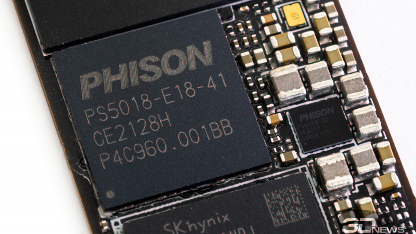
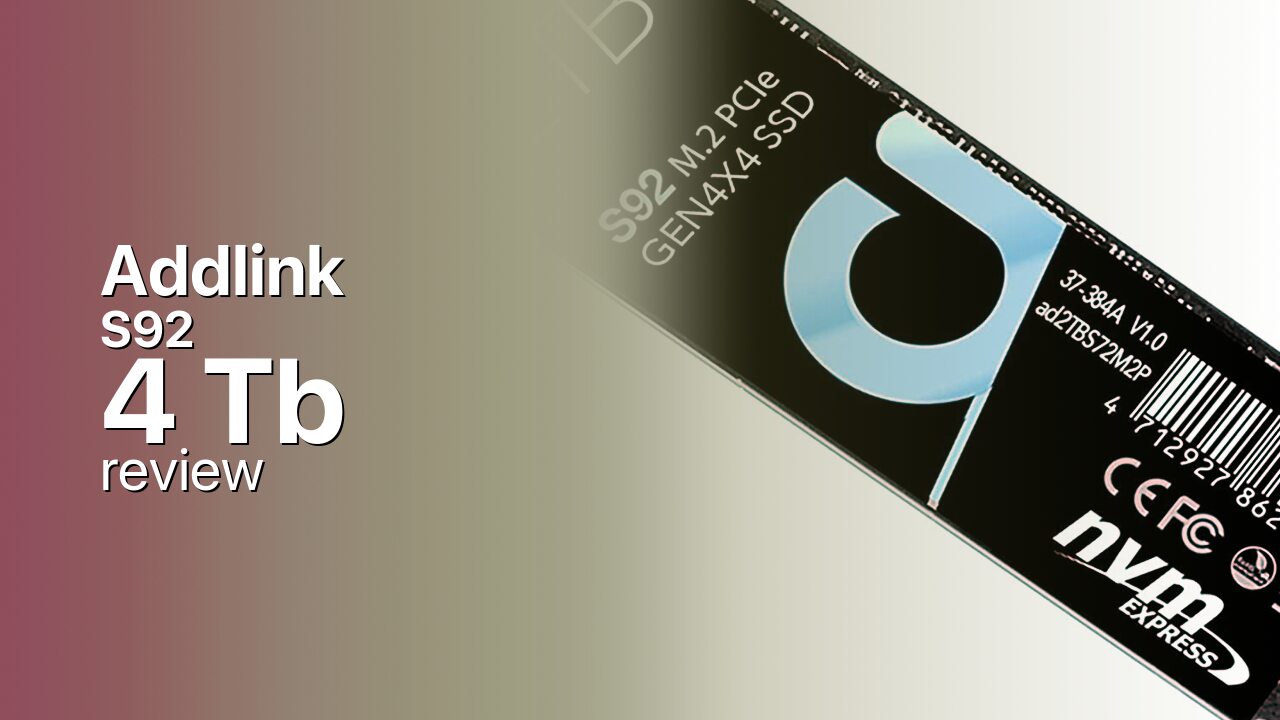
The 4 TB Addlink S92 is the fully populated variant of the QLC Phison E16 platform. It uses the same 8-channel PS5016-E16 controller, DDR3 DRAM cache, and Micron 3D QLC NAND as its smaller siblings, but fills both sides of the M.2 2280 PCB with NAND packages to reach 4 TB — a capacity that was rare for consumer M.2 drives when the S92 launched. The endurance rating climbs to 600 TBW, which is triple the 1 TB variant but notably does not double the 2 TB's 400 TBW — QLC endurance does not scale linearly with capacity in the same way TLC does.
The S92 family spans 1 TB, 2 TB, and 4 TB. The 4 TB reviewed here is the capacity play: a single-drive solution for a massive game library, a media server cache, or a photo and video archive where the working set far exceeds what a 2 TB drive can hold. The competition at 4 TB in the QLC space is thin — the Corsair MP400 tops out at 8 TB (SATA-class speeds on a different controller revision), and the Sabrent Rocket Q 4 TB uses the same E16 platform with similar specs. The S92 4 TB competes more against external hard drives and entry-level SATA SSDs than against other NVMe drives — its selling point is 4 TB of decently fast NVMe storage at a price per gigabyte that approaches spinning rust.
Use the S92 4 TB as bulk storage: a Steam and Game Pass library, a Plex media cache, a photo archive. Fill it once over a weekend and spend the next five years reading from it. That is the QLC value proposition in a nutshell, and at 4 TB the S92 delivers it at a scale where the endurance ceiling, while low for the capacity, is still high enough in absolute terms for read-heavy use.
Storage Comparisons:
S92 Performance & Benchmarks
Addlink rates the S92 4 TB at up to 4,900 MB/s sequential reads and 3,600 MB/s sequential writes — identical to the 1 TB and 2 TB variants, as the E16 controller ceiling does not change with capacity. Random performance is rated at up to 350,000 read IOPS and 700,000 write IOPS. The 4 TB capacity brings a larger SLC write cache — likely 250—400 GB when the drive is empty, based on E16 QLC platform behaviour — which means the initial fill and large file transfers stay at full speed across substantially larger data volumes before the QLC write cliff arrives.
Addlink S92 4 TB vs M.2 4.0 x 4 peers
Switch between sequential throughput and random IOPS to see how this drive stacks up against other M.2 4.0 x 4 SSDs in our database. The highlighted bar is the drive on this page — click any other bar to open that drive.
- Patriot Viper PV593 1 TB: 14,500 MB/s read, 14,000 MB/s write
- Patriot Viper PV593 2 TB: 14,500 MB/s read, 14,000 MB/s write
- Patriot Viper PV593 4 TB: 14,500 MB/s read, 14,000 MB/s write
- Patriot Viper PV573 2 TB: 14,000 MB/s read, 12,000 MB/s write
- Addlink S92 4 TB (this drive): 4,900 MB/s read, 3,600 MB/s write
After the pSLC cache exhausts, direct-to-QLC writes settle at roughly 200—400 MB/s — the same post-cache floor as the smaller capacities, since the bottleneck is QLC NAND program time, not NAND parallelism. For a drive that will likely be filled once with terabytes of games or media and then read from indefinitely, this is acceptable: the initial fill may take hours, but subsequent use is read-only at full NVMe speeds. The Phison E16 controller requires a heatsink for sustained writes — filling 4 TB in one session will push the controller to its thermal limit on a bare drive. A motherboard M.2 heatsink or active airflow is strongly recommended during the initial fill.
Addlink S92 vs Competitors
See how the S92 stacks up against other M.2 4.0 x 4 drives in our database:
Compare with rival drives:
Endurance, TBW & Warranty
The 4 TB Addlink S92 carries a 600 TBW endurance rating and a 5-year limited warranty. At a typical 20 GB/day write rate — reasonable for a media archive or game library — this translates to roughly 82 years of service. The endurance does not scale linearly from the 2 TB's 400 TBW, which may reflect the practical limits of QLC NAND endurance even with additional capacity. For context, the Sabrent Rocket Q 4 TB (also QLC E16) is rated at 800 TBW. The S92's 600 TBW is low for a 4 TB drive but still provides adequate headroom for the read-heavy workloads the drive is designed for. Addlink handles warranty through its distribution network.
Addlink S92 4 TB Specifications
| Category | Value |
|---|---|
| Capacity [?] | 4 TB |
| Interface [?] | M.2 4.0 x 4 |
| Controller [?] | Phison PS5016-E16 |
| Memory type [?] | Micron 3D QLC |
| DRAM [?] | DDR3 |
| Read speed (MB/s) [?] | 4900 |
| Write speed (MB/s) [?] | 3600 |
| Read IOPS [?] | 350000 |
| Write IOPS [?] | 700000 |
| Endurance (TBW) [?] | 600 |
| MTBF (million hours) [?] | 1.8 |
| Warranty (years) [?] | 5 |
Verdict: Is the S92 Worth It in 2026?
The Addlink S92 4 TB is a specialist drive for a specific buyer: someone who needs 4 TB of NVMe storage at the lowest possible cost and whose workload is overwhelmingly reads. It is a game library, a media server cache, a photo archive — a drive you fill once and read from for years. Buy it if capacity per dollar is your only metric and you understand that QLC endurance and post-cache write speeds are the price of admission. Skip it if you write heavily, if you need a boot drive, or if sustained throughput matters — a TLC alternative like the WD Black SN850X 4 TB or the Samsung 990 Pro 4 TB will cost more but remove every QLC compromise. The S92 4 TB is QLC executed at scale, and for the right workload it is hard to beat on value.
+ Pros
- 4 TB of PCIe 4.0 NVMe storage at a budget price per gigabyte
- 4,900 MB/s reads — fast enough for game loads and media streaming
- DDR3 DRAM cache for consistent read latency
- 5-year warranty on the highest capacity in the S92 lineup
- Larger SLC cache than lower capacities for sustained burst writes
- Single-drive solution for large game and media libraries
- Cons
- 600 TBW endurance — low for a 4 TB drive, below QLC competitors
- Direct-to-QLC write speed drops to 200—400 MB/s after cache fills
- Initial fill of 4 TB takes hours at post-cache write speeds
- DDR3 DRAM is slower than the DDR4 used in most E16 designs
- Phison E16 requires a heatsink for sustained writes
Buy this or similar SSD Storage:



Video Review
Can an Amazon 1TB SSD compete with a Samsung EVO? Actually... yes | Hardware