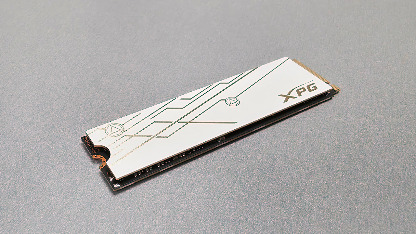
Sabrent Rocket Q 4 TB Review — 4 TB QLC PCIe 3.0 NVMe (2026)
Quick answer
The Sabrent Rocket Q 4 TB earns its slot if you want four terabytes of single-M.2 NVMe storage and your platform is still PCIe 3.0 — game libraries, Plex caches, large project scratch space, and bulk Steam installs are exactly the workload it was designed for.
Read: 3400 MB/s Write: 3000 MB/s Endurance: 940 TBW Warranty: 5 years Interface: M.2 3.0 x 4
The Sabrent Rocket Q 4 TB is one of the few affordable QLC NVMe drives that scales to four terabytes on a single M.2 stick, aimed at bulk game and media libraries.
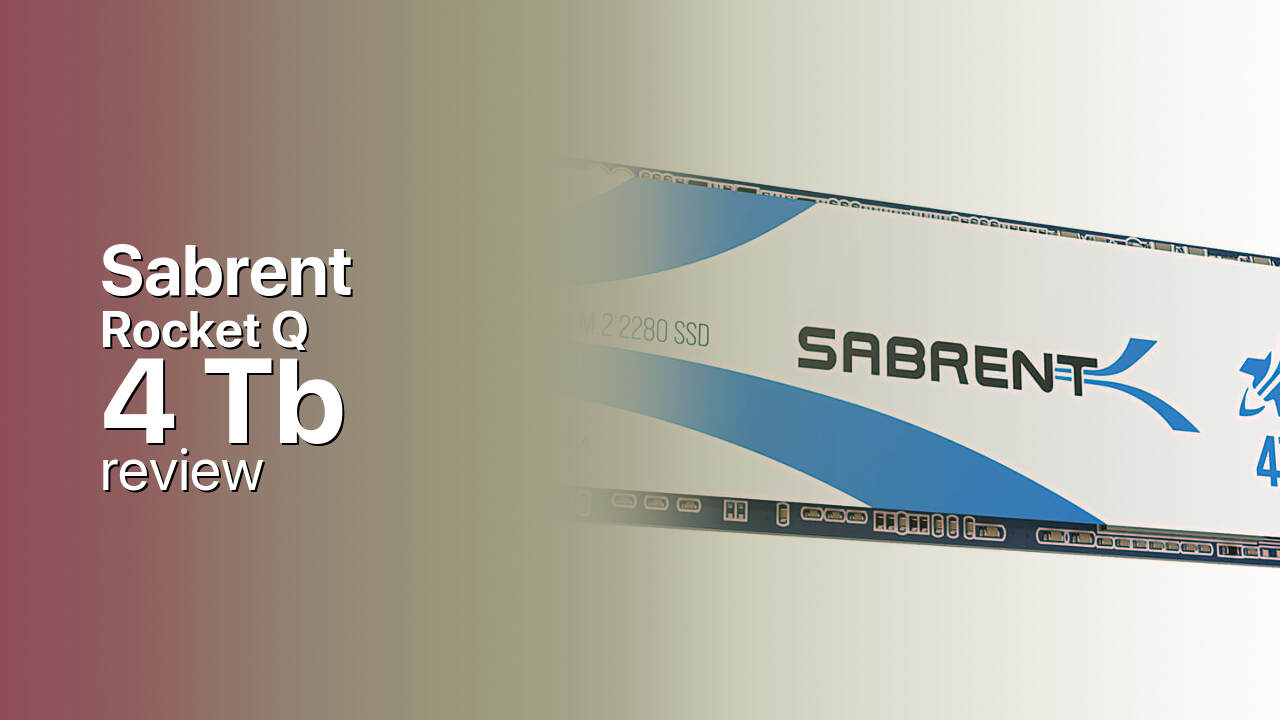
Controller & Memory
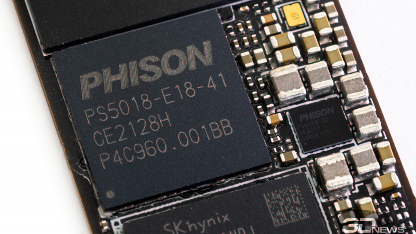
The Sabrent Rocket Q 4 TB pairs a Phison E12S controller with Micron 96-layer QLC NAND and a dedicated 2 GB SK hynix DDR4 cache, sitting on a double-sided M.2 2280 PCB. The Phison E12S is the same eight-channel TLC-class controller you find in the Rocket NVMe, here adapted for QLC density — its role is to hide QLC's slower native write speed behind aggressive SLC caching and a large DRAM map. The result is a drive that advertises 3,400 MB/s sequential reads and 3,000 MB/s sequential writes over PCIe 3.0 x4, which is essentially the ceiling of the Gen 3 interface.
This 4 TB capacity is the one that historically made the Rocket Q interesting: until QLC-based PCIe 4.0 drives like the Crucial P3 Plus arrived, the Rocket Q was one of the only single-M.2 paths to four terabytes for under a SATA-array price. The closer modern rivals are the Samsung 870 QVO 4 TB (SATA QLC, roughly half the sequential speed but a known quantity) and the Crucial P3 Plus 4 TB (PCIe 4.0 QLC, DRAM-less HMB, faster on Gen 4 systems but lower TBW). If you already own a PCIe 4.0 machine, the P3 Plus often wins on price; if you want DRAM and a Phison-controlled drive, the Rocket Q is still the cleaner pick.
The Rocket Q ships in 1, 2, 4 and 8 TB capacities — the 8 TB variant is a notable single-M.2 storage anchor, but the 4 TB is the volume sweet spot. The PCB is double-sided to fit four QLC packages, so it is not suitable for laptops or PS5 expansion slots that require a single-sided design under 11.25 mm in thickness. Sabrent does not include a heatsink in the retail box, and the controller does run warm under sustained loads, so a basic M.2 heatsink or motherboard-supplied shroud is recommended for desktops that push large file transfers.
Storage Comparisons:
Rocket Q Performance & Benchmarks
On paper the Rocket Q 4 TB delivers up to 3,400 MB/s sequential reads and 3,000 MB/s sequential writes, with Sabrent rating it at up to 650,000 IOPS for both random reads and random writes. Those numbers sit at the practical limit of the PCIe 3.0 x4 bus and will feel near-identical to any other top Gen 3 NVMe in everyday Windows use, game loading, and DirectStorage-friendly workloads on PC. Compared to a SATA SSD, expect roughly five to six times faster sequential transfers and meaningfully snappier mass-asset loading in modern games.
Sabrent Rocket Q 4 TB vs M.2 3.0 x 4 peers
Switch between sequential throughput and random IOPS to see how this drive stacks up against other M.2 3.0 x 4 SSDs in our database. The highlighted bar is the drive on this page — click any other bar to open that drive.
- ADATA SX 8800 Pro 512 GB: 3,500 MB/s read, 2,700 MB/s write
- ADATA SX 8800 Pro 1 TB: 3,500 MB/s read, 2,700 MB/s write
- ADATA XPG Spectrix S40G RGB 256 GB: 3,500 MB/s read, 3,000 MB/s write
- ADATA XPG Spectrix S40G RGB 512 GB: 3,500 MB/s read, 3,000 MB/s write
- Sabrent Rocket Q 4 TB (this drive): 3,400 MB/s read, 3,000 MB/s write
The catch with any 4 TB QLC drive is sustained write behaviour. The Phison E12S aggressively caches incoming writes in an SLC region carved out of the QLC NAND, so the first tens of gigabytes of a copy are fast; once that SLC cache is exhausted, independent reviewers consistently find sustained writes drop into the low hundreds of MB/s on QLC NVMe drives of this generation. For boot, OS, gaming, and Steam-library use that is irrelevant — you almost never write tens of gigabytes contiguously. For video editors dumping multi-hundred-gigabyte projects onto the Rocket Q, sustained write is the most important number on the page, and a higher-tier TLC drive like the Sabrent Rocket 4 Plus is the better tool.
Sabrent Rocket Q vs Competitors
See how the Rocket Q stacks up against other M.2 3.0 x 4 drives in our database:
Compare with rival drives:
Endurance, TBW & Warranty
Sabrent rates the Rocket Q 4 TB at 940 TBW (terabytes written), the highest endurance figure in the Rocket Q lineup and one of the larger QLC TBW ratings on the consumer market. Spread over the 5-year warranty period that is roughly 515 GB of writes every single day for five straight years — far more than a typical desktop or laptop user will ever generate, even running it as a Steam library scratch disk. At a more realistic 30 GB/day workload the rated endurance corresponds to well over 80 years of nominal life before the TBW counter is exhausted. The published MTBF figure is 1.8 million hours, which is a statistical population metric rather than a guaranteed lifespan for any individual drive. Warranty service is handled directly by Sabrent and requires product registration to claim the full five years.
Sabrent Rocket Q 4 TB Specifications
| Category | Value |
|---|---|
| Capacity [?] | 4 TB |
| Interface [?] | M.2 3.0 x 4 |
| Controller [?] | Phison E12S |
| Memory type [?] | QLC |
| DRAM [?] | DDR4 |
| Read speed (MB/s) [?] | 3400 |
| Write speed (MB/s) [?] | 3000 |
| Read IOPS [?] | 650000 |
| Write IOPS [?] | 650000 |
| Endurance (TBW) [?] | 940 |
| MTBF (million hours) [?] | 1.8 |
| Warranty (years) [?] | 5 |
Verdict: Is the Rocket Q Worth It in 2026?
The Sabrent Rocket Q 4 TB earns its slot if you want four terabytes of single-M.2 NVMe storage and your platform is still PCIe 3.0 — game libraries, Plex caches, large project scratch space, and bulk Steam installs are exactly the workload it was designed for. Skip it if your motherboard or laptop is PCIe 4.0 and price is the top priority, because a Crucial P3 Plus 4 TB or a Sabrent Rocket 4 Plus will usually extract more from the bus, and skip it again if you are looking for a PS5 expansion drive — the double-sided PCB and Gen 3 interface rule it out. The closer modern alternative for PCIe 3.0 systems is the WD Blue SN570 or the Crucial P3 in 4 TB form, both DRAM-less, both slower under sustained load, but typically cheaper. Overall the Rocket Q 4 TB is still one of the cleanest large-capacity Gen 3 picks of its era.
+ Pros
- 3,400 MB/s sequential reads on PCIe 3.0
- 940 TBW rated endurance for QLC
- 2 GB SK hynix DDR4 DRAM cache
- Phison E12S controller with mature firmware
- Five-year warranty with registration
- Available up to 8 TB single-M.2 capacity
- Cons
- PCIe 3.0 caps it on Gen 4 systems
- QLC sustained writes drop after SLC cache
- Double-sided PCB blocks PS5 expansion slot
- No heatsink included in retail box
- Lower TBW than TLC alternatives at 4 TB
Buy this or similar SSD Storage:
Video Review
Sabrent Rocket Q 4TB Review - All the SSD You’ll Ever Need - TechteamGB