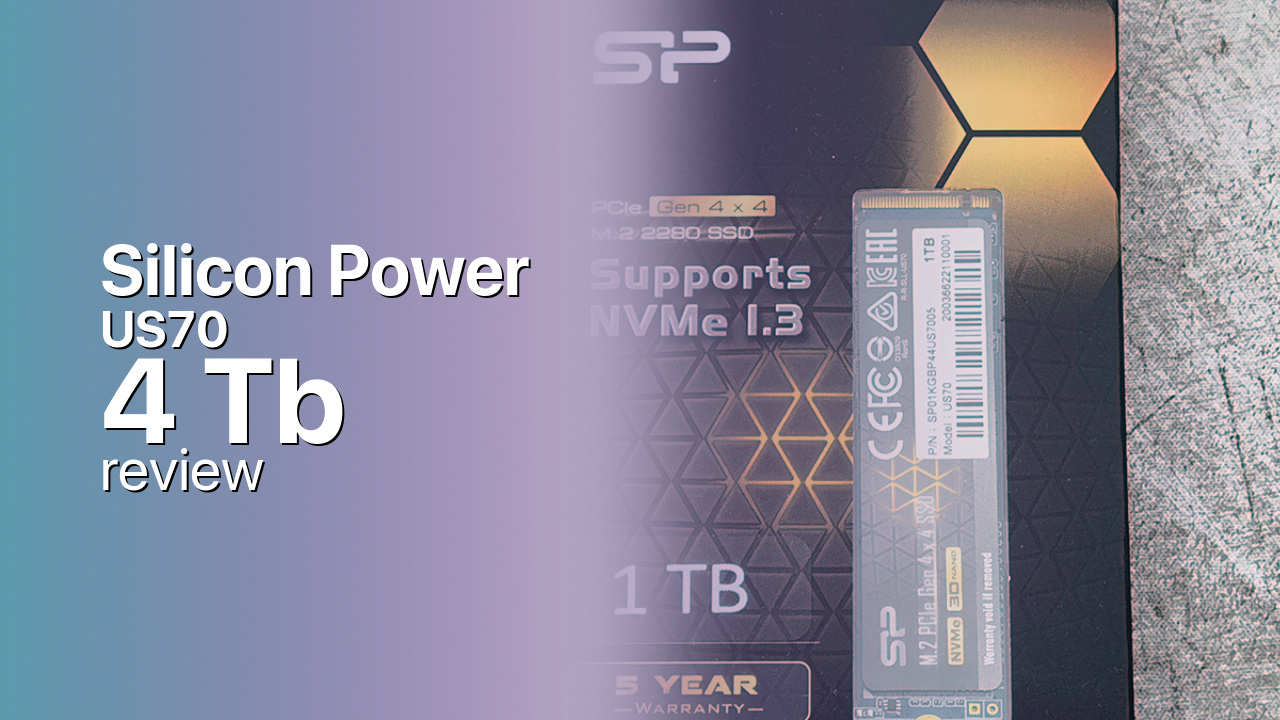
Silicon Power US70 4TB PCIe 4.0 NVMe SSD Review (2026)
Quick answer
The Silicon Power US70 4 TB is a sensible pick for a buyer who wants a lot of proven, reliable PCIe 4.0 storage without paying for the newest 7,000 MB/s parts.
Read: 5000 MB/s Write: 4400 MB/s Endurance: 3600 TBW Warranty: 5 years Interface: M.2 4.0 x 4
The Silicon Power US70 4 TB is the largest capacity of Silicon Power's Phison E16 PCIe 4.0 lineup, pairing Kioxia 96-layer TLC with a DDR4 DRAM cache for 5,000 MB/s sequential reads.
Controller & Memory
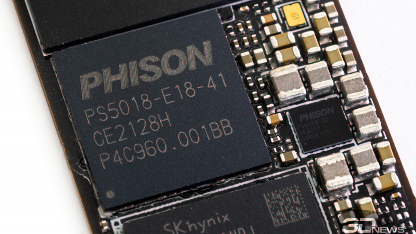
The Silicon Power US70 is the brand's mainstream PCIe 4.0 NVMe drive, built on the Phison PS5016-E16 8-channel controller that launched the Gen4 era back in 2019. The 4 TB model reviewed here is the top of the US70 range, which spans 1 TB to 4 TB, and it pairs that E16 controller with Kioxia 96-layer 3D TLC NAND and a DDR4 DRAM cache. The platform is a known quantity: it is the same basic design used by early Gen4 drives like the original Corsair MP600 and Sabrent Rocket 4.0, which means the hardware story is well understood and the firmware is mature.
What makes the 4 TB interesting is capacity value rather than bleeding-edge speed. At 5,000 MB/s sequential read and 4,400 MB/s sequential write the US70 sits in the lower-middle of the PCIe 4.0 field, behind newer E21T or Maxio-based drives that push 7,000 MB/s, but it trades that peak speed for a large 4 TB footprint and a DDR4 DRAM cache at a competitive price. Silicon Power rates the 4 TB at 3,600 TBW endurance and backs it with a five-year warranty, both of which are strong figures that reflect the proven TLC-plus-DRAM architecture. It is a drive aimed at buyers who want a lot of reliable fast storage rather than the absolute highest benchmark numbers.
The US70 ships as a bare M.2 2280 stick with no heatsink, which is normal for a value Gen4 drive. The Phison E16 controller is known to run warmer than newer Gen4 designs, so on a motherboard without a dedicated M.2 heatsink it can throttle under sustained writes, though for typical desktop and gaming workloads it stays within limits. The drive competes with other value PCIe 4.0 4 TB options like the WD Black SN850X, the Samsung 980 and the Crucial P3 Plus, trading peak speed for a DDR4 DRAM cache and aggressive pricing.
Storage Comparisons:
US70 Performance & Benchmarks
Silicon Power rates the US70 4 TB at up to 5,000 MB/s sequential read and 4,400 MB/s sequential write, with 750,000 random read and 750,000 random write IOPS. Those numbers place it squarely in the entry-to-mid PCIe 4.0 tier: fast enough to handle large game loads, video scrubbing and bulk file transfers comfortably, but well behind the 7,000 MB/s ceiling of newer Gen4 drives built on Phison E21T or Maxio MAP1602 controllers. The DDR4 DRAM cache helps sustained random performance and keeps the drive responsive under mixed workloads, which is the main practical advantage of this design over DRAM-less competitors.
Silicon Power US70 4 TB vs M.2 4.0 x 4 peers
Switch between sequential throughput and random IOPS to see how this drive stacks up against other M.2 4.0 x 4 SSDs in our database. The highlighted bar is the drive on this page — click any other bar to open that drive.
- Patriot Viper PV593 1 TB: 14,500 MB/s read, 14,000 MB/s write
- Patriot Viper PV593 2 TB: 14,500 MB/s read, 14,000 MB/s write
- Patriot Viper PV593 4 TB: 14,500 MB/s read, 14,000 MB/s write
- Patriot Viper PV573 2 TB: 14,000 MB/s read, 12,000 MB/s write
- Silicon Power US70 4 TB (this drive): 5,000 MB/s read, 4,400 MB/s write
In real-world desktop and gaming use the US70 4 TB feels quick and responsive, and the gap to a 7,000 MB/s drive is rarely noticeable outside of large sequential file moves. The Phison E16 controller's one weakness is heat: it runs warmer than modern Gen4 parts, so under long sustained writes a drive without a heatsink may pull back to protect itself. For a 4 TB drive used as a game and media library that is rarely an issue, but heavy content-creation workloads benefit from a motherboard M.2 heatsink. Independent reviews of the US70 family confirm it meets its rated sequential figures and behaves like a solid, predictable Gen4 performer.
Silicon Power US70 vs Competitors
See how the US70 stacks up against other M.2 4.0 x 4 drives in our database:
Compare with rival drives:
Endurance, TBW & Warranty
Silicon Power backs the US70 with a five-year limited warranty, and the 4 TB model carries a 3,600 TBW (terabytes written) endurance rating. That is strong coverage for a value Gen4 drive: 3,600 TBW works out to roughly 1,970 GB of writes every single day for five years, vastly more than any typical 20 to 50 GB daily consumer workload. At 50 GB of writes per day you would need around 197 years to exhaust the rated endurance, so the NAND will outlast the warranty term by a wide margin and wear is not a realistic concern. The five-year term is the binding limit, and it matches or exceeds the warranty length on most competing PCIe 4.0 drives. Silicon Power handles RMAs through its regional service centres, and proof of purchase is required, so keep your receipt. For a 4 TB drive likely holding a large game and media library, the combination of TLC NAND, a DRAM cache, a 3,600 TBW rating and five-year cover is reassuring.
Silicon Power US70 4 TB Specifications
| Category | Value |
|---|---|
| Capacity [?] | 4 TB |
| Interface [?] | M.2 4.0 x 4 |
| Controller [?] | Phison PS5016-E16 |
| Memory type [?] | 3D TLC |
| DRAM [?] | DDR4 |
| Read speed (MB/s) [?] | 5000 |
| Write speed (MB/s) [?] | 4400 |
| Read IOPS [?] | 750000 |
| Write IOPS [?] | 750000 |
| Endurance (TBW) [?] | 3600 |
| MTBF (million hours) [?] | 2000000 |
| Warranty (years) [?] | 5 |
Verdict: Is the US70 Worth It in 2026?
The Silicon Power US70 4 TB is a sensible pick for a buyer who wants a lot of proven, reliable PCIe 4.0 storage without paying for the newest 7,000 MB/s parts. Its strengths are capacity, a DDR4 DRAM cache, a 3,600 TBW endurance rating and a five-year warranty, all at a competitive price. Its weaknesses are equally clear: the older Phison E16 controller caps sequential speed at 5,000 MB/s and runs warmer than modern Gen4 designs, so buyers chasing peak benchmarks or a cool-running drive should look elsewhere. Choose it for a large game and media library where capacity and warranty matter more than the last word in speed; skip it if you want the fastest Gen4 drive or a DRAM-less part that sips power.
+ Pros
- Large 4 TB capacity at a competitive price
- DDR4 DRAM cache for sustained performance
- Kioxia 96-layer 3D TLC NAND
- 3,600 TBW endurance rating
- 5-year warranty
- Mature, well-understood Phison E16 platform
- Cons
- 5,000 MB/s is slower than newer Gen4 drives
- Phison E16 controller runs warm under sustained writes
- No heatsink included
- Older Gen4 design behind current 7,000 MB/s parts
Buy this or similar SSD Storage:



Video Review
Silicon Power US70 PCIe 4 SSD Review - Still Worth It?