Corsair MP600 Pro 4TB Review — Gen4 NVMe SSD (2026)
Quick answer
Power users who need 4 TB of fast Gen4 storage in a single M.2 slot — game libraries, video editing scratch disks, or dual-boot setups — will find the Corsair MP600 Pro 4 TB one of the few options that combines both high capacity and PCIe 4.0 throughput.
Read: 7000 MB/s Write: 6850 MB/s Endurance: 3000 TBW Warranty: 5 years Interface: M.2 4.0 x 4
The Corsair MP600 Pro 4 TB is the range-topping capacity of Corsair's Phison E18-powered PCIe 4.0 NVMe line, offering 3,000 TBW endurance and 6,850 MB/s writes that outpace the smaller capacities.
Controller & Memory
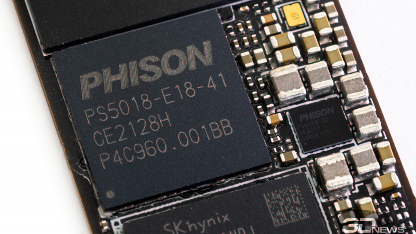
The 4 TB MP600 Pro uses the same Phison PS5018-E18 eight-channel controller as the 1 TB and 2 TB models, paired with Micron 96-layer 3D TLC NAND and a SK Hynix DDR4 DRAM chip for the mapping table. With 4 TB of capacity, the NAND is fully populated across both sides of the M.2 2280 PCB, making this a double-sided drive. That rules out laptops and SFF systems that only accept single-sided M.2 modules, though it fits standard desktop and PS5 M.2 slots without issue.
The 4 TB variant is the fastest in the MP600 Pro range, rated for 6,850 MB/s sequential writes — ahead of the 2 TB's 6,550 MB/s and the 1 TB's 5,500 MB/s. Random IOPS also scale up to 650K reads and 700K writes. Endurance is rated at 3,000 TBW, more than double the 2 TB's 1,400 TBW. AES 256-bit hardware encryption is supported, and NVMe 1.4 runs over PCIe 4.0 x4. The MTBF rating is 1.8 million hours, slightly higher than the smaller capacities' 1.7 million.
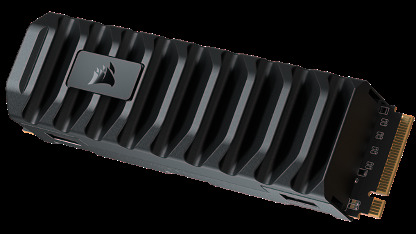
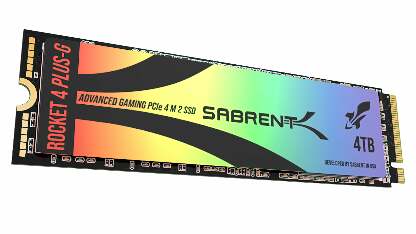
Competitors at 4 TB include the Sabrent Rocket 4 Plus 4 TB and the Corsair MP600 Core 4 TB (QLC-based, lower endurance). Few PCIe 4.0 drives reach 4 TB, so the MP600 Pro 4 TB occupies a niche for users who want both high capacity and Gen4 throughput. The bundled aluminum heatsink is included, and the Hydro X Edition water-block variant is also available at this capacity.
Storage Comparisons:
MP600 Pro Performance & Benchmarks
The 4 TB model is rated for up to 7,000 MB/s sequential read and 6,850 MB/s sequential write — the highest write speed in the MP600 Pro range, benefiting from the fully populated NAND layout. Random performance is rated at up to 650,000 read IOPS and 700,000 write IOPS. These figures are modestly higher than the 2 TB's 660K/800K for reads and writes, though the write IOPS are slightly lower — likely a consequence of managing twice the NAND density.
Corsair MP600 Pro 4 TB vs M.2 4.0 x 4 peers
Switch between sequential throughput and random IOPS to see how this drive stacks up against other M.2 4.0 x 4 SSDs in our database. The highlighted bar is the drive on this page — click any other bar to open that drive.
- Patriot Viper PV593 1 TB: 14,500 MB/s read, 14,000 MB/s write
- Patriot Viper PV593 2 TB: 14,500 MB/s read, 14,000 MB/s write
- Patriot Viper PV593 4 TB: 14,500 MB/s read, 14,000 MB/s write
- Patriot Viper PV573 2 TB: 14,000 MB/s read, 12,000 MB/s write
- Corsair MP600 Pro 4 TB (this drive): 7,000 MB/s read, 6,850 MB/s write
Independent reviews of the 4 TB model are scarce; most outlets tested the 1 TB and 2 TB variants. Based on the common Phison E18 platform, the 4 TB is expected to share the same characteristics: a relatively small SLC cache (likely around 150-200 GB on the 4 TB), direct-to-TLC writes at roughly 1,500-2,000 MB/s after cache exhaustion, and thermal throttling that begins at 68 °C. The included heatsink should manage thermals adequately in a desktop with reasonable airflow. For sustained-write scenarios like 4K video capture or large dataset transfers, the 4 TB's larger SLC cache pool is an advantage over the smaller capacities.
Corsair MP600 Pro vs Competitors
See how the MP600 Pro stacks up against other M.2 4.0 x 4 drives in our database:
Compare with rival drives:
Endurance, TBW & Warranty
Corsair covers the MP600 Pro 4 TB with a five-year limited warranty, capped at 3,000 TBW — whichever is reached first. At Corsair's typical usage figure of 35 GB of writes per day, the drive would take roughly 235 years to exhaust its endurance. Even at a heavy 200 GB/day workload — realistic for a 4 TB drive used as a video editing scratch disk or NAS cache — the drive would last approximately 41 years before hitting the TBW limit. The 1.8 million hour MTBF is a population-level reliability metric, not a guarantee for any individual unit. Corsair's SSD Toolbox provides SMART data and firmware update capability. The five-year warranty length is standard for this tier, matching the Samsung 980 Pro and WD Black SN850.
Corsair MP600 Pro 4 TB Specifications
| Category | Value |
|---|---|
| Capacity [?] | 4 TB |
| Interface [?] | M.2 4.0 x 4 |
| Controller [?] | Phison PS5018-E18-41 |
| Memory type [?] | Micron 3D TLC |
| DRAM [?] | SKHynix 1GB DDR4-2666 |
| Read speed (MB/s) [?] | 7000 |
| Write speed (MB/s) [?] | 6850 |
| Read IOPS [?] | 650000 |
| Write IOPS [?] | 700000 |
| Endurance (TBW) [?] | 3000 |
| MTBF (million hours) [?] | 1.8 |
| Warranty (years) [?] | 5 |
Verdict: Is the MP600 Pro Worth It in 2026?
Power users who need 4 TB of fast Gen4 storage in a single M.2 slot — game libraries, video editing scratch disks, or dual-boot setups — will find the Corsair MP600 Pro 4 TB one of the few options that combines both high capacity and PCIe 4.0 throughput. Those who prioritise raw performance over capacity should consider the 2 TB variant instead, which posts slightly higher write IOPS and has more independent benchmark data available. For users who need 4 TB but can accept slower writes and lower endurance, the Corsair MP600 Core 4 TB (QLC-based) is the budget alternative. Overall, the MP600 Pro 4 TB fills a genuine niche where few competitors operate.
+ Pros
- 7,000/6,850 MB/s sequential read/write — fastest in range
- 3,000 TBW endurance for long-term confidence
- 4 TB capacity on a single M.2 2280 module
- Bundled aluminum heatsink included
- AES 256-bit hardware encryption
- 5-year warranty
- Cons
- Double-sided PCB limits laptop compatibility
- Few independent reviews for 4 TB specifically
- Write IOPS (700K) slightly lower than 2 TB (800K)
- Thermal throttle at 68 °C is aggressive for dense PCB
- Limited 4 TB PCIe 4.0 competitors for price comparison
Buy this or similar SSD Storage:



Video Review
Worth the Premium Price? - Corsair MP600 PRO Review