Crucial P5 Plus 500 GB Review — PCIe 4.0 NVMe SSD (2026)
Quick answer
The Crucial P5 Plus 500 GB is the right pick if you want a fully-in-house Micron NVMe \xe2\x80\x94 controller, NAND, and DRAM all under one roof \xe2\x80\x94 at the entry-flagship Gen 4 tier and you do not need more than 500 GB of fast storage.
Read: 6600 MB/s Write: 4000 MB/s Endurance: 300 TBW Warranty: 5 years Interface: M.2 4.0 x 4
The Crucial P5 Plus 500 GB is Micron\xe2\x80\x99s most affordable in-house-controlled Gen 4 NVMe \xe2\x80\x94 a DRAM-equipped TLC drive that hits 6,600 MB/s reads at an entry-flagship price.
Controller & Memory
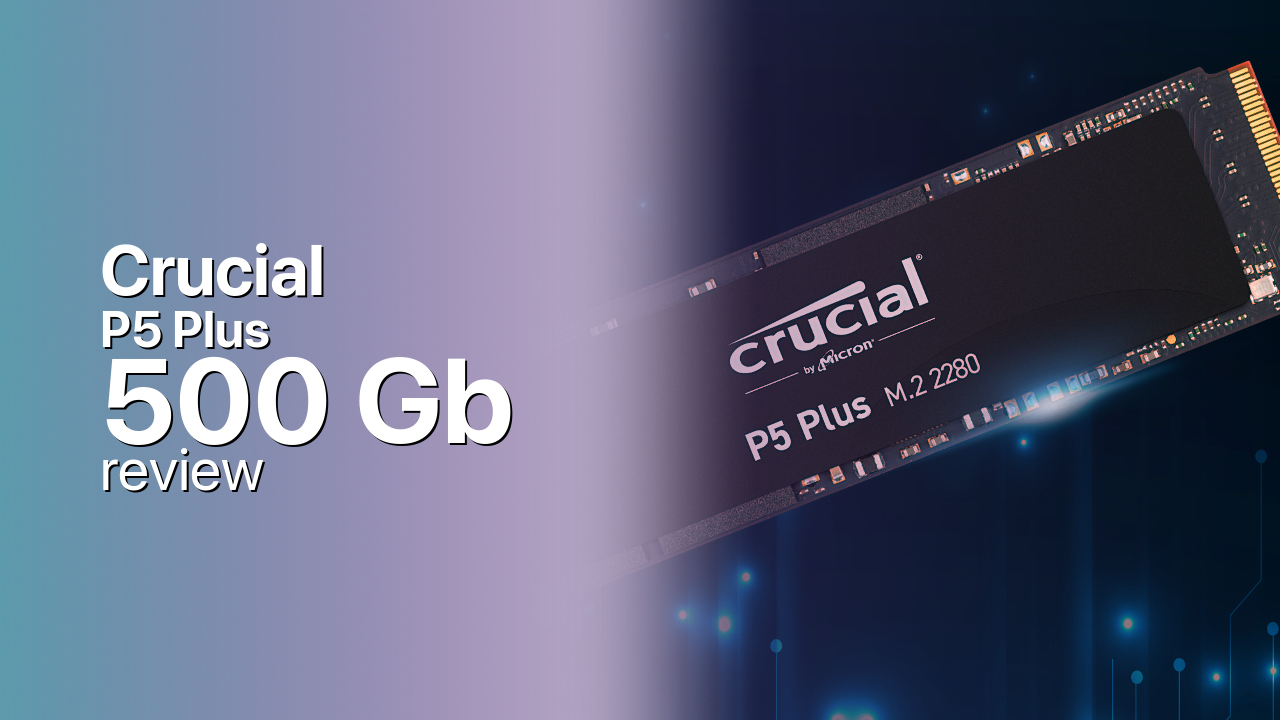
The Crucial P5 Plus 500 GB is the entry capacity of Micron’s upper-mainstream PCIe 4.0 NVMe family, built around the Micron DM02A1 controller — an in-house design used exclusively in this series and paired with Micron’s own 176-layer (B47R) 3D TLC NAND and an LPDDR4 DRAM cache. The PCB is single-sided M.2 2280, which makes the P5 Plus a clean drop-in for desktops, modern laptops, and the PS5 expansion bay. Because Crucial is a Micron consumer brand, the entire bill of materials is in-house — controller, NAND, DRAM — which is unusual at this tier and is the main selling point against Phison- or InnoGrit-based rivals.
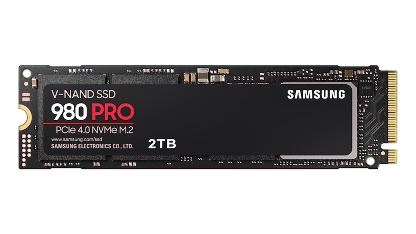
At 500 GB the P5 Plus hits the family’s rated 6,600 MB/s sequential read but trades a measurable amount of sequential write speed against the 1 TB and 2 TB capacities: 4,000 MB/s rated writes against 5,000 MB/s on the larger sizes. Random IOPS scale similarly. The closest direct rivals at 500 GB and Gen 4 are the WD Black SN850X 1 TB (no 500 GB SKU — the 1 TB is the entry point), the Samsung 980 Pro 500 GB (older Elpis controller, similar TLC, lower TBW), and the WD Black SN770 500 GB (DRAM-less HMB, cheaper). The P5 Plus’s case against the SN770 is the dedicated DRAM cache and full hardware encryption (TCG Opal 2.01); its weakness against the 980 Pro is firmware feature breadth.
The drive is a fit for budget Gen 4 desktop builds, modern laptops with a single-sided M.2 slot, and as a PS5 expansion drive where the 500 GB capacity is enough for a couple of large modern games. Independent reviewers note the DM02A1 controller runs warmer than the Phison E18 and SanDisk in-house parts under sustained writes, so a basic M.2 heatsink helps consistency on long transfers.
Storage Comparisons:
P5 Plus Performance & Benchmarks
Crucial rates the P5 Plus 500 GB at up to 6,600 MB/s sequential reads and 4,000 MB/s sequential writes on a PCIe 4.0 x4 link, with random IOPS of up to 360,000 reads and 700,000 writes — the random write figure is the same across the family, while the random read scales upward to 720,000 IOPS on the 1 TB and 2 TB. In real-world benchmarks the 500 GB P5 Plus lands in the upper-mainstream Gen 4 group: ahead of any DRAM-less HMB drive on mixed workloads, behind a Samsung 990 Pro 1 TB on sustained sequential, and roughly on par with the 980 Pro 500 GB on game-load tests.
Crucial P5 Plus 500 GB vs M.2 4.0 x 4 peers
Switch between sequential throughput and random IOPS to see how this drive stacks up against other M.2 4.0 x 4 SSDs in our database. The highlighted bar is the drive on this page — click any other bar to open that drive.
- Patriot Viper PV593 1 TB: 14,500 MB/s read, 14,000 MB/s write
- Patriot Viper PV593 2 TB: 14,500 MB/s read, 14,000 MB/s write
- Patriot Viper PV593 4 TB: 14,500 MB/s read, 14,000 MB/s write
- Patriot Viper PV573 2 TB: 14,000 MB/s read, 12,000 MB/s write
- Crucial P5 Plus 500 GB (this drive): 6,600 MB/s read, 4,000 MB/s write
The SLC cache behaviour is the part to be aware of at 500 GB. The dynamic SLC region carved out of the small NAND pool exhausts after a few dozen gigabytes of continuous writes, and independent reviewers consistently find post-cache speeds settle into the high-hundreds-of-MB/s range — well above any QLC entry drive, but below TLC rivals with larger NAND pools. The Adaptive Thermal Protection feature backs off performance if the controller hits its temperature ceiling, which can be visible on hot, fan-less laptops during 300 GB-plus pours. For OS, gaming, and ordinary creator workloads the cache exhaustion is invisible.
Crucial P5 Plus vs Competitors
See how the P5 Plus stacks up against other M.2 4.0 x 4 drives in our database:
Compare with rival drives:
Endurance, TBW & Warranty
Crucial rates the P5 Plus 500 GB at 300 TBW (terabytes written) over a 5-year limited warranty, whichever limit is reached first. That is a typical TLC endurance figure for this capacity — below the 600 TBW WD Black SN850X 1 TB but in line with Samsung’s 980 Pro 500 GB, which is rated at the same 300 TBW. At 165 GB of host writes per day for the full five-year warranty window, the 300 TBW figure vastly exceeds what any gamer or ordinary creator generates. At a more realistic 20–30 GB/day workload the rated 300 TBW corresponds to roughly 27 to 41 years of nominal life before the counter is exhausted. The published MTTF figure is 2 million hours, a statistical population metric rather than a guaranteed lifespan for any individual drive. Warranty service is handled directly via Crucial RMA with proof of purchase, and Crucial’s Storage Executive utility provides SMART monitoring and firmware updates on Windows. TBW scales with capacity: 600 TBW at 1 TB, 1,200 TBW at 2 TB.
Crucial P5 Plus 500 GB Specifications
| Category | Value |
|---|---|
| Capacity [?] | 500 GB |
| Interface [?] | M.2 4.0 x 4 |
| Controller [?] | Micron DM02A1 |
| Memory type [?] | Micron TLC |
| DRAM [?] | LPDDR4 |
| Read speed (MB/s) [?] | 6600 |
| Write speed (MB/s) [?] | 4000 |
| Read IOPS [?] | 720000 |
| Write IOPS [?] | 700000 |
| Endurance (TBW) [?] | 300 |
| MTBF (million hours) [?] | 2 |
| Warranty (years) [?] | 5 |
Verdict: Is the P5 Plus Worth It in 2026?
The Crucial P5 Plus 500 GB is the right pick if you want a fully-in-house Micron NVMe \xe2\x80\x94 controller, NAND, and DRAM all under one roof \xe2\x80\x94 at the entry-flagship Gen 4 tier and you do not need more than 500 GB of fast storage. Skip it if 500 GB is too small for your library and the 1 TB P5 Plus is within budget, because the 1 TB delivers full rated write speed and double the TBW for usually a modest price step up. The closest direct alternative is the Samsung 980 Pro 500 GB, which is functionally similar at parity on price; the WD Black SN770 500 GB is the cheaper DRAM-less alternative for users who do not need the full feature set. As a single 500 GB Gen 4 drive in a budget gaming desktop or a small PS5 capacity bump, the P5 Plus 500 GB is a quietly strong pick.
+ Pros
- 6,600 MB/s sequential reads on PCIe 4.0
- 300 TBW endurance with 5-year warranty
- Micron in-house DM02A1 controller and NAND
- Dedicated LPDDR4 DRAM cache on board
- Full TCG Opal 2.01 hardware encryption
- Single-sided M.2 2280 fits PS5 and laptops
- Cons
- 4,000 MB/s writes trail 1 TB and 2 TB siblings
- DM02A1 runs warmer than Phison E18 under load
- Smaller SLC cache at 500 GB capacity
- Random read IOPS below 1 TB and 2 TB siblings
- Adaptive thermal protection trims sustained speed
Buy this or similar SSD Storage:
Video Review
Crucial P5 Plus NVMe SSD Review – How Crucial Is It?