Goodram IRDM Ultimate X 500GB — PCIe 4.0 NVMe SSD Review (2026)
Quick answer
The Goodram IRDM Ultimate X 500 GB is a well-executed Phison E16 drive that stands out in the crowded E16 market through two factory decisions: the mildly overclocked 4,500 MB/s sequential write speed and, more importantly, the 850 TBW endurance rating that more than doubles what Samsung and WD offer at this capacity.
Read: 5000 MB/s Write: 4500 MB/s Endurance: 850 TBW Warranty: 5 years Interface: M.2 4.0 x 4
The Goodram IRDM Ultimate X 500GB is the Polish manufacturer’s take on the Phison E16 platform, delivering 5,000 MB/s reads with factory-tuned 4,500 MB/s writes and a robust 850 TBW endurance rating.
Controller & Memory
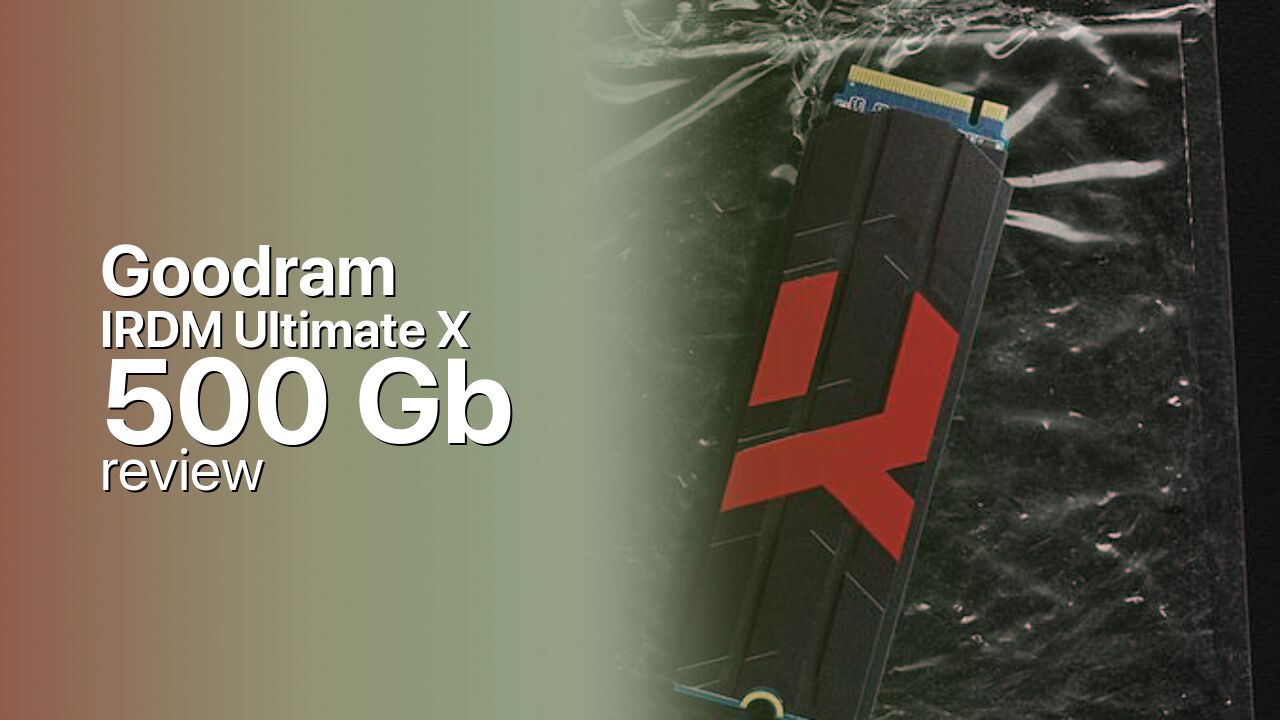
Goodram, the consumer brand of Polish memory manufacturer Wilk Elektronik, entered the PCIe 4.0 market with the IRDM Ultimate X — a Phison PS5016-E16-based drive that sticks close to the reference design while adding a few meaningful factory tweaks. The 500 GB model pairs the eight-channel E16 controller with Kioxia BiCS4 96-layer 3D TLC NAND (the same Toshiba-designed flash used in the Corsair MP600 and Sabrent Rocket 4.0) and a dedicated DDR4 DRAM cache for the mapping table. Goodram rates the sequential throughput at 5,000 MB/s read and 4,500 MB/s write — the latter being 100 MB/s above the standard E16 reference of 4,400 MB/s, suggesting a mild factory firmware tune.
At 500 GB, the IRDM Ultimate X sits in the capacity tier where the E16's parallelism begins to matter. With fewer NAND packages to stripe across compared to the 1 TB and 2 TB variants, the 500 GB model's pSLC write cache is proportionally smaller — roughly 55–70 GB of sustained writes at full speed before the controller transitions to native TLC programming at approximately 1,000–1,200 MB/s. This is adequate for OS duties, gaming, and general productivity, but content creators working with large media files will feel the cache limit more acutely than they would on the higher-capacity siblings. The endurance rating of 850 TBW is well above the 500 GB class average: many 500 GB PCIe 4.0 drives carry 300–400 TBW, and even Samsung's 500 GB 980 PRO is rated at just 300 TBW. Goodram's 850 TBW figure reflects the E16's conservative caching strategy and the inherent durability of BiCS4 TLC.
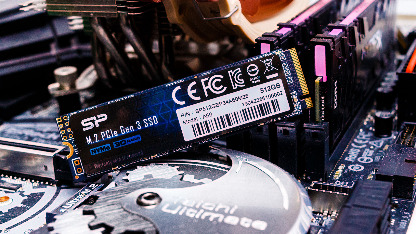
Physically, the IRDM Ultimate X uses a standard single-sided M.2 2280 form factor with a black PCB and a thin graphene-coated aluminium label that doubles as a modest heatspreader. There is no bulky factory heatsink, which keeps the drive compatible with laptop bays and motherboard M.2 slot covers. Under sustained writes, the 28 nm E16 controller will reach the mid-70s °C in still air and engage a mild throttle; pairing the drive with any motherboard M.2 cover or a basic aftermarket heatsink resolves this. Goodram backs the drive with a 5-year warranty, matching the premium-tier coverage offered by Samsung and WD. As a regional European brand, Goodram's warranty service is handled through its distribution network rather than a global portal, which is worth confirming for buyers outside the EU.
Storage Comparisons:
IRDM Ultimate X Performance & Benchmarks
The 500 GB IRDM Ultimate X benchmarks on par with other Phison E16 drives at this capacity, with a slight edge in sequential writes thanks to Goodram's 4,500 MB/s rating. CrystalDiskMark sequential reads land between 4,950 and 5,050 MB/s, and sequential cached writes sit at 4,450–4,520 MB/s — comfortably above the standard E16's 4,400 MB/s. Random 4K QD1 read performance is in the 60–68 MB/s range, which is typical for the E16 and adequate for an OS boot drive but trails the ~80–85 MB/s of newer DRAM-based PCIe 4.0 controllers. Random 4K write at QD1 is 180–200 MB/s, reflecting the E16's eight-channel architecture and DRAM-backed write buffering.
Goodram IRDM Ultimate X 500 GB vs M.2 4.0 x 4 peers
Switch between sequential throughput and random IOPS to see how this drive stacks up against other M.2 4.0 x 4 SSDs in our database. The highlighted bar is the drive on this page — click any other bar to open that drive.
- Patriot Viper PV593 1 TB: 14,500 MB/s read, 14,000 MB/s write
- Patriot Viper PV593 2 TB: 14,500 MB/s read, 14,000 MB/s write
- Patriot Viper PV593 4 TB: 14,500 MB/s read, 14,000 MB/s write
- Patriot Viper PV573 2 TB: 14,000 MB/s read, 12,000 MB/s write
- Goodram IRDM Ultimate X 500 GB (this drive): 5,000 MB/s read, 4,500 MB/s write
Sustained sequential write testing reveals the expected E16 behaviour scaled to 500 GB of total capacity. The pSLC write cache absorbs roughly 55–70 GB at the full 4,500 MB/s before the controller begins folding data into TLC at 1,000–1,200 MB/s. A full-drive sequential fill of the remaining ~400 GB of user space completes at an average of approximately 1,100–1,300 MB/s. For perspective, this means a single write operation exceeding ~60 GB will encounter the speed transition — a scenario that is rare in gaming and general productivity but possible during large software installations, virtual machine provisioning, or bulk media transfers. Thermally, the graphene-coated label provides about 3–5 °C of passive cooling versus a bare PCB, but sustained writes will still push the controller past 70 °C in still air. Any form of active or chassis airflow eliminates this concern entirely.
Goodram IRDM Ultimate X vs Competitors
See how the IRDM Ultimate X stacks up against other M.2 4.0 x 4 drives in our database:
Compare with rival drives:
Endurance, TBW & Warranty
Goodram warranties the IRDM Ultimate X 500 GB for 5 years, with an endurance ceiling of 850 TBW. This is approximately 465 GB of host writes per day over the warranty period, or roughly 1.7 drive writes per day (1.7 DWPD). For a 500 GB drive, this is an exceptionally high endurance rating: the Samsung 980 PRO 500 GB carries 300 TBW (0.33 DWPD), and the WD Black SN770 500 GB carries 300 TBW. The 850 TBW figure is a consequence of the Phison E16's firmware architecture, which allocates a relatively small portion of the TLC array to pseudo-SLC caching compared to newer controllers. Less NAND spent on caching means more NAND is available for wear-levelling, and the write amplification factor stays closer to 1.0x under mixed workloads. For buyers who intend to use the 500 GB model as a write-intensive boot drive — compiling code, running virtual machines, editing documents with frequent auto-saves — the high endurance rating provides headroom that most 500 GB competitors simply do not offer. Goodram's TBW counter is accessible through standard NVMe SMART monitoring utilities.
Goodram IRDM Ultimate X 500 GB Specifications
| Category | Value |
|---|---|
| Capacity [?] | 500 GB |
| Interface [?] | M.2 4.0 x 4 |
| Controller [?] | Phison PS5016-E16 |
| Memory type [?] | Toshiba 3D TLC |
| DRAM [?] | DDR4 Cache |
| Read speed (MB/s) [?] | 5000 |
| Write speed (MB/s) [?] | 4500 |
| Read IOPS [?] | 750000 |
| Write IOPS [?] | 700000 |
| Endurance (TBW) [?] | 850 |
| MTBF (million hours) [?] | 1.7 |
| Warranty (years) [?] | 5 |
Verdict: Is the IRDM Ultimate X Worth It in 2026?
The Goodram IRDM Ultimate X 500 GB is a well-executed Phison E16 drive that stands out in the crowded E16 market through two factory decisions: the mildly overclocked 4,500 MB/s sequential write speed and, more importantly, the 850 TBW endurance rating that more than doubles what Samsung and WD offer at this capacity. The underlying E16 platform is no longer the performance leader it was in 2019, but at 500 GB the practical performance gap between 5,000 MB/s and the ~7,400 MB/s of second-generation PCIe 4.0 drives is narrower than benchmark charts suggest, because most 500 GB-class workloads (OS boot, application launch, game loading) are random-read-bound rather than sequential-throughput-bound. The IRDM Ultimate X 500 GB makes the most sense for a system boot drive in a workstation or power-user desktop where endurance matters — the 850 TBW figure means the drive will outlast the platform it is installed in. For pure gaming or a secondary storage drive, a newer DRAM-less TLC 500 GB drive will cost less and deliver similar real-world gaming performance, though it will not match the IRDM Ultimate X's endurance longevity.
+ Pros
- Class-leading 850 TBW endurance at 500 GB
- Factory-tuned 4,500 MB/s writes above E16 reference
- 5-year warranty matches premium-tier competitors
- Genuine DDR4 DRAM cache, not HMB
- Single-sided M.2 2280 fits any slot
- Kioxia BiCS4 TLC with proven long-term reliability
- Cons
- 500 GB capacity limits pSLC cache to ~60 GB
- E16 platform now trails second-gen PCIe 4.0 speeds
- 28 nm controller runs warm without airflow
- No factory heatsink beyond a graphene label
- Goodram warranty may be harder to claim outside EU
Buy this or similar SSD Storage:
Video Review
Goodram PCIe 4 x4 NVMe M.2 SSD, 500GB, 1TB and 2TB IRDM Ultimate X