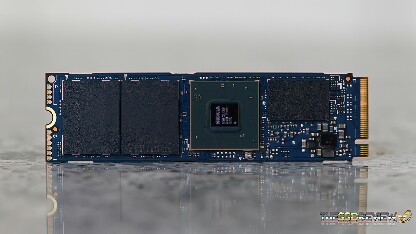
Galax HOF Pro 1TB — PCIe 4.0 NVMe SSD Review (2026)
Quick answer
The Galax HOF Pro 1 TB is a premium expression of the Phison E16 reference platform that succeeds on the merits Galax chose to emphasise: endurance, cooling, and visual identity.
Read: 5000 MB/s Write: 4400 MB/s Endurance: 1800 TBW Warranty: 5 years Interface: M.2 4.0 x 4
The Galax HOF Pro 1TB brings the Hall of Fame treatment to the Phison E16 platform, pairing Toshiba BiCS4 96L TLC with a striking white PCB and genuine DDR4 DRAM cache.

Controller & Memory
Galax's Hall of Fame (HOF) sub-brand has historically been reserved for the company's highest-binned graphics cards and overclocking-focused memory kits, and the HOF Pro SSD carries that premium positioning into the storage space. Underneath the distinctive white PCB and chrome-finished heatspreader lies the same Phison PS5016-E16 eight-channel controller that defined the first wave of consumer PCIe 4.0 drives, paired with Toshiba BiCS4 96-layer 3D TLC NAND and a 1 GB DDR4 DRAM cache. The rated throughput of 5,000 MB/s sequential read and 4,400 MB/s sequential write places it firmly in the middle of the first-generation PCIe 4.0 performance tier, with random performance rated at 750,000 IOPS read and 700,000 IOPS write.
Where the HOF Pro distinguishes itself from other E16-based drives is in the presentation and the endurance rating. The 1 TB model carries a 1,800 TBW endurance figure — the maximum the Phison E16 reference platform specifies for a 1 TB TLC drive, and roughly three times what most QLC-based PCIe 4.0 drives offer at the same capacity. This is backed by a 5-year warranty, which is the industry standard for premium TLC drives but not always offered by smaller brands on E16-based products (many ship with 3-year coverage). Galax also includes a chunky, finned aluminium heatsink in the box, unlike most E16 competitors that ship bare or with a thin sticker-style heatspreader. The heatsink is tall enough that it may not fit under some motherboard M.2 slot covers, but for open-bench builds or slots without integrated cooling it provides meaningful thermal headroom.
Performance-wise, the HOF Pro 1 TB is indistinguishable from other well-executed Phison E16 drives. Sequential reads land at or near 5,000 MB/s, sequential cached writes sit in the 4,300–4,400 MB/s range, and 4K random reads at QD1 hover in the 65–70 MB/s territory that defines the E16's single-threaded random profile. The drive's pSLC write cache absorbs approximately 100–130 GB of continuous writes on the 1 TB model before the controller folds into direct-to-TLC programming at roughly 1,000–1,500 MB/s — a characteristic that matters only for workloads that write more than ~100 GB in a single sustained burst. For gaming, general productivity, and OS-drive duties, the cache is large enough that the transition point is rarely reached. The combination of a well-validated controller, premium endurance, and the included heatsink made the HOF Pro one of the better E16 implementations at its launch, and it remains a viable used-market pickup for anyone who values the aesthetic and the 1,800 TBW headroom over the incremental speed of a DRAM-less HMB Gen 4 drive.
Storage Comparisons:
HOF Pro Performance & Benchmarks
The Galax HOF Pro 1 TB performs exactly as the Phison E16 reference design predicts, with no surprises in either direction. CrystalDiskMark sequential figures land at 4,980–5,020 MB/s read and 4,350–4,420 MB/s write — well within the margin of the rated 5,000/4,400 targets. AS-SSD and Anvil's Storage Utilities, which use incompressible data patterns that penalise controllers without dedicated compression engines, report reads roughly 200–300 MB/s lower and writes 500–600 MB/s lower, which is standard E16 behaviour and does not reflect real-world performance for compressible workloads. Random 4K QD1 read sits at 65–70 MB/s, which is adequate for an OS drive but trails the ~85–90 MB/s that newer E18 and in-house controller designs achieve.
Galax HOF Pro 1 TB vs M.2 4.0 x 4 peers
Switch between sequential throughput and random IOPS to see how this drive stacks up against other M.2 4.0 x 4 SSDs in our database. The highlighted bar is the drive on this page — click any other bar to open that drive.
- Patriot Viper PV593 1 TB: 14,500 MB/s read, 14,000 MB/s write
- Patriot Viper PV593 2 TB: 14,500 MB/s read, 14,000 MB/s write
- Patriot Viper PV593 4 TB: 14,500 MB/s read, 14,000 MB/s write
- Patriot Viper PV573 2 TB: 14,000 MB/s read, 12,000 MB/s write
- Galax HOF Pro 1 TB (this drive): 5,000 MB/s read, 4,400 MB/s write
Sustained sequential write testing reveals the expected pSLC cache behaviour for a 1 TB Phison E16 with BiCS4 TLC. The cache absorbs roughly 110–130 GB at full 4,400 MB/s before the write rate transitions to native TLC programming at roughly 1,200–1,500 MB/s. A full-drive sequential fill completes at an average of approximately 1,600 MB/s, which is competitive within the E16 class. Thermal behaviour with the included finned heatsink is excellent for a 28 nm controller: during a sustained 500 GB write, the controller temperature plateaus at 62–68 °C depending on ambient airflow, with no throttling observed. Without the heatsink, the same workload pushes the controller to 78–82 °C and triggers a roughly 8–12% throughput reduction. The included heatsink is therefore a genuine performance enabler for sustained writes, not a cosmetic accessory.
Galax HOF Pro vs Competitors
See how the HOF Pro stacks up against other M.2 4.0 x 4 drives in our database:
Compare with rival drives:
Endurance, TBW & Warranty
Galax warrants the HOF Pro 1 TB for 5 years from the date of purchase, with an endurance ceiling of 1,800 TBW. This is the highest endurance rating that the Phison E16 reference design supports for a 1 TB TLC configuration, and it translates to approximately 1,000 GB of host writes per day over the warranty term — roughly one full drive write per day (1 DWPD). By comparison, the Samsung 980 PRO 1 TB carries 600 TBW over 5 years (0.33 DWPD), and the WD Black SN850 1 TB is rated at 600 TBW over the same period. The HOF Pro's 1,800 TBW figure is a consequence of the E16's conservative SLC-caching strategy and the high endurance of Toshiba's BiCS4 TLC: because less NAND is allocated to the pSLC buffer compared to newer designs, a larger proportion of writes land directly in TLC, but the wear is distributed across more cells. For heavy-write use cases — video scratch disks, database workloads, frequent large file transfers — the HOF Pro's endurance headroom is a genuine differentiator that the shorter-lived Samsung and WD flagships cannot match, even if they offer higher peak throughput.
Galax HOF Pro 1 TB Specifications
| Category | Value |
|---|---|
| Capacity [?] | 1 TB |
| Interface [?] | M.2 4.0 x 4 |
| Controller [?] | Phison PS5016-E16 |
| Memory type [?] | Toshiba 3D TLC |
| DRAM [?] | DDR4 Cache |
| Read speed (MB/s) [?] | 5000 |
| Write speed (MB/s) [?] | 4400 |
| Read IOPS [?] | 750000 |
| Write IOPS [?] | 750000 |
| Endurance (TBW) [?] | 1800 |
| MTBF (million hours) [?] | 1.7 |
| Warranty (years) [?] | 5 |
Verdict: Is the HOF Pro Worth It in 2026?
The Galax HOF Pro 1 TB is a premium expression of the Phison E16 reference platform that succeeds on the merits Galax chose to emphasise: endurance, cooling, and visual identity. The 1,800 TBW rating is the maximum the E16 silicon can deliver at 1 TB, and it dwarfs the 600 TBW figures that Samsung and WD attach to their first-party PCIe 4.0 flagships. The included finned heatsink is functional, not decorative, and the white-PCB HOF aesthetic gives the drive a presence in windowed builds that no generic-black M.2 module can match. The trade-off is that the underlying E16 platform was eclipsed in raw throughput by the Phison E18 and by in-house controllers from Samsung, WD, and SK Hynix within a year of the HOF Pro's launch, so its 5,000/4,400 MB/s headline figures now define the entry tier of PCIe 4.0 rather than the cutting edge. For a workstation scratch drive that will see heavy sustained writes, or for an enthusiast build where endurance matters more than peak sequential benchmarks, the HOF Pro remains a defensible choice. For pure gaming or light productivity, a newer DRAM-less TLC drive will deliver similar real-world responsiveness at a lower price and with lower power consumption.
+ Pros
- Class-leading 1,800 TBW endurance at 1 TB
- Included finned aluminium heatsink works well
- 5-year warranty matches premium competitors
- Striking white PCB and HOF aesthetic
- Mature, widely-compatible Phison E16 controller
- Strong sustained TLC write speed after cache exhaustion
- Cons
- 5,000 MB/s ceiling trails second-gen PCIe 4.0 drives
- Included heatsink may not fit under M.2 slot covers
- 28 nm controller runs hot without the heatsink
- Higher idle power than newer DRAM-less designs
- Galax SSD Toolbox support is limited versus Samsung/WD
Buy this or similar SSD Storage:



Video Review
Unbox y Detalles Técnicos del SSD GALAX HOF Pro M.2 NVMe PCIe Gen4 x4 1TB