Team Group T-Force Cardea II 1TB NVMe SSD — Full Review (2026)
Quick answer
The Team Group T-Force Cardea II 1TB is a well-executed E12 NVMe SSD with genuinely effective thermal management and exceptional endurance.
Read: 3400 MB/s Write: 3000 MB/s Endurance: 1665 TBW Warranty: 3 years Interface: M.2 3.0 x 4
The Team Group T-Force Cardea II 1TB is the flagship of the Cardea II lineup, delivering the full Phison E12 performance envelope — 3,400/3,000 MB/s — with a patented finned heatsink and 1,665 TBW endurance.
Controller & Memory
The Cardea II 1TB uses the Phison PS5012-E12 controller paired with Toshiba 64 layer 3D TLC NAND and DRAM for the flash translation layer. The E12 is one of the most widely deployed PCIe 3.0 NVMe controllers, appearing in drives from Corsair (MP510), ADATA (SX8200 Pro), Kingston (KC2000), and Silicon Power (P34A80). At 1TB, the drive reaches the platform's full performance potential with maximum NAND die count for parallelism.
Gigabyte rates the 1TB at 3,400 MB/s sequential read and 3,000 MB/s sequential write with 180,000 random read and 160,000 random write IOPS. These are the highest speeds in the Cardea II family — the 256GB writes at only 1,000 MB/s and the 512GB at 2,000 MB/s. The 1TB also carries 1,665 TBW endurance, more than four times the 256GB model's 380 TBW.
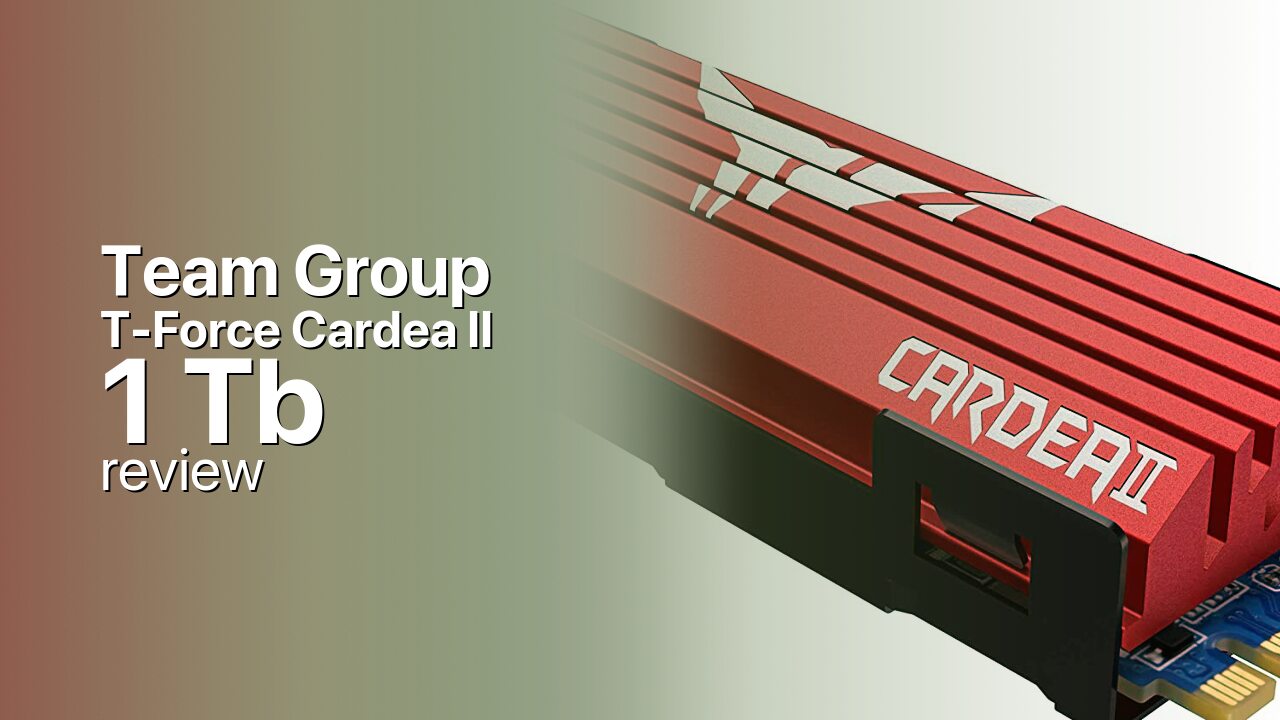
The patented gaming-fin aluminum heatsink is the Cardea II's visual and thermal signature. Team Group claims it reduces temperatures by up to 10 degrees in closed chassis and 30 degrees in open air. The heatsink is tall and will not fit under most motherboard M.2 coolers without removal. An alternative PCIe add-in card version with RGB lighting is available for systems without M.2 slots.
Storage Comparisons:
T-Force Cardea II Performance & Benchmarks
The Cardea II 1TB delivers 3,400 MB/s sequential read and 3,000 MB/s sequential write — the full E12 platform ceiling at this capacity. Guru3D's testing confirmed the drive performs identically to other E12-based 1TB drives, which is expected since the E12 is a reference design with manufacturer-specific firmware tweaks.
Team Group T-Force Cardea II 1 TB vs M.2 3.0 x 4 peers
Switch between sequential throughput and random IOPS to see how this drive stacks up against other M.2 3.0 x 4 SSDs in our database. The highlighted bar is the drive on this page — click any other bar to open that drive.
- ADATA SX 8800 Pro 512 GB: 3,500 MB/s read, 2,700 MB/s write
- ADATA SX 8800 Pro 1 TB: 3,500 MB/s read, 2,700 MB/s write
- ADATA XPG Spectrix S40G RGB 256 GB: 3,500 MB/s read, 3,000 MB/s write
- ADATA XPG Spectrix S40G RGB 512 GB: 3,500 MB/s read, 3,000 MB/s write
- Team Group T-Force Cardea II 1 TB (this drive): 3,400 MB/s read, 3,000 MB/s write
Random performance at 180K read and 160K write IOPS is competitive with other E12 drives at 1TB. At QD1, the drive handles gaming, OS boot, and application launches responsively. Guru3D found the finned heatsink effective at maintaining peak speed during extended write workloads, with temperatures staying well below throttling. The SLC cache at 1TB is estimated at roughly 333 GB — generous enough for virtually all consumer burst-write scenarios. Post-cache sustained writes hold steady at TLC-native speeds, and Guru3D noted the drive handles heavy workloads without the performance drops seen on some thinner-cooled E12 drives.
Team Group T-Force Cardea II vs Competitors
See how the T-Force Cardea II stacks up against other M.2 3.0 x 4 drives in our database:
Compare with rival drives:
Endurance, TBW & Warranty
The 1TB model carries a 1,665 TBW endurance rating — one of the highest among consumer PCIe 3.0 NVMe drives at this capacity. This is more than double the Samsung 970 EVO Plus 1TB (600 TBW) and on par with the Team Group MP34 1TB (1,660 TBW). The warranty is 3 years, which is the Cardea II's main compromise versus premium 5-year drives. At 50 GB of daily writes, the 1,665 TBW rating translates to roughly 91 years. The MTBF is rated at 2.0 million hours.
Team Group T-Force Cardea II 1 TB Specifications
| Category | Value |
|---|---|
| Capacity [?] | 1 TB |
| Interface [?] | M.2 3.0 x 4 |
| Controller [?] | Phison PS5012-E12 |
| Memory type [?] | Toshiba 64L 3D TLC |
| DRAM [?] | DDR3 or DDR4 |
| Read speed (MB/s) [?] | 3400 |
| Write speed (MB/s) [?] | 3000 |
| Read IOPS [?] | 180000 |
| Write IOPS [?] | 160000 |
| Endurance (TBW) [?] | 1665 |
| MTBF (million hours) [?] | 2 |
| Warranty (years) [?] | 3 |
Verdict: Is the T-Force Cardea II Worth It in 2026?
The Team Group T-Force Cardea II 1TB is a well-executed E12 NVMe SSD with genuinely effective thermal management and exceptional endurance. The 3,400/3,000 MB/s speeds are competitive with other PCIe 3.0 drives, and the 1,665 TBW endurance is among the best at any price point. The finned heatsink is both an asset (thermal performance) and a liability (height compatibility). For desktop builders who want a cooled, high-endurance gaming NVMe drive and have the clearance for the heatsink, the Cardea II 1TB is a strong choice. For builds with existing M.2 cooling, the Team Group MP34 1TB offers similar endurance and performance without the heatsink premium. The Samsung 970 EVO Plus 1TB provides a longer warranty and slightly better peak performance but lower endurance.
+ Pros
- 3,400 MB/s read, 3,000 MB/s write
- 1,665 TBW endurance is exceptional
- Patented finned heatsink prevents throttling
- Phison E12 with DRAM cache
- 1 TB capacity for OS and game library
- Cons
- 3-year warranty on a gaming-branded drive
- Heatsink too tall for laptops and some motherboards
- PCIe 3.0, not Gen4
- No management software available
Buy this or similar SSD Storage:
Video Review
Best Bang for Buck PCIe 3.0 NVMe SSD? ⏩ T-Force Cardea z340 SSD Review