TeamGroup T-Force Cardea Liquid 1TB Review — PCIe 3.0 NVMe SSD with Liquid Cooling (2026)
Quick answer
The TeamGroup Cardea Liquid 1 TB is best suited for enthusiasts building small-form-factor systems or anyone pushing their M.2 slots thermally, where the integrated liquid cooling provides genuine value.
Read: 3400 MB/s Write: 3000 MB/s Endurance: 1237 TBW Warranty: 3 years Interface: M.2 3.0 x 4
The TeamGroup T-Force Cardea Liquid 1 TB is a distinctive PCIe 3.0 NVMe SSD that pairs Phison's flagship E12 controller with a built-in liquid cooling block, targeting enthusiasts who want sustained performance without thermal throttling.
Controller & Memory
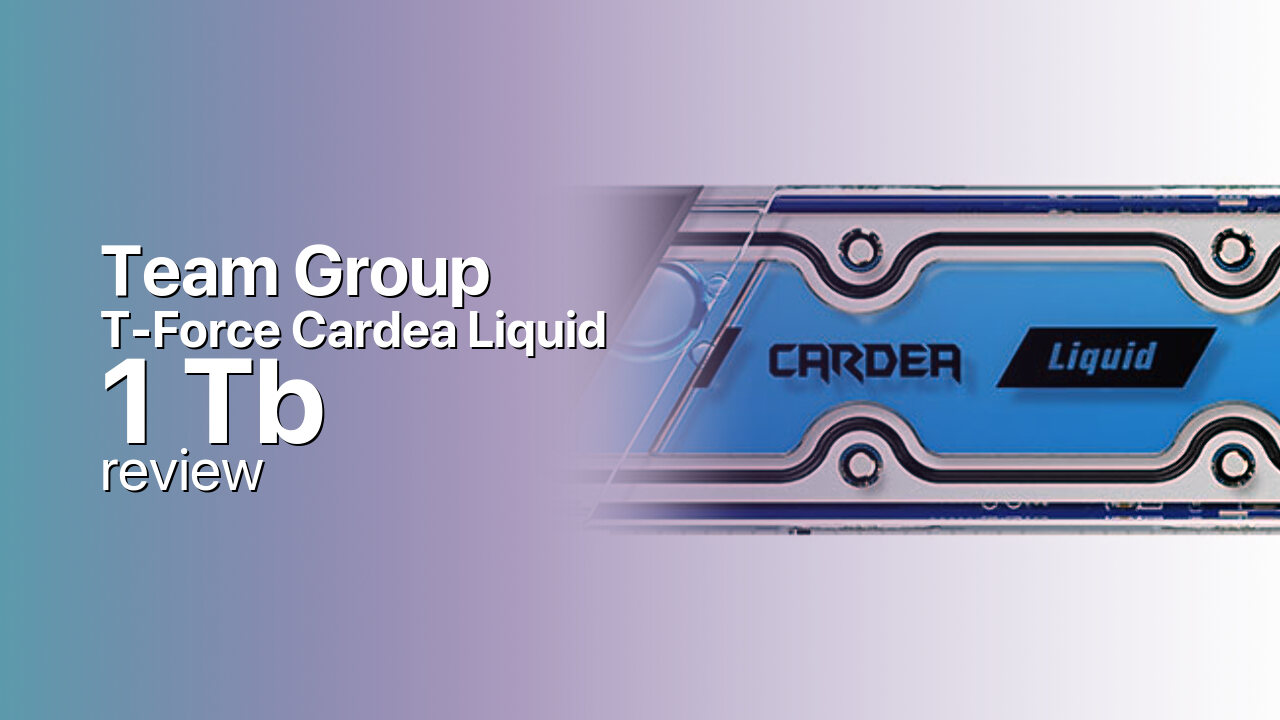
Under the hood, the Cardea Liquid runs on Phison's PS5012-E12 controller — a PCIe 3.0 x4 flagship that was among the fastest controllers of its generation before PCIe 4.0 arrived. It pairs Toshiba BiCS 3D TLC NAND with a DRAM cache buffer to keep performance consistent, even during sustained workloads. The drive's signature feature is its integrated cooling solution: a patented liquid cooling block that circulates coolant to maintain temperatures under heavy load. This design choice makes it particularly appealing for small-form-factor builds where traditional heatsinks won't fit or where airflow is limited.
The 1 TB variant sits in the middle of the Cardea Liquid lineup, with 512 GB and 2 TB models also available. Like most NVMe drives, the 1 TB capacity hits the performance sweet spot — lower capacities often sacrifice write speeds and cache size, while the 2 TB commands a significant price premium. This drive competes directly with other enthusiast PCIe 3.0 options like the Samsung 970 EVO Plus, WD Black SN750, and Seagate FireCuda 510. What sets the Cardea Liquid apart is the cooling solution out of the box — many premium drives require purchasing a separate heatsink or motherboard with M.2 shielding to maintain peak performance. The drive uses a standard M.2 2280 form factor, ensuring compatibility with virtually all modern desktop motherboards and laptops that have the physical clearance for its taller cooling block.
Storage Comparisons:
T-Force Cardea Liquid Performance & Benchmarks
The TeamGroup Cardea Liquid 1 TB is rated for up to 3,400 MB/s sequential reads and 3,000 MB/s sequential writes, with random 4K performance reaching up to 450,000 read IOPS and 100,000 write IOPS. These numbers place it squarely in the upper tier of PCIe 3.0 drives — competitive with Samsung's 970 EVO Plus and faster than midrange options like the WD Blue SN570. For gaming, the difference between a drive like this and a SATA SSD is measurable: open-world titles with large asset streams can see 20-40% faster load times, though the real-world gap narrows once games are actually loaded into RAM.
Team Group T-Force Cardea Liquid 1 TB vs M.2 3.0 x 4 peers
Switch between sequential throughput and random IOPS to see how this drive stacks up against other M.2 3.0 x 4 SSDs in our database. The highlighted bar is the drive on this page — click any other bar to open that drive.
- ADATA SX 8800 Pro 512 GB: 3,500 MB/s read, 2,700 MB/s write
- ADATA SX 8800 Pro 1 TB: 3,500 MB/s read, 2,700 MB/s write
- ADATA XPG Spectrix S40G RGB 256 GB: 3,500 MB/s read, 3,000 MB/s write
- ADATA XPG Spectrix S40G RGB 512 GB: 3,500 MB/s read, 3,000 MB/s write
- Team Group T-Force Cardea Liquid 1 TB (this drive): 3,400 MB/s read, 3,000 MB/s write
The Phison E12 controller is known for sustaining its rated speeds better than budget controllers, thanks to its more aggressive SLC caching strategy and better thermal management. Independent testing of the Cardea Liquid shows it maintaining close to its 3,000 MB/s write speed for the duration of typical consumer workloads, with thermal throttling only emerging in artificial prolonged-write scenarios that few users encounter. The liquid cooling block isn't just aesthetic — reviews consistently show it running 5-10°C cooler than bare drives under sustained load, which translates directly to more consistent performance in cramped ITX builds or during long file transfer sessions.
Team Group T-Force Cardea Liquid vs Competitors
See how the T-Force Cardea Liquid stacks up against other M.2 3.0 x 4 drives in our database:
Compare with rival drives:
Endurance, TBW & Warranty
TeamGroup rates the Cardea Liquid 1 TB for 1,237 terabytes written (TBW), which is excellent endurance for a consumer drive. To put that in perspective, writing 50 GB per day — a workload that exceeds typical consumer usage — would take roughly 68 years to exhaust the drive's rated endurance. The TBW rating is backed by a 3-year warranty, which is shorter than the 5-year coverage offered by Samsung and Western Digital on their flagship PCIe 3.0 drives. The drive is also rated for 2 million hours mean time between failures (MTBF), a standard figure for consumer NVMe SSDs that reflects population-level reliability rather than an individual drive's lifespan. It is worth noting that TeamGroup's warranty process typically goes through the retailer in many regions, which can streamline returns but may vary depending on where you purchased the drive.
Team Group T-Force Cardea Liquid 1 TB Specifications
| Category | Value |
|---|---|
| Capacity [?] | 1 TB |
| Interface [?] | M.2 3.0 x 4 |
| Controller [?] | Phison PS5012-E12 |
| Memory type [?] | Toshiba 3D TLC |
| DRAM [?] | DRAM cache buffer |
| Read speed (MB/s) [?] | 3400 |
| Write speed (MB/s) [?] | 3000 |
| Read IOPS [?] | 450000 |
| Write IOPS [?] | 100000 |
| Endurance (TBW) [?] | 1237 |
| MTBF (million hours) [?] | 2 |
| Warranty (years) [?] | 3 |
Verdict: Is the T-Force Cardea Liquid Worth It in 2026?
The TeamGroup Cardea Liquid 1 TB is best suited for enthusiasts building small-form-factor systems or anyone pushing their M.2 slots thermally, where the integrated liquid cooling provides genuine value. Gamers and general users who prioritize price-to-performance over thermals will find better value in drives like the WD Black SN770 or Samsung 970 EVO Plus, which offer similar real-world performance without the cooling premium. Those who already have adequate motherboard M.2 shielding or don't run sustained write workloads can safely skip the Liquid variant. However, if you are building a compact ITX gaming rig, a Steam Deck dock, or any system where airflow around the M.2 slot is constrained, the Cardea Liquid's all-in-one cooling solution justifies its existence. The Phison E12 controller remains a solid performer in 2026, and the 1,237 TBW endurance rating gives confidence for long-term use.
+ Pros
- Integrated liquid cooling block maintains low temps
- Phison E12 flagship controller for sustained performance
- 1,237 TBW endurance is excellent for the capacity
- Competitive 3,400/3,000 MB/s read/write speeds
- DRAM cache for consistent random performance
- Cons
- 3-year warranty is shorter than flagship competitors
- Liquid cooling adds cost for users with adequate airflow
- PCIe 3.0 limits headroom versus newer PCIe 4.0 drives
- Slower random write IOPS than some competitors
Buy this or similar SSD Storage:



Video Review
World's First Liquid M.2 NVMe ! The TEAM GROUP T-FORCE Cardea Liquid SSD