Patriot P400 1TB PCIe 4.0 NVMe SSD Review (2026)
Quick answer
Buy the Patriot P400 1 TB if you need a PCIe 4.0 boot drive on a tight budget and want better endurance than the cheapest QLC options.
Read: 5000 MB/s Write: 4800 MB/s Endurance: 800 TBW Warranty: 3 years Interface: M.2 4.0 x 4
The Patriot P400 1 TB is a budget PCIe 4.0 NVMe that trades DRAM for Host Memory Buffer technology to hit a mainstream price point while still delivering respectable sequential performance.
Controller & Memory
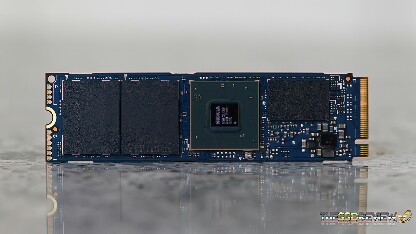
Inside the P400 you will find Innogrit's Rainier IG5220 controller paired with Micron 3D TLC NAND. This is a DRAM-less design that relies on Host Memory Buffer (HMB) — the drive borrows a small slice of system RAM for its mapping table rather than carrying its own DRAM chip. HMB drives typically run cooler and cost less than full-DRAM equivalents, though they can show slightly higher latency in random-heavy workloads.
The P400 is also available in a 512 GB capacity, and both sizes use the same single-sided M.2 2280 form factor. The single-sided layout is good news for laptop upgraders and PS5 expansion — the drive fits in thin slots without obstructing nearby components. Patriot does not include a heatsink in the box, so if you plan to push this drive with sustained transfers or install it in a PS5, you will want to budget for a low-profile M.2 cooler.
In the PCIe 4.0 budget tier, the P400 competes against drives like the WD Blue SN580, Kingston NV2, and Crucial P3. All four use DRAM-less architectures, but the P400's Innogrit controller and Micron NAND combo gives it slightly stronger endurance ratings than some QLC-based alternatives at similar prices.
Storage Comparisons:
P400 Performance & Benchmarks
Patriot rates the 1 TB P400 at up to 5,000 MB/s sequential reads and 4,800 MB/s sequential writes. Random performance comes in at up to 620,000 IOPS reads and 550,000 IOPS writes. Those sequential figures put the drive squarely in the mainstream PCIe 4.0 bracket — roughly 75% of the throughput you get from flagship drives like the Samsung 990 Pro, but at less than half the price.
Patriot P400 1 TB vs M.2 4.0 x 4 peers
Switch between sequential throughput and random IOPS to see how this drive stacks up against other M.2 4.0 x 4 SSDs in our database. The highlighted bar is the drive on this page — click any other bar to open that drive.
- Patriot Viper PV593 1 TB: 14,500 MB/s read, 14,000 MB/s write
- Patriot Viper PV593 2 TB: 14,500 MB/s read, 14,000 MB/s write
- Patriot Viper PV593 4 TB: 14,500 MB/s read, 14,000 MB/s write
- Patriot Viper PV573 2 TB: 14,000 MB/s read, 12,000 MB/s write
- Patriot P400 1 TB (this drive): 5,000 MB/s read, 4,800 MB/s write
Real-world testing from independent reviewers consistently shows the P400 performing as advertised for everyday workloads. Game load times see modest gains over SATA and PCIe 3.0 drives, though the delta shrinks in titles that are not well-optimized for high-speed storage. Sustained write performance is where DRAM-less drives can struggle; once the SLC cache exhausts, write speeds drop. For typical consumer workloads — booting, launching apps, loading games — this limitation is rarely noticeable, but video editors working with large files may want a DRAM-equipped drive instead.
Patriot P400 vs Competitors
See how the P400 stacks up against other M.2 4.0 x 4 drives in our database:
Compare with rival drives:
Endurance, TBW & Warranty
Patriot backs the P400 1 TB with a 3-year warranty and an endurance rating of 800 TBW. That means you can write 800 terabytes to the drive before it falls out of warranty coverage — at a heavy 50 GB/day workload, that translates to over 43 years of use. For most users, TBW exhaustion is effectively a non-issue. The warranty length is slightly shorter than the 5-year coverage offered by premium drives, but typical for the budget segment. RMA processing goes through Patriot rather than the retailer, so keep your purchase receipt handy if you ever need to make a claim.
Patriot P400 1 TB Specifications
| Category | Value |
|---|---|
| Capacity [?] | 1 TB |
| Interface [?] | M.2 4.0 x 4 |
| Controller [?] | Innogrit Rainier IG5220 |
| Memory type [?] | Micron 3D TLC |
| DRAM [?] | HMB |
| Read speed (MB/s) [?] | 5000 |
| Write speed (MB/s) [?] | 4800 |
| Read IOPS [?] | 620000 |
| Write IOPS [?] | 550000 |
| Endurance (TBW) [?] | 800 |
| MTBF (million hours) [?] | 1500000 |
| Warranty (years) [?] | 3 |
Verdict: Is the P400 Worth It in 2026?
Buy the Patriot P400 1 TB if you need a PCIe 4.0 boot drive on a tight budget and want better endurance than the cheapest QLC options. Skip it if you regularly move hundreds of gigabytes at a time or need the lowest possible latency for database work — a DRAM-equipped drive like the WD Black SN850X or Sabrent Rocket 4 is worth the extra cost in those cases. For most gamers and general-purpose users, the P400 hits a solid value sweet spot.
+ Pros
- 5,000 MB/s sequential reads on PCIe 4.0
- 800 TBW endurance for the 1 TB model
- Single-sided PCB fits PS5 and thin laptops
- DRAM-less HMB design runs cool and efficient
- Innogrit IG5220 controller with Micron TLC NAND
- Cons
- No included heatsink
- Slower sustained writes after SLC cache fills
- 3-year warranty is shorter than premium competitors
- HMB adds slight random latency vs full DRAM
Buy this or similar SSD Storage:



Video Review
How fast is this DRAM-less SSD? Patriot P400 1TB NVMe SSD Review