Intel SSD 670P 2TB QLC NVMe Review (2026)
Quick answer
The Intel 670P 2TB is the best capacity in Intel's QLC lineup and the one that makes the most sense for budget-focused buyers who need bulk storage.
Read: 3500 MB/s Write: 2700 MB/s Endurance: 740 TBW Warranty: 5 years Interface: M.2 3.0 x 4
The Intel 670P 2TB is the flagship capacity of Intel's QLC NVMe line, pairing 144-layer QLC flash with the SM2265G controller for read speeds that rival mainstream TLC drives and enough endurance for serious daily use.
Controller & Memory
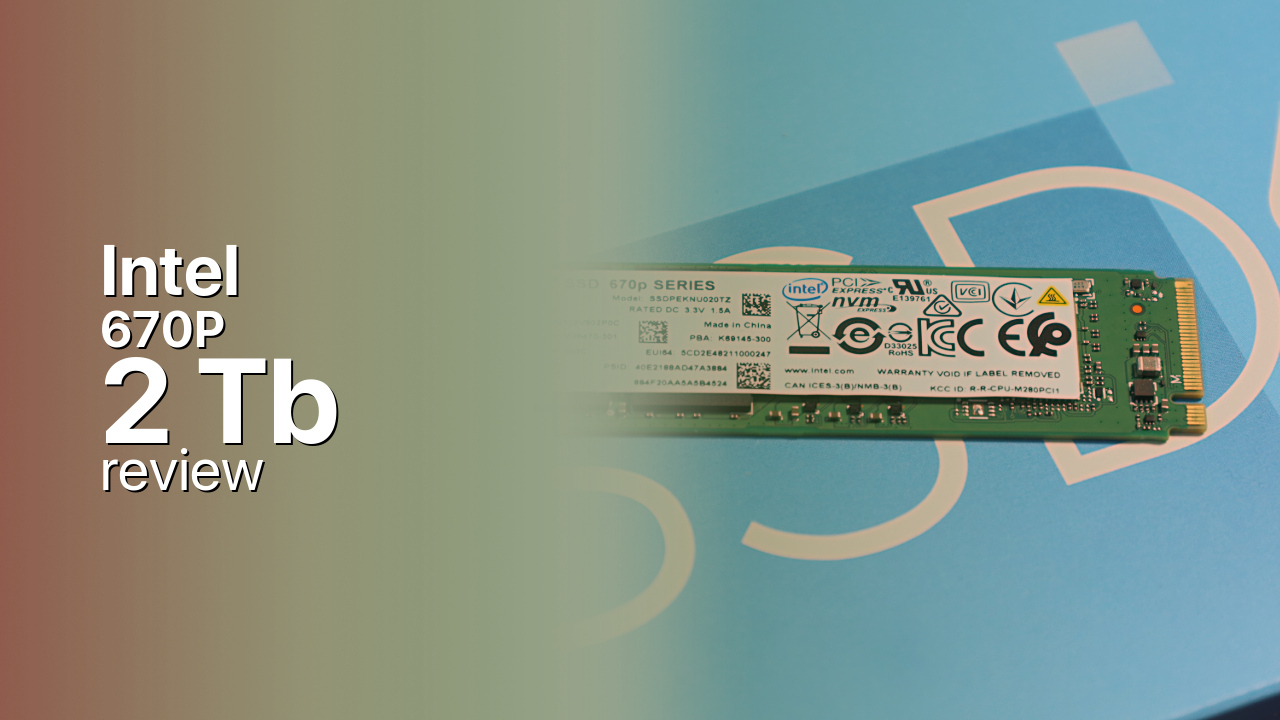
The 670P 2 TB uses the Silicon Motion SM2265G controller paired with Intel's 144-layer 1 Tbit 3D QLC NAND. A 256 MB Nanya DDR3L DRAM chip handles the flash translation layer. Intel packages the 2 TB capacity into just two NAND packages on a single-sided M.2 2280 PCB, thanks to high-density die stacking.
This is the capacity where the 670P hits its full stride: 3,500 MB/s sequential reads, 2,700 MB/s writes, 310,000 random read IOPS, and 340,000 random write IOPS. Endurance is rated at 740 TBW, and the variable SLC cache scales from 24 GB minimum up to 280 GB on a mostly empty drive. These numbers are all significant improvements over the 660P.
The 2 TB 670P competes with high-capacity QLC drives like the Crucial P3 2 TB and Samsung 870 QVO 2 TB, as well as mainstream TLC NVMe drives like the Kingston KC2500 2 TB. For users who need bulk NVMe storage on a budget, the 670P offers a compelling cost-per-GB ratio with read performance that matches many TLC drives.
Storage Comparisons:
670P Performance & Benchmarks
At 3,500 MB/s sequential reads and 2,700 MB/s writes, the 2 TB 670P effectively saturates the PCIe 3.0 x4 interface. These numbers are nearly identical to mainstream TLC NVMe drives, a testament to how far QLC has come since the 660P. Random IOPS reach 310,000 reads and 340,000 writes, both strong figures.
Intel 670P 2 TB vs M.2 3.0 x 4 peers
Switch between sequential throughput and random IOPS to see how this drive stacks up against other M.2 3.0 x 4 SSDs in our database. The highlighted bar is the drive on this page — click any other bar to open that drive.
- Intel 670P 2 TB (this drive): 3,500 MB/s read, 2,700 MB/s write
- ADATA SX 8800 Pro 512 GB: 3,500 MB/s read, 2,700 MB/s write
- ADATA SX 8800 Pro 1 TB: 3,500 MB/s read, 2,700 MB/s write
- ADATA XPG Spectrix S40G RGB 256 GB: 3,500 MB/s read, 3,000 MB/s write
- ADATA XPG Spectrix S40G RGB 512 GB: 3,500 MB/s read, 3,000 MB/s write
AnandTech tested the 2 TB model extensively and found it competitive with TLC drives in real-world trace benchmarks when the SLC cache was available. The review noted that the 670P \"owes most of its improved performance to the upgraded SSD controller\" -- the SM2265G's faster interface to the flash eliminates the 2.4 GB/s bottleneck that limited the older SM2263.
The QLC limitation persists under sustained writes. Once the 280 GB SLC cache is exhausted on a full drive (minimum cache: 24 GB), write speed drops to native QLC rates. For typical consumer workloads with idle periods, this is rarely encountered. For users who regularly write hundreds of gigabytes in one session, a TLC drive is still the better tool.
Intel 670P vs Competitors
See how the 670P stacks up against other M.2 3.0 x 4 drives in our database:
Compare with rival drives:
Endurance, TBW & Warranty
Intel rates the 670P 2 TB at 740 TBW over its 5-year warranty, which equates to roughly 405 GB of writes per day. At 0.2 drive writes per day, this is a significant improvement over the 660P's 400 TBW at the same capacity and approaches the endurance class of mainstream TLC drives. A typical consumer writing 30 to 50 GB daily would need decades to reach this limit. Warranty service goes through Intel's standard RMA process.
Intel 670P 2 TB Specifications
| Category | Value |
|---|---|
| Capacity [?] | 2 TB |
| Interface [?] | M.2 3.0 x 4 |
| Controller [?] | Silicon Motion SM2265G |
| Memory type [?] | Intel 144L 3D QLC |
| DRAM [?] | Nanya 256MB DDR3L |
| Read speed (MB/s) [?] | 3500 |
| Write speed (MB/s) [?] | 2700 |
| Read IOPS [?] | 310000 |
| Write IOPS [?] | 340000 |
| Endurance (TBW) [?] | 740 |
| MTBF (million hours) [?] | 1200000 |
| Warranty (years) [?] | 5 |
Verdict: Is the 670P Worth It in 2026?
The Intel 670P 2TB is the best capacity in Intel's QLC lineup and the one that makes the most sense for budget-focused buyers who need bulk storage. Read speeds match mainstream TLC NVMe drives, the 740 TBW endurance is generous, and the 2 TB capacity handles OS, applications, and a large game library in one drive. The QLC write penalty after cache exhaustion is the main compromise. Against TLC alternatives like the Kingston KC2500 2 TB, the 670P wins on price per GB but loses on sustained write consistency. Choose based on workload: read-heavy users will not notice the QLC trade-off.
+ Pros
- 3,500 MB/s sequential reads
- 2,700 MB/s sequential writes
- 740 TBW endurance rating
- Up to 280 GB SLC cache on empty drive
- DRAM cache (256 MB Nanya DDR3L)
- Single-sided M.2 2280 fits thin laptops
- 310,000 random read IOPS
- Cons
- QLC write speed drops after SLC cache fills
- PCIe 3.0 only, no PCIe 4.0
- 0.2 DWPD endurance lower than TLC (0.3 DWPD)
- 24 GB minimum SLC cache on full drives
- No hardware encryption listed
Buy this or similar SSD Storage:



Video Review
Introducing the Intel QLC SSD 670p