Micron 3400 512GB SSD — In-Depth Review & Specs (2026)
Quick answer
The Micron 3400 512GB is a competent, power-efficient PCIe 4.0 NVMe SSD that punches above its weight class for an OEM DRAM-less drive.
Read: 6600 MB/s Write: 3600 MB/s Endurance: 300 TBW Warranty: 3 years Interface: M.2 4.0 x 4
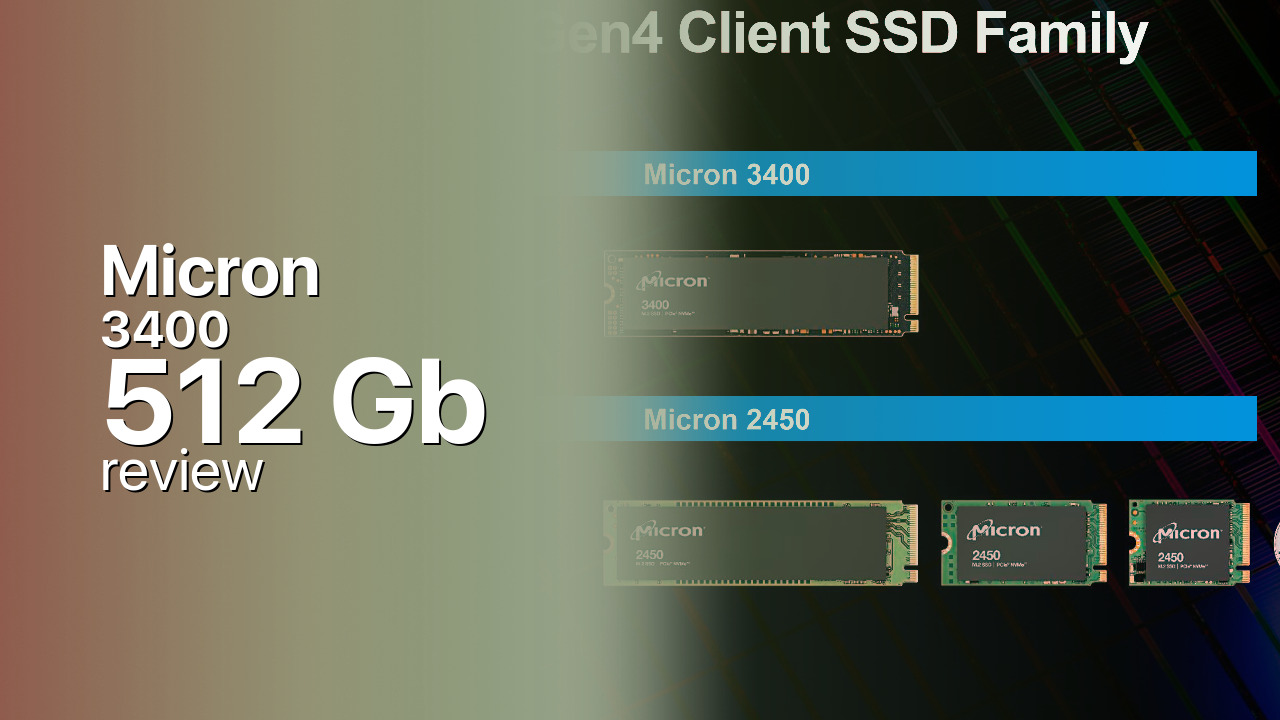
The Micron 3400 is an OEM-focused M.2 NVMe SSD built on PCIe 4.0 and Micron's own 176-layer TLC NAND. It is not sold at retail — you will typically find it inside Dell, HP, Lenovo, and other brand-name laptops and pre-built desktops. The 512GB variant delivers up to 6,600 MB/s sequential reads and 3,600 MB/s writes, making it a competent mid-range Gen4 drive for everyday computing, creative work, and gaming.
Controller & Memory
Micron designed the 3400 around its in-house DM02A1 controller, a 6-channel, DRAM-less architecture that relies on the NVMe Host Memory Buffer (HMB) protocol — it borrows a small slice of your system RAM (usually 32–64 MB) instead of carrying its own DRAM cache. This keeps the bill of materials low while maintaining respectable real-world responsiveness. The flash is Micron's 176-layer Replacement Gate (RG) TLC, the same generation that powers the company's high-end Crucial T500 retail drives, albeit tuned here for OEM efficiency targets rather than peak performance.
In sequential throughput the 512GB model is rated at 6,600 MB/s read and 3,600 MB/s write — the write figure is notably lower than the 5,000 MB/s of the 1TB and 2TB siblings, a consequence of fewer NAND dies to stripe writes across. Random performance sits at 360,000 IOPS read and 700,000 IOPS write, which is perfectly adequate for an OS drive handling mixed workloads. Power efficiency is a genuine strength: Micron claims 25% lower idle power versus its previous-generation parts, and the drive rarely throttles under sustained load in a well-ventilated laptop chassis.
Who should consider the Micron 3400 512GB? It makes the most sense as a drop-in replacement for an older SATA or PCIe 3.0 M.2 SSD in a laptop that supports PCIe 4.0. The capacity is tight for a game library but fine for a boot drive paired with secondary storage. If you are pulling one from a salvaged OEM system, it is a reliable, power-sipping Gen4 drive that will not set off thermal alarms. Just do not expect the sustained write grunt of a DRAM-equipped, 8-channel flagship — that is not the brief here.
Storage Comparisons:
3400 Performance & Benchmarks
The 3400's real-world PCMark 10 storage scores land in the mid-range of PCIe 4.0 drives — faster than any Gen3 drive but a step behind DRAM-equipped Gen4 flagships in latency-sensitive tasks. Sequential reads hit the advertised 6,600 MB/s mark consistently. Sequential writes at 3,600 MB/s are ample for everyday file copies but will feel constrained if you regularly move large video projects. The DRAM-less HMB design means the drive leans on system memory for its mapping tables; on modern platforms (Windows 10/11, recent Linux kernels) this works transparently. On older systems without robust HMB support, random I/O can suffer slightly. Temperature under load typically settles between 60–70°C without a heatsink, which is warm but within spec for a DRAM-less Gen4 drive.
Micron 3400 512 GB vs M.2 4.0 x 4 peers
Switch between sequential throughput and random IOPS to see how this drive stacks up against other M.2 4.0 x 4 SSDs in our database. The highlighted bar is the drive on this page — click any other bar to open that drive.
- Patriot Viper PV593 1 TB: 14,500 MB/s read, 14,000 MB/s write
- Patriot Viper PV593 2 TB: 14,500 MB/s read, 14,000 MB/s write
- Patriot Viper PV593 4 TB: 14,500 MB/s read, 14,000 MB/s write
- Patriot Viper PV573 2 TB: 14,000 MB/s read, 12,000 MB/s write
- Micron 3400 512 GB (this drive): 6,600 MB/s read, 3,600 MB/s write
Micron 3400 vs Competitors
See how the 3400 stacks up against other M.2 4.0 x 4 drives in our database:
Compare with rival drives:
Endurance, TBW & Warranty
As an OEM product, the Micron 3400 carries no direct end-user warranty. The drive is warrantied through the system manufacturer (Dell, HP, Lenovo, etc.) as part of the original device. If purchased separately through resellers or pulled from a decommissioned machine, you should assume no warranty coverage. Always confirm return policies with the seller before buying an OEM drive on the secondary market.
Micron 3400 512 GB Specifications
| Category | Value |
|---|---|
| Capacity [?] | 512 GB |
| Interface [?] | M.2 4.0 x 4 |
| Controller [?] | Micron |
| Memory type [?] | Micron 3D TLC |
| DRAM [?] | No (HMB) |
| Read speed (MB/s) [?] | 6600 |
| Write speed (MB/s) [?] | 3600 |
| Read IOPS [?] | 360000 |
| Write IOPS [?] | 700000 |
| Endurance (TBW) [?] | 300 |
| MTBF (million hours) [?] | 2 |
| Warranty (years) [?] | 3 |
Verdict: Is the 3400 Worth It in 2026?
The Micron 3400 512GB is a competent, power-efficient PCIe 4.0 NVMe SSD that punches above its weight class for an OEM DRAM-less drive. The 176-layer TLC NAND and Micron's in-house controller deliver solid Gen4 sequential throughput and more than enough random I/O for a responsive Windows or Linux daily driver. It is not a performance leader, and the 512GB capacity limits both write speed and usable space, but for the right price — particularly as a pulled OEM unit — it offers a meaningful upgrade over any SATA or PCIe 3.0 drive. If you need retail packaging and a direct warranty, look at the Crucial P5 Plus or T500 instead.
+ Pros
- Strong 6,600 MB/s sequential reads
- Excellent idle power efficiency with 176L TLC
- Compact M.2 2280 single-sided form factor
- AES 256-bit hardware encryption
- Runs cool enough for most laptop installations
- Cons
- 512GB write speed (3,600 MB/s) trails larger capacities
- DRAM-less HMB design limits peak random performance
- No direct end-user warranty (OEM product only)
- Not sold at retail — availability depends on pulls or system resellers
- Small capacity for a primary game or media library
Buy this or similar SSD Storage:



Video Review
M.2 vs NVME: What's the difference?