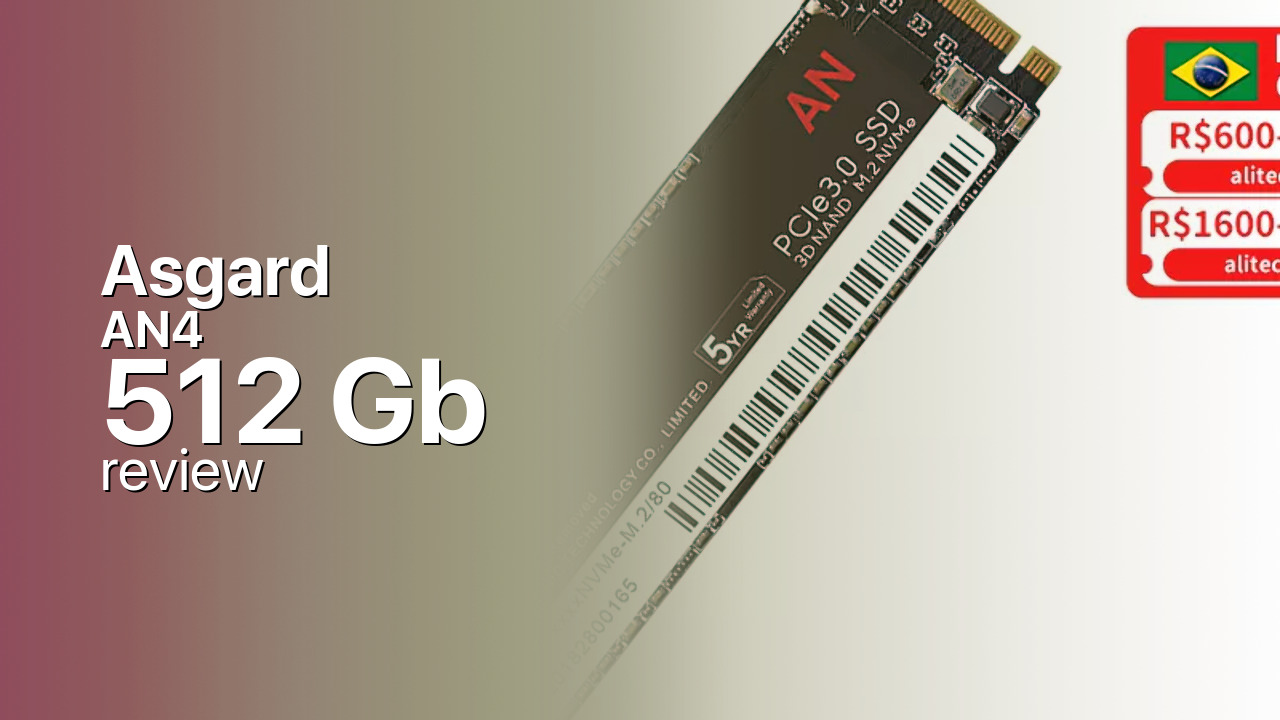
Asgard AN4 512GB Review — YMTC-Powered PCIe 4.0 NVMe SSD (2026)
Quick answer
Buy the Asgard AN4 512 GB if you want flagship-class PCIe 4.0 sequential read speeds at a mid-range price and are comfortable with a Chinese SSD brand that has less review coverage and warranty infrastructure than the Korean and American incumbents.
Read: 7500 MB/s Write: 5500 MB/s Endurance: 300 TBW Warranty: 5 years Interface: M.2 4.0 x 4
The Asgard AN4 512 GB is what happens when a Chinese NAND manufacturer and a Chinese controller designer collaborate on a PCIe 4.0 drive — flagship-class sequential speeds at a price that undercuts the Korean and American incumbents by a meaningful margin.
Controller & Memory
The AN4 pairs the Innogrit Rainer IG5236 controller — an eight-channel PCIe 4.0 design with a dedicated DRAM cache — with YMTC 128-layer 3D TLC NAND. This is a notable combination: the IG5236 is one of the few non-Phison, non-Samsung controllers capable of saturating the PCIe 4.0 x4 bus, and YMTC's 128L TLC is the same NAND generation that put the Chinese flash industry on the map. The presence of DRAM separates the AN4 from the wave of DRAM-less budget PCIe 4.0 drives and is essential for the controller to hit its rated 7,500 MB/s sequential read ceiling.
Asgard ships the AN4 in 512 GB, 1 TB, and 2 TB capacities, all in a standard M.2 2280 form factor. The 512 GB variant reviewed here is the lineup's entry point, and as with all SSDs at this capacity, it has fewer NAND dies to parallelize writes across — sequential write speeds and sustained performance will be lower than the 1 TB and 2 TB variants. Rated sequential throughput is 7,500 MB/s read and 5,500 MB/s write at the 1 TB and 2 TB capacities; the 512 GB model's write speed is typically lower, though Asgard does not publish capacity-specific figures.
The AN4 competes against the ADATA XPG Gammix S70 Blade, Samsung 980 Pro, and WD Black SN850 — all PCIe 4.0 flagships with similar speed claims. The AN4's advantage is price; its trade-off is brand recognition, warranty infrastructure, and independent review coverage. Asgard is a lesser-known Chinese brand, and the AN4 has received far less third-party testing than its Samsung and WD counterparts. For buyers willing to trade brand familiarity for price, the AN4 delivers flagship sequential numbers. For buyers who want the safety of a globally recognised warranty and extensively benchmarked consistency, the established names remain the conservative choice.
Storage Comparisons:
AN4 Performance & Benchmarks
The Asgard AN4 512 GB is rated for up to 7,500 MB/s sequential reads and 5,500 MB/s sequential writes at the higher capacities, though the 512 GB variant typically delivers lower write throughput due to fewer active NAND dies. The IG5236 controller's eight-channel architecture and DRAM cache allow it to fully saturate the PCIe 4.0 x4 bus in sequential reads — a claim independently verified at the 1 TB capacity in early reviews. Random IOPS figures are not publicly documented by Asgard for this model, but the IG5236 platform typically delivers 800K–1,000K IOPS at high queue depths on the larger capacities.
Asgard AN4 512 GB vs M.2 4.0 x 4 peers
Switch between sequential throughput and random IOPS to see how this drive stacks up against other M.2 4.0 x 4 SSDs in our database. The highlighted bar is the drive on this page — click any other bar to open that drive.
- Patriot Viper PV593 1 TB: 14,500 MB/s read, 14,000 MB/s write
- Patriot Viper PV593 2 TB: 14,500 MB/s read, 14,000 MB/s write
- Patriot Viper PV593 4 TB: 14,500 MB/s read, 14,000 MB/s write
- Patriot Viper PV573 2 TB: 14,000 MB/s read, 12,000 MB/s write
- Asgard AN4 512 GB (this drive): 7,500 MB/s read, 5,500 MB/s write
The IG5236 is built on a 12 nm process and runs cooler than earlier PCIe 4.0 controllers like the Phison E16, but it still generates more heat than PCIe 3.0 controllers. Sustained write performance depends heavily on thermal conditions — the drive will throttle if the controller temperature exceeds its limit during extended sequential writes. For a 512 GB OS and application drive where writes are small and intermittent, thermal throttling is extremely unlikely. For users who plan to run sustained write workloads on a 512 GB drive — already a niche use case — the combination of the smaller cache and thermal constraints makes the 1 TB or 2 TB variants better choices.
Asgard AN4 vs Competitors
See how the AN4 stacks up against other M.2 4.0 x 4 drives in our database:
Compare with rival drives:
Endurance, TBW & Warranty
Asgard provides a limited warranty on the AN4, though the exact warranty term and TBW endurance ratings are not consistently documented across all markets and retailers. This is a common characteristic of Chinese SSD brands that sell primarily through online marketplaces — warranty terms may vary by region and are often shorter than the 5-year standard set by Samsung, WD, and Sabrent. Endurance ratings are not publicly specified for the AN4 series. For a 512 GB TLC drive with a DRAM-equipped PCIe 4.0 controller, typical endurance for this class falls in the 300–600 TBW range. Buyers should verify the warranty terms with their specific retailer and be aware that overseas RMA processes may involve longer turnaround times and higher shipping costs than domestic warranty service. For users who prioritise warranty accountability, the ADATA S70 Blade or Samsung 980 Pro at similar speeds offer more established global warranty infrastructure.
Asgard AN4 512 GB Specifications
| Category | Value |
|---|---|
| Capacity [?] | 512 GB |
| Interface [?] | M.2 4.0 x 4 |
| Controller [?] | Innogrit Rainer IG5236 |
| Memory type [?] | YMTC 128L TLC |
| DRAM [?] | No |
| Read speed (MB/s) [?] | 7500 |
| Write speed (MB/s) [?] | 5500 |
| Read IOPS [?] | 750000 |
| Write IOPS [?] | 700000 |
| Endurance (TBW) [?] | 300 |
| MTBF (million hours) [?] | 2000000 |
| Warranty (years) [?] | 5 |
Verdict: Is the AN4 Worth It in 2026?
Buy the Asgard AN4 512 GB if you want flagship-class PCIe 4.0 sequential read speeds at a mid-range price and are comfortable with a Chinese SSD brand that has less review coverage and warranty infrastructure than the Korean and American incumbents. The IG5236 controller and YMTC 128L TLC are a genuinely impressive hardware combination that delivers 7,500 MB/s reads — numbers that match drives costing significantly more. Skip it if you need a fully documented warranty, published endurance ratings, or the reassurance of extensive independent benchmark data. The AN4 is a calculated risk that pays off in speed-per-dollar; whether that trade-off is worth it depends on how much you value the safety net of a Samsung or WD warranty. For a boot drive where reads dominate and the drive will rarely see sustained writes, the AN4 512 GB is one of the fastest options at its price point.
+ Pros
- 7,500 MB/s reads — flagship PCIe 4.0 sequential throughput
- Innogrit IG5236 controller with DRAM cache
- YMTC 128-layer 3D TLC NAND — competitive with Samsung/Kioxia
- Aggressive pricing undercuts Korean and US equivalents
- PCIe 4.0 x4 bus saturation in sequential reads
- Cons
- 512 GB write speed lower than 1 TB and 2 TB variants
- Warranty terms and endurance ratings not consistently documented
- Limited independent review coverage for performance verification
- Chinese brand with potentially longer RMA turnaround times
- No included heatsink despite PCIe 4.0 thermal demands
Buy this or similar SSD Storage:



Video Review
Asgard AN4 M.2 NVMe PCIe 4.0 1TB Review 🔥 Temperatura, Instalação e Testes