Intel Optane Memory H20 1TB Review — Optane Meets QLC in a Hybrid NVMe SSD (2026)
Quick answer
The Intel Optane Memory H20 1 TB is a fascinating piece of storage engineering that arrived at exactly the wrong time and on the wrong terms.
Read: 3300 MB/s Write: 2100 MB/s Endurance: 370 TBW Warranty: 5 years Interface: M.2 3.0 x 4
The Intel Optane Memory H20 1 TB is the last consumer Optane product Intel ever shipped — a hybrid drive that pairs 32 GB of low-latency 3D XPoint with 1 TB of QLC NAND, and one that only works on a specific generation of Intel platforms.
Controller & Memory
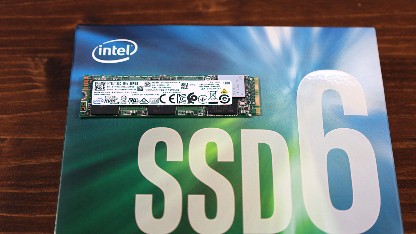
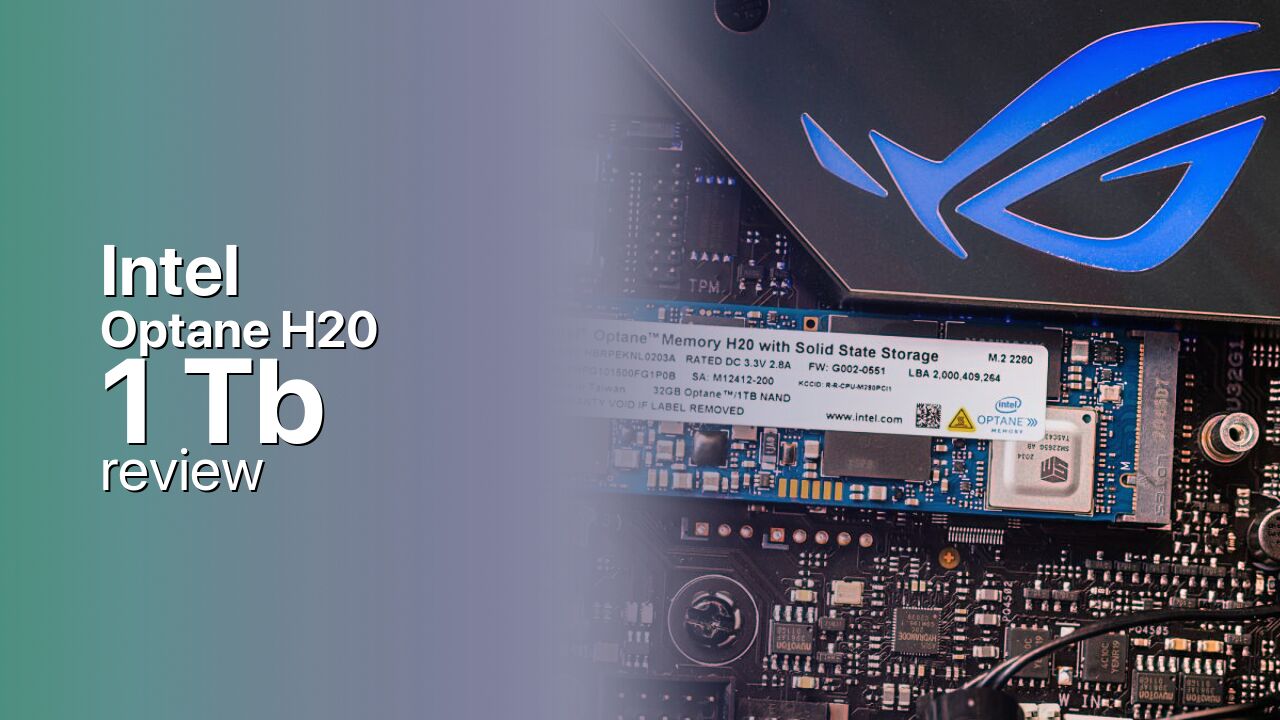
The Intel Optane Memory H20 is unlike any other SSD on this site. It combines two separate storage subsystems on a single M.2 2280 PCB: a 32 GB Intel Optane module built from 3D XPoint memory — Intel's discontinued non-volatile memory technology with roughly 10-microsecond latency — and a 1 TB Intel 144-layer QLC NAND array managed by a Silicon Motion SM2265 controller with 256 MB of Nanya DDR3 DRAM. The PCIe 3.0 x4 interface is hardware-bifurcated: two lanes feed the Optane die and two lanes feed the QLC controller, with Intel Rapid Storage Technology (RST) version 18.1 or newer managing data placement between them transparently. The drive appears as a single volume to the operating system; the Optane cache automatically absorbs frequently-accessed hot data while bulk cold data stays on QLC.
This architecture was Intel's answer to a specific problem: QLC NAND is cheap and dense but has terrible low-queue-depth random read latency, which determines how snappy a system feels during boot, application launch, and multitasking. Optane has the best low-QD random performance of any storage medium ever shipped in a consumer product. By caching hot data on the Optane tier and leaving everything else on QLC, the H20 delivers near-Optane responsiveness for everyday tasks at near-QLC cost per gigabyte. The catch — and it is a fatal one for most users — is platform lock-in. The H20 requires an 11th-generation Intel Core processor (Tiger Lake) or newer paired with an Intel 500-series chipset and Intel RST 18.1 or later. It will not work on AMD platforms, older Intel systems, or any system without proper RST driver support. This hard dependency, combined with the OEM-only distribution model (it was never sold at retail), limited the H20's reach to a handful of laptop SKUs from Dell, HP, and Lenovo.
Intel wound down its entire Optane business in July 2022 and discontinued the H20 alongside every other Optane product. The drives that exist in the wild — almost entirely inside OEM laptops — will continue to function but will receive no further firmware updates, driver updates, or support. The Intel RST driver stack required for Optane caching may not be maintained for future Windows versions. For anyone evaluating this drive today, it is a dead-end product from a cancelled technology line, and its value is entirely tied to the specific OEM laptop it shipped in.
Storage Comparisons:
Optane H20 Performance & Benchmarks
The Intel Optane Memory H20 1 TB is rated for 3,300 MB/s sequential reads and 2,100 MB/s sequential writes, with random performance rated at 65,000 IOPS reads and 40,000 IOPS writes — but those IOPS figures are measured at Queue Depth 1, not the QD32 that nearly every other SSD manufacturer uses. At QD1, 65,000 IOPS is actually competitive: most NVMe SSDs score far lower at QD1 because their latency advantage over SATA disappears at low queue depths. Optane's sub-10-microsecond read latency means the H20 delivers its best performance exactly where real-world workloads live — opening applications, switching between browser tabs, booting Windows — rather than in synthetic QD32 benchmarks that rarely reflect desktop use.
Intel Optane H20 1 TB vs M.2 3.0 x 4 peers
Switch between sequential throughput and random IOPS to see how this drive stacks up against other M.2 3.0 x 4 SSDs in our database. The highlighted bar is the drive on this page — click any other bar to open that drive.
- ADATA SX 8800 Pro 512 GB: 3,500 MB/s read, 2,700 MB/s write
- ADATA SX 8800 Pro 1 TB: 3,500 MB/s read, 2,700 MB/s write
- ADATA XPG Spectrix S40G RGB 256 GB: 3,500 MB/s read, 3,000 MB/s write
- ADATA XPG Spectrix S40G RGB 512 GB: 3,500 MB/s read, 3,000 MB/s write
- Intel Optane H20 1 TB (this drive): 3,300 MB/s read, 2,100 MB/s write
In practice, the H20 is a study in contrasts. StorageReview's CrystalDiskMark testing measured roughly 2,900 to 3,200 MB/s sequential reads and 1,400 to 1,700 MB/s sequential writes, consistent with the PCIe 3.0 x2 link feeding the QLC side. PCMark 10 storage benchmarks — which simulate real application workloads — placed the H20 significantly ahead of pure QLC drives and competitive with mid-range TLC SSDs, thanks entirely to the Optane cache accelerating the small, random reads that dominate application launch traces. Tom's Hardware confirmed that the H20 rivaled high-end NVMe SSDs in light and mixed real-world workloads. However, for large sequential transfers — video files, game installations, bulk copies — the Optane cache provides zero benefit, and the drive performs like a standard QLC SSD. Sustained writes after the QLC's pSLC cache exhausts drop to approximately 100 to 200 MB/s, which is slower than a mechanical hard drive.
The H20's 32 GB Optane cache is both its greatest strength and its primary limitation. For a typical office workload — Windows, Outlook, a browser, a few productivity apps — the working set of hot data fits comfortably within 32 GB, and the drive feels exceptionally snappy. For heavier multitasking, large creative applications, or gaming, the cache thrashes as active data exceeds the Optane tier, and performance degrades toward baseline QLC levels. Thermally and electrically, the H20 is excellent: 170 mW average active power and 35 mW idle make it one of the most power-efficient NVMe SSDs ever produced, ideal for laptop battery life. The single-sided M.2 2280 PCB fits into any laptop with an M.2 slot, though the bifurcation requirement means it physically fits but electrically fails in most systems.
Intel Optane H20 vs Competitors
See how the Optane H20 stacks up against other M.2 3.0 x 4 drives in our database:
Compare with rival drives:
Endurance, TBW & Warranty
The Intel Optane Memory H20 carries a 5-year limited warranty, but with a critical caveat: it was sold exclusively to OEMs, not at retail. Warranty claims go through the system vendor — Dell, HP, Lenovo, or whichever manufacturer built the laptop — rather than through Intel directly. End users cannot RMA an H20 to Intel. The drive is rated for 370 TBW of endurance on the 1 TB model (185 TBW for the 512 GB variant), which is QLC-class endurance and reflects the QLC NAND's limited write tolerance. At a typical 30 GB/day consumer pace, the endurance translates to roughly 33 years, so light-duty users are unlikely to hit the limit. However, the Optane cache's write amplification characteristics differ from standard SSDs: Intel RST's caching algorithms can generate additional write traffic as data is promoted and demoted between the Optane and QLC tiers, which may accelerate wear beyond what a simple TBW calculation suggests. The MTBF is rated at 1.6 million hours. Intel has ended all Optane product support as of mid-2022, meaning no further firmware updates, driver updates, or warranty service improvements will be issued. The drive is effectively abandonware.
Intel Optane H20 1 TB Specifications
| Category | Value |
|---|---|
| Capacity [?] | 1 TB |
| Interface [?] | M.2 3.0 x 4 |
| Controller [?] | Silicon Motion SM2265 |
| Memory type [?] | Intel 144L QLC |
| DRAM [?] | 256MB DDR3 and 32GB Optane |
| Read speed (MB/s) [?] | 3300 |
| Write speed (MB/s) [?] | 2100 |
| Read IOPS [?] | 65000 |
| Write IOPS [?] | 40000 |
| Endurance (TBW) [?] | 370 |
| MTBF (million hours) [?] | 1600000 |
| Warranty (years) [?] | 5 |
Verdict: Is the Optane H20 Worth It in 2026?
The Intel Optane Memory H20 1 TB is a fascinating piece of storage engineering that arrived at exactly the wrong time and on the wrong terms. The hybrid Optane-plus-QLC architecture genuinely works — the drive feels significantly more responsive than a pure QLC SSD for everyday tasks, and the automatic, transparent caching requires no user configuration — but the Intel platform lock-in, OEM-only distribution, and Optane's subsequent cancellation make it impossible to recommend as an aftermarket purchase. If you already own a laptop with an H20, it is a perfectly capable drive for office and general use, and the Optane cache gives it a responsiveness edge that ages better than the raw sequential numbers suggest. Do not try to transplant one into a different system. Do not buy one used expecting it to work on AMD or older Intel hardware. The H20 is a product that only makes sense in its original OEM context, and that context ended when Intel shut down Optane in 2022.
+ Pros
- Optane 3D XPoint cache dramatically improves low-QD random read responsiveness
- PCMark 10 scores rival mid-range TLC drives for real-world application workloads
- Fully automatic, transparent caching — no user configuration needed
- Extremely power efficient — 170 mW active, 35 mW idle
- Single-sided M.2 2280 fits thin laptops
- 5-year warranty through OEM system vendor
- Cons
- OEM-only — never sold at retail, no aftermarket upgrade path
- Requires specific Intel 11th Gen platform and RST 18.1+ — incompatible with AMD or older Intel
- Only 32 GB of Optane — cache thrashes under heavy multitasking or large working sets
- QLC-class endurance of 370 TBW with no direct end-user warranty
- Sustained writes drop to 100-200 MB/s after QLC pSLC cache fills
- Discontinued — entire Optane product line cancelled by Intel in 2022
- No AES-256 hardware encryption
- Zero benefit from Optane for large sequential workloads
Buy this or similar SSD Storage:



Video Review
Is Intel Optane FINALLY Worth It? Optane H10 Tested!