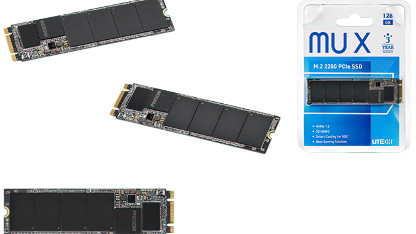
Gigabyte M30 1TB — Fast PCIe 3.0 NVMe with Large Capacity (2026)
Quick answer
The Gigabyte M30 1TB is a strong mid-range PCIe 3.0 NVMe SSD that saturates the interface with 3,500/3,000 MB/s speeds and backs it with a generous 5-year warranty and 650 TBW endurance.
Read: 3500 MB/s Write: 3000 MB/s Endurance: 650 TBW Warranty: 5 years Interface: M.2 3.0 x 4
The Gigabyte M30 1TB is the larger-capacity variant of Gigabyte's PCIe 3.0 NVMe SSD, offering double the storage with matching performance and higher endurance.
Controller & Memory
The Gigabyte M30 1TB is a PCIe 3.0 x4 NVMe SSD launched in May 2021. It uses an undisclosed controller paired with 3D TLC NAND and DDR3L DRAM cache. The DRAM cache gives the M30 an advantage over DRAM-less budget drives, providing more consistent random I/O performance and better sustained write handling.
The 1TB variant is rated at 3,500 MB/s sequential reads and 3,000 MB/s writes — matching the 512GB model's speeds and essentially saturating the PCIe 3.0 x4 interface. The endurance rating jumps to 650 TBW with a 5-year warranty, nearly double the 512GB model's 350 TBW. This is the kind of capacity-appropriate scaling we like to see.
The controller is not disclosed by Gigabyte, which is common for first-party branded drives. Based on the performance characteristics — 3,500/3,000 MB/s speeds and DRAM cache — it likely uses a Silicon Motion or Phison mid-range controller from the PCIe 3.0 era.
The 1TB capacity makes the M30 practical as a primary drive for gamers, content creators, and power users. At this size, it competes against the WD Black SN750 1TB, Kingston KC2500 1TB, and Crucial P5 1TB. Gigabyte's entry into the SSD market leverages their established reputation in motherboards and graphics cards, though their SSD division is relatively new compared to dedicated storage manufacturers.
Storage Comparisons:
M30 Performance & Benchmarks
The Gigabyte M30 1TB is rated at up to 3,500 MB/s sequential reads and 3,000 MB/s writes. At 3,500 MB/s, the drive essentially saturates the PCIe 3.0 x4 interface — this is about as fast as a PCIe 3.0 drive can go. The 3,000 MB/s write speed is equally impressive and matches the 512GB model, indicating the controller handles both capacities well.
Gigabyte M30 1 TB vs M.2 3.0 x 4 peers
Switch between sequential throughput and random IOPS to see how this drive stacks up against other M.2 3.0 x 4 SSDs in our database. The highlighted bar is the drive on this page — click any other bar to open that drive.
- Gigabyte M30 1 TB (this drive): 3,500 MB/s read, 3,000 MB/s write
- ADATA SX 8800 Pro 512 GB: 3,500 MB/s read, 2,700 MB/s write
- ADATA SX 8800 Pro 1 TB: 3,500 MB/s read, 2,700 MB/s write
- ADATA XPG Spectrix S40G RGB 256 GB: 3,500 MB/s read, 3,000 MB/s write
- ADATA XPG Spectrix S40G RGB 512 GB: 3,500 MB/s read, 3,000 MB/s write
Random read and write IOPS are strong, though specific figures for the 1TB variant aren't separately listed from the 512GB's 308K/332K. The presence of DDR3L DRAM cache is a key factor — it maintains the flash translation layer in fast memory, reducing latency on random reads and writes. In real-world use, this translates to snappy OS responsiveness, fast application launches, and quick game loading.
The SLC cache on a 1TB drive will be generous — likely 100-200 GB or more depending on free space — meaning the M30 will sustain its advertised write speeds for extended periods. This makes the 1TB variant particularly well-suited for video editing workflows, large game libraries, and content creation tasks. Only sustained writes exceeding the SLC cache size would drop to direct TLC write speeds. Independent reviews of the M30 are limited, but the advertised speeds place it competitively against the WD Black SN750 and Kingston KC2500.
Gigabyte M30 vs Competitors
See how the M30 stacks up against other M.2 3.0 x 4 drives in our database:
Compare with rival drives:
Endurance, TBW & Warranty
The Gigabyte M30 carries a 5-year warranty — matching mainstream competitors like the WD Black SN750 and Samsung 970 EVO. The endurance rating is 650 TBW on the 1TB model, nearly double the 512GB's 350 TBW. For context, the WD Black SN750 1TB carries 600 TBW, and the Samsung 970 EVO 1TB carries 600 TBW as well. The M30's 650 TBW is slightly above these competitors. At typical consumer write loads of 20-50 GB per day, the 650 TBW rating equates to roughly 36-89 years of usage before hitting the endurance limit — well beyond the 5-year warranty period.
Gigabyte M30 1 TB Specifications
| Category | Value |
|---|---|
| Capacity [?] | 1 TB |
| Interface [?] | M.2 3.0 x 4 |
| Controller [?] | Silicon Motion SM2262EN |
| Memory type [?] | 3D TLC |
| DRAM [?] | 2GB DDR3l and SLC caching |
| Read speed (MB/s) [?] | 3500 |
| Write speed (MB/s) [?] | 3000 |
| Read IOPS [?] | 308000 |
| Write IOPS [?] | 332000 |
| Endurance (TBW) [?] | 650 |
| MTBF (million hours) [?] | 2 |
| Warranty (years) [?] | 5 |
Verdict: Is the M30 Worth It in 2026?
The Gigabyte M30 1TB is a strong mid-range PCIe 3.0 NVMe SSD that saturates the interface with 3,500/3,000 MB/s speeds and backs it with a generous 5-year warranty and 650 TBW endurance. The 1TB capacity is practical for gamers and content creators who need ample fast storage. Gigabyte's limited track record in the SSD market is the main caveat. If you can find the M30 at a competitive price, it's a compelling alternative to the WD Black SN750 and Kingston KC2500.
+ Pros
- 3,500 MB/s reads saturates PCIe 3.0 x4 interface
- DRAM cache for consistent random I/O performance
- 650 TBW endurance with 5-year warranty
- 1TB capacity practical for full system builds
- 3D TLC NAND (more durable than QLC)
- Cons
- Controller not disclosed by Gigabyte
- Limited SSD track record from Gigabyte
- Scarce independent reviews available
- PCIe 3.0 — outpaced by PCIe 4.0 alternatives
- No included heatsink for sustained workloads
Buy this or similar SSD Storage:



Video Review
Gigabyte M.2 SSD PCIe NVMe Review and speed tests