MyDigitalSSD SBXe 960GB SSD — In-Depth Review & Specs (2026)
Quick answer
The MyDigitalSSD SBXe 960GB is a straightforward value proposition: it takes the DRAM-less Phison E13T platform to its maximum capacity and extracts every bit of throughput the four-channel design can provide.
Read: 2500 MB/s Write: 2100 MB/s Endurance: 720 TBW Warranty: 5 years Interface: M.2 3.0 x 4
The MyDigitalSSD SBXe 960GB sits at the top of the SBXe capacity stack, pairing the DRAM-less Phison PS5013-E13T controller with Toshiba BiCS3 64-layer 3D TLC NAND across all four channels at full parallelism. At nearly a full terabyte, it delivers the highest sequential and random performance the E13T platform can offer — 2,500/2,100 MB/s sequential and up to 430,000 random write IOPS — along with a 720 TBW endurance rating that outclasses many budget competitors. This review covers what the 960GB flagship brings to the table and where the DRAM-less architecture still leaves performance on the table.
Controller & Memory
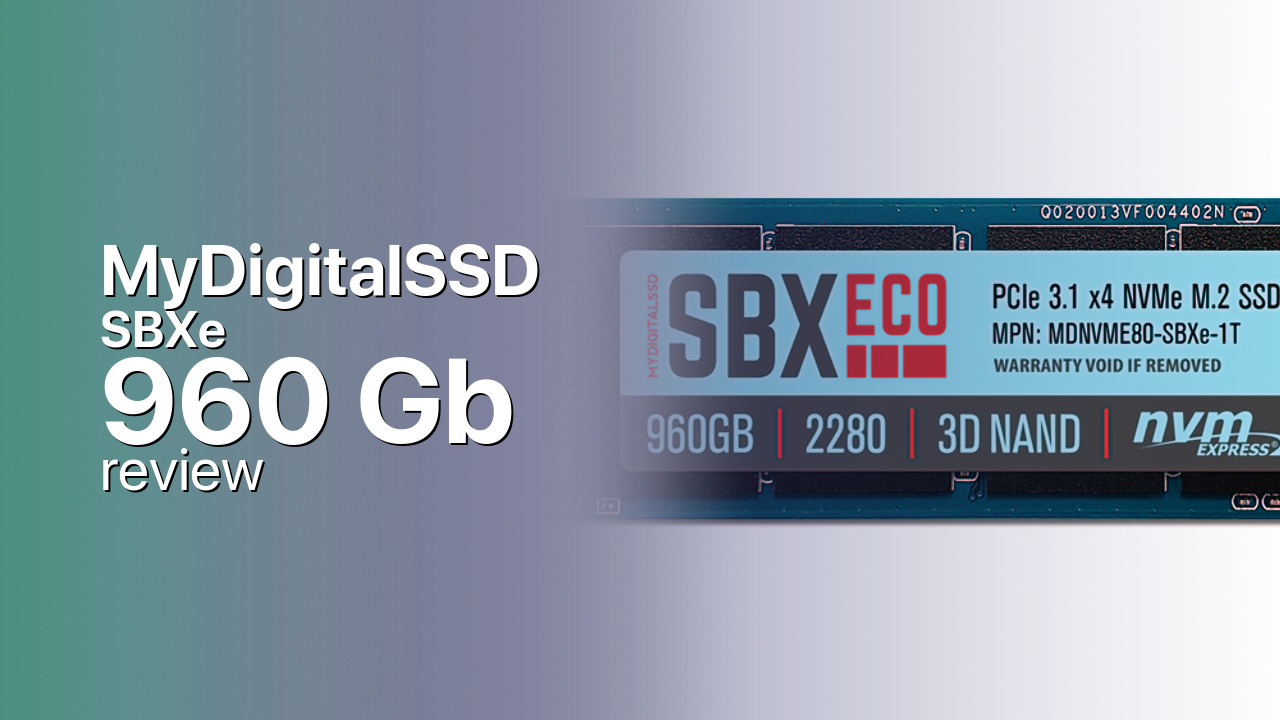
The Phison PS5013-E13T is a 4-channel DRAM-less NVMe controller built for cost efficiency. It uses NVMe 1.3's Host Memory Buffer (HMB) to borrow roughly 32-64 MB of system RAM for the flash translation layer, eliminating the need for a dedicated DRAM chip. At the 960GB capacity point all four NAND channels run at full interleave, extracting the maximum parallelism the platform can deliver: 2,500 MB/s sequential read, 2,100 MB/s sequential write, 295,000 random read IOPS, and 430,000 random write IOPS. These numbers push against the PCIe 3.0 x4 ceiling for a 4-channel design and handily outpace any SATA SSD — you're getting roughly 4.5x the sequential throughput of a 550 MB/s SATA drive.
The NAND is Toshiba BiCS3 64-layer 3D TLC, a mature and widely-deployed flash generation that MyDigitalSSD backs with a 720 TBW endurance rating — notably higher than many budget 1TB-class drives that ship with 600 TBW or less. An SLC write cache absorbs burst writes; once depleted (roughly 150-200 GB of sustained writes at the 960GB capacity), throughput falls to native TLC speeds around 500-600 MB/s. For typical consumer usage patterns — OS operation, game installs, application launches — the cache is rarely exhausted, and the real-world experience is indistinguishable from a DRAM-equipped NVMe drive.
The single-sided M.2 2280 form factor is a practical advantage: it fits every M.2 slot, including ultrathin laptops that reject double-sided PCBs. Power consumption is low, thermals are well-behaved, and the drive supports NVMe autonomous power state transitions and L1.2 idle power states for laptop battery longevity. The Phison E13T includes LDPC error correction, end-to-end data path protection, and thermal throttling.
Storage Comparisons:
SBXe Performance & Benchmarks
At 2,500/2,100 MB/s sequential and 295K/430K random IOPS, the SBXe 960GB delivers the ceiling of what the E13T platform can achieve. Sequential reads saturate the four NAND channels and push close to the PCIe 3.0 x4 practical throughput limit for a 4-channel design. Independent testing by Legit Reviews confirmed that the drive hits its rated numbers in sequential benchmarks, with CrystalDiskMark sequential results matching the 2,500/2,100 MB/s specification.
MyDigitalSSD SBXe 960 GB vs M.2 3.0 x 4 peers
Switch between sequential throughput and random IOPS to see how this drive stacks up against other M.2 3.0 x 4 SSDs in our database. The highlighted bar is the drive on this page — click any other bar to open that drive.
- ADATA SX 8800 Pro 512 GB: 3,500 MB/s read, 2,700 MB/s write
- ADATA SX 8800 Pro 1 TB: 3,500 MB/s read, 2,700 MB/s write
- ADATA XPG Spectrix S40G RGB 256 GB: 3,500 MB/s read, 3,000 MB/s write
- ADATA XPG Spectrix S40G RGB 512 GB: 3,500 MB/s read, 3,000 MB/s write
- MyDigitalSSD SBXe 960 GB (this drive): 2,500 MB/s read, 2,100 MB/s write
The HMB design shows its character in random I/O. Lightly-threaded random reads and writes — the pattern that dominates desktop and gaming workloads — feel crisp and responsive because the HMB-sourced mapping table is cached in fast system DRAM. Application launches, Windows boots, and game level loads complete in times that are effectively identical to DRAM-equipped NVMe drives at similar throughput tiers. Where the E13T falls behind is under sustained high-queue-depth mixed workloads: a DRAM-equipped 8-channel controller like the SM2262EN or Phison E12 will pull ahead when multiple VMs, database writes, or heavy content-creation scratch I/O hit the drive simultaneously. For the home/office PC, student laptop, or gaming rig that the SBXe targets, this distinction is irrelevant — the drive never sees those workload patterns.
Thermally the 960GB SBXe is well-behaved. The E13T's modest power envelope means even sustained sequential writes won't push the controller past 70-75C in a case with any airflow at all. Laptop users in particular benefit from the single-sided layout and low thermal output.
MyDigitalSSD SBXe vs Competitors
See how the SBXe stacks up against other M.2 3.0 x 4 drives in our database:
Compare with rival drives:
Endurance, TBW & Warranty
MyDigitalSSD backs the SBXe 960GB with a 5-year limited warranty and a 720 TBW endurance rating — roughly 0.41 drive-writes-per-day over the warranty period. This is competitive with and often exceeds the endurance ratings of better-known brands in the budget NVMe segment. The warranty is tied to the original purchaser and does not cover data recovery services.
MyDigitalSSD SBXe 960 GB Specifications
| Category | Value |
|---|---|
| Capacity [?] | 960 GB |
| Interface [?] | M.2 3.0 x 4 |
| Controller [?] | Phison PS5013-E13T |
| Memory type [?] | Toshiba TLC |
| DRAM [?] | HMB |
| Read speed (MB/s) [?] | 2500 |
| Write speed (MB/s) [?] | 2100 |
| Read IOPS [?] | 295000 |
| Write IOPS [?] | 430000 |
| Endurance (TBW) [?] | 720 |
| MTBF (million hours) [?] | 2000000 |
| Warranty (years) [?] | 5 |
Verdict: Is the SBXe Worth It in 2026?
The MyDigitalSSD SBXe 960GB is a straightforward value proposition: it takes the DRAM-less Phison E13T platform to its maximum capacity and extracts every bit of throughput the four-channel design can provide. The 2,500/2,100 MB/s sequential speeds and 720 TBW endurance rating make it a legitimate option for a budget high-capacity NVMe drive, and the single-sided form factor guarantees compatibility with any M.2 2280 slot. The lack of dedicated DRAM is the only real asterisk, and for the target audience — users upgrading from SATA or hard drives, building budget gaming rigs, or populating secondary M.2 slots — the HMB-based design delivers 95% of the NVMe experience at a meaningful discount. If your workload is typical consumer mixed-use and you want a near-terabyte of NVMe storage without paying for a DRAM-equipped flagship, the SBXe 960GB earns its place on the shortlist.
+ Pros
- 2,500/2,100 MB/s — ceiling performance for the 4-channel E13T platform
- 720 TBW endurance — higher than many budget competitors at similar capacity
- 430,000 random write IOPS — benefits from full 4-channel NAND interleave at 960GB
- Single-sided M.2 2280 — universal fit including Ultrabooks
- 5-year warranty — longer coverage than typical budget-drive terms
- Cool and efficient — low power draw, no heatsink required
- Cons
- DRAM-less HMB design — latency penalty under heavy mixed workloads
- Post-cache TLC write speed drops to ~500 MB/s
- Phison E13T is 4-channel — cannot match 8-channel Gen3 drives at high queue depth
- Limited brand recognition and retail availability vs. major OEMs
- No hardware encryption (TCG Opal / Pyrite)
- ~$0.09/GB at launch was competitive but not class-leading for DRAM-less
Buy this or similar SSD Storage:



Video Review
Video Unbox Técnico MyDigitalSSD M.2 NVMe BPX 480GB SSD MLC