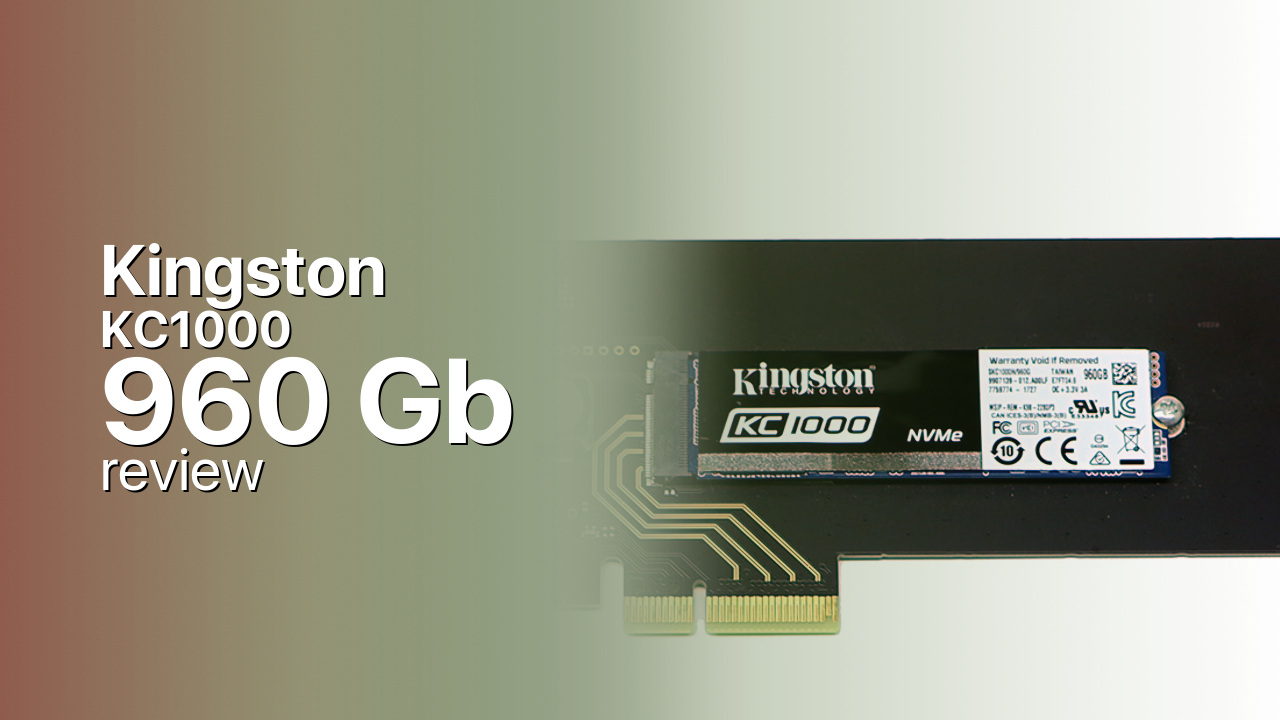
Kingston KC1000 960GB NVMe SSD Review (2026)
Quick answer
The Kingston KC1000 960GB is an end-of-life MLC NVMe SSD whose primary appeal is consistent write performance without SLC cache tricks.
Read: 2700 MB/s Write: 1600 MB/s Endurance: 101 TBW Warranty: 5 years Interface: M.2 or PCIe 3.0 x 4
The Kingston KC1000 960GB is the flagship capacity of Kingston's first-generation high-end NVMe line, offering the most space of any KC1000 model with Toshiba MLC NAND for consistent write performance.
Controller & Memory
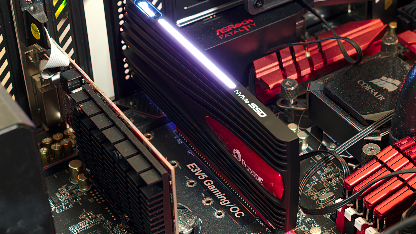
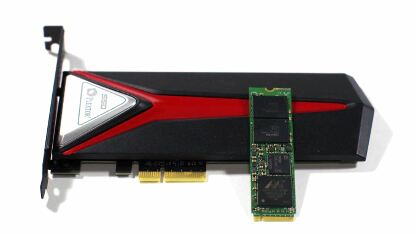
The KC1000 960 GB uses the Phison PS5007-E7 controller with Toshiba (Kioxia) MLC NAND flash and two Kingston-branded 512 MB DRAM chips. It is available in M.2 2280 or HHHL add-in card form factors on PCIe 3.0 x4.
Sequential speeds match the smaller capacities at 2,700 MB/s reads and 1,600 MB/s writes. Random IOPS are 290,000 reads and 190,000 writes. Endurance is rated at 101 TBW over a 5-year warranty -- notably lower than the 240 GB (300 TBW) and 480 GB (200 TBW) models, which is unusual and reflects Kingston's specific endurance binning for this product.
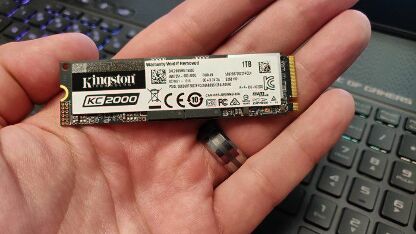
The 960 GB capacity was the largest in the KC1000 line and provides the most usable space of any MLC-based Kingston consumer NVMe SSD. It competes with the Samsung 960 Pro 1 TB (also MLC at the time) and other early high-end NVMe drives. The KC1000 was replaced by the KC2000, which uses TLC NAND but offers higher speeds and larger capacities.
Storage Comparisons:
KC1000 Performance & Benchmarks
Sequential throughput of 2,700 MB/s reads and 1,600 MB/s writes is identical across all KC1000 capacities. The 960 GB model does not gain speed from additional NAND dies. Random IOPS of 290,000 reads and 190,000 writes are also unchanged.
Kingston KC1000 960 GB vs M.2 or PCIe 3.0 x 4 peers
Switch between sequential throughput and random IOPS to see how this drive stacks up against other M.2 or PCIe 3.0 x 4 SSDs in our database. The highlighted bar is the drive on this page — click any other bar to open that drive.
- Kingston KC2000 1 TB: 3,200 MB/s read, 2,200 MB/s write
- Kingston KC2000 2 TB: 3,200 MB/s read, 2,200 MB/s write
- Plextor M9Pe Series 512 GB: 3,200 MB/s read, 2,000 MB/s write
- Plextor M9Pe Series 1 TB: 3,200 MB/s read, 2,100 MB/s write
- Kingston KC1000 960 GB (this drive): 2,700 MB/s read, 1,600 MB/s write
KitGuru reviewed the KC1000 960 GB and found it competitive with the Samsung 960 EVO and Intel 600p in their benchmark suite. The MLC NAND delivers consistent write performance without the SLC cache exhaustion that affects TLC drives. For sustained writes, the KC1000 maintains its 1,600 MB/s rated speed without dropping.
For a 2017-era NVMe SSD, the performance is solid. For a modern build, the KC2000 or KC2500 at 1 TB offers 3,200 to 3,500 MB/s reads at lower cost.
Kingston KC1000 vs Competitors
See how the KC1000 stacks up against other M.2 or PCIe 3.0 x 4 drives in our database:
Compare with rival drives:
Endurance, TBW & Warranty
Kingston rates the KC1000 960 GB at 101 TBW over its 5-year warranty, which equals roughly 55 GB of writes per day. This is lower than the endurance ratings on the 240 GB and 480 GB models and lower than the 0.3 DWPD typical of TLC drives. For a boot drive with light to moderate writes, it is adequate. Heavy write workloads should look to newer drives with higher endurance. The 2 million hour MTBF is a population reliability estimate. Kingston provides a 5-year limited warranty with free technical support.
Kingston KC1000 960 GB Specifications
| Category | Value |
|---|---|
| Capacity [?] | 960 GB |
| Interface [?] | M.2 or PCIe 3.0 x 4 |
| Controller [?] | Phison PS5007-E7 |
| Memory type [?] | Toshiba MLC |
| DRAM [?] | Kingston 2 X 512MB |
| Read speed (MB/s) [?] | 2700 |
| Write speed (MB/s) [?] | 1600 |
| Read IOPS [?] | 290000 |
| Write IOPS [?] | 190000 |
| Endurance (TBW) [?] | 101 |
| MTBF (million hours) [?] | 2 |
| Warranty (years) [?] | 5 |
Verdict: Is the KC1000 Worth It in 2026?
The Kingston KC1000 960GB is an end-of-life MLC NVMe SSD whose primary appeal is consistent write performance without SLC cache tricks. Its 101 TBW endurance is surprisingly low for a 960 GB drive and is actually the lowest in the KC1000 lineup, which limits its suitability for write-heavy use. For new purchases, the KC2000 or KC2500 at 1 TB are superior in speed, endurance, and cost per GB. The KC1000 960 GB is only worth considering at a deep discount where the MLC consistency matters.
+ Pros
- Toshiba MLC NAND with consistent writes
- 2,700 MB/s sequential reads
- 960 GB capacity on MLC
- DRAM cache (two 512 MB chips)
- No SLC cache cliff
- Available as M.2 or HHHL AIC
- Cons
- End-of-life, replaced by KC2000
- Only 101 TBW endurance, low for the capacity
- 2,700 MB/s reads, below modern NVMe drives
- 1,600 MB/s writes
- PCIe 3.0 only
- No hardware encryption
Buy this or similar SSD Storage:



Video Review
Kingston SSD NVMe PCIe 240GB - 960GB KC1000