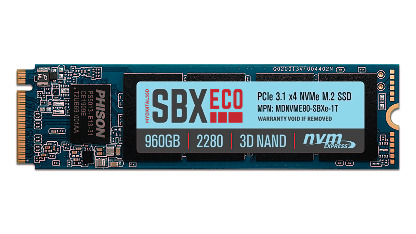
Integral Memory Ultima Pro X 960GB - PCIe 3.0 NVMe SSD (2026)
Quick answer
The Integral Memory Ultima Pro X 960 GB is a credible legacy pick for UK and European buyers who specifically want TCG Opal 2.0 hardware encryption on a PCIe 3.0 NVMe and value Integral's regional warranty support.
Read: 3300 MB/s Write: 3000 MB/s Endurance: 989 TBW Warranty: 3 years Interface: M.2 3.0 x 4
The Integral Memory Ultima Pro X 960GB is a UK-brand PCIe 3.0 NVMe built on the Phison PS5012-E12 controller with 3D TLC NAND, 1 GB DRAM cache, and TCG Opal 2.0 hardware encryption support.
Controller & Memory
The Integral Memory Ultima Pro X 960 GB pairs Phison's PS5012-E12 eight-channel PCIe 3.0 controller with 3D TLC NAND and a 1 GB DDR4 DRAM cache. The E12 was a flagship-class PCIe 3.0 controller during 2018-2020 and is the same silicon that drove early Sabrent Rocket, Corsair MP510, and Silicon Power P34A80 drives - all known for near-line-rate PCIe 3.0 performance and durable construction. The PCB is M.2 2280 with hardware encryption support via TCG Opal 2.0 and 256-bit AES, a feature absent from many newer PCIe 4.0 budget drives.
Integral Memory is a UK-headquartered storage brand (Edenbridge, Kent) with a long history in flash memory cards, USB drives, and SSDs. The Ultima Pro X line was the company's NVMe flagship during the PCIe 3.0 era, sold in 240 GB, 480 GB, 960 GB, and 1.92 TB capacities. Integral has since released the M Series Premium and P Series PCIe 4.0 ranges to replace the Ultima Pro X, so the drive is best treated as legacy or new-old-stock inventory rather than a current product. Retail availability concentrates in UK and European retailers such as Box, Scan, Mindfactory, and Amazon UK.
The Ultima Pro X 960 GB targets buyers replacing an older SATA SSD or hard drive in a PCIe 3.0 system, plus business buyers in the UK who specifically need TCG Opal 2.0 encryption for compliance or data-protection requirements. Direct rivals at the time of release were the Samsung 970 EVO 1 TB, Crucial P5 1 TB, and WD Black SN750 1 TB - all faster than the Ultima Pro X on raw benchmarks but lacking the Opal 2.0 hardware encryption that some enterprise IT environments mandate.
Storage Comparisons:
Ultima Pro X Performance & Benchmarks
Manufacturer ratings for the Ultima Pro X 960 GB land at 3,300 MB/s sequential reads and 3,000 MB/s sequential writes, with random performance up to 500,000 read and 410,000 write IOPS. Those numbers represent peak PCIe 3.0 x4 throughput, very close to the 3,500 MB/s interface ceiling. The Phison E12 controller is mature and well-characterised - it delivers consistent random-read latency at low queue depths thanks to the dedicated DRAM cache, and the 1 GB buffer keeps NTFS metadata operations responsive under sustained load.
Integral Memory Ultima Pro X 960 GB vs M.2 3.0 x 4 peers
Switch between sequential throughput and random IOPS to see how this drive stacks up against other M.2 3.0 x 4 SSDs in our database. The highlighted bar is the drive on this page — click any other bar to open that drive.
- ADATA SX 8800 Pro 512 GB: 3,500 MB/s read, 2,700 MB/s write
- ADATA SX 8800 Pro 1 TB: 3,500 MB/s read, 2,700 MB/s write
- ADATA XPG Spectrix S40G RGB 256 GB: 3,500 MB/s read, 3,000 MB/s write
- ADATA XPG Spectrix S40G RGB 512 GB: 3,500 MB/s read, 3,000 MB/s write
- Integral Memory Ultima Pro X 960 GB (this drive): 3,300 MB/s read, 3,000 MB/s write
Sustained writes hold up well for a PCIe 3.0 drive. The dynamic SLC pseudocache plus the dedicated DRAM mean the Ultima Pro X 960 GB can absorb roughly 200-300 GB of continuous writes before the cache exhausts on a near-empty drive, after which writes fall to a TLC direct-write rate around 1,200-1,500 MB/s. For boot, application, and gaming workloads on a PCIe 3.0 system the drive feels comparable to a Samsung 970 EVO 1 TB; for very large file moves the Samsung's slightly higher direct-write rate edges ahead. DirectStorage operates at PCIe 3.0 speeds rather than the higher PCIe 4.0 ceiling that current games target, so this is not a DirectStorage-optimised drive for 2026 gaming.
Integral Memory Ultima Pro X vs Competitors
See how the Ultima Pro X stacks up against other M.2 3.0 x 4 drives in our database:
Compare with rival drives:
Endurance, TBW & Warranty
Integral Memory backs the Ultima Pro X 960 GB with a three-year limited warranty and an endurance rating in the high hundreds of TBW typical of Phison E12 drives with high-quality TLC NAND. The published MTBF exceeds two million hours, in line with consumer NVMe SSDs of the era and a population statistic rather than a per-drive guarantee. TCG Opal 2.0 plus 256-bit AES hardware encryption is supported and can be paired with Windows BitLocker or third-party management software such as WinMagic or Sophos SafeGuard for enterprise compliance scenarios. Integral RMA handling runs through the company's UK support office and authorised resellers; non-UK buyers should confirm shipping logistics before purchase. The three-year warranty is shorter than the five-year terms offered by Samsung, WD, and Crucial on competing drives, which is a real consideration for long-life builds.
Integral Memory Ultima Pro X 960 GB Specifications
| Category | Value |
|---|---|
| Capacity [?] | 960 GB |
| Interface [?] | M.2 3.0 x 4 |
| Controller [?] | Phison PS5012-E12 |
| Memory type [?] | 3D TLC |
| DRAM [?] | 1,024 cache |
| Read speed (MB/s) [?] | 3300 |
| Write speed (MB/s) [?] | 3000 |
| Read IOPS [?] | 500000 |
| Write IOPS [?] | 410000 |
| Endurance (TBW) [?] | 989 |
| MTBF (million hours) [?] | 2 |
| Warranty (years) [?] | 3 |
Verdict: Is the Ultima Pro X Worth It in 2026?
The Integral Memory Ultima Pro X 960 GB is a credible legacy pick for UK and European buyers who specifically want TCG Opal 2.0 hardware encryption on a PCIe 3.0 NVMe and value Integral's regional warranty support. Anyone who can use a newer drive should look at the Crucial P5 Plus 1 TB or WD Black SN770 1 TB - both newer-generation PCIe 4.0 designs with 5-year warranties, similar capacity, and meaningfully higher peak performance. Skip the Ultima Pro X if you do not need hardware encryption and are not constrained to PCIe 3.0, since several current alternatives perform better and carry longer warranty terms. As a niche compliance-driven PCIe 3.0 NVMe at 960 GB it serves a specific buyer profile competently.
+ Pros
- 3,300 MB/s sequential reads on PCIe 3.0
- 1 GB DDR4 DRAM cache via Phison E12 controller
- TCG Opal 2.0 with 256-bit AES hardware encryption
- 500,000 IOPS rated random reads
- MTBF over 2,000,000 hours
- UK-based brand with regional warranty support
- Cons
- PCIe 3.0 only, one generation behind current drives
- Three-year warranty shorter than Samsung, WD, Crucial peers
- Discontinued, replaced by Integral M Series Premium
- No included heatsink in retail box
- Limited availability outside UK and Europe
Buy this or similar SSD Storage:



Video Review
M.2 NVMe SSD Explained - M.2 vs SSD