PNY XLR8 CS3030 1TB Review (2026)
Quick answer
The PNY XLR8 CS3030 1TB delivers top-tier PCIe 3.0 performance at a competitive price.
Read: 3500 MB/s Write: 3000 MB/s Endurance: 192 TBW Warranty: 5 years Interface: M.2 3.0 x 4
The PNY XLR8 CS3030 1TB uses the proven Phison E12 platform to hit near the PCIe 3.0 ceiling at a competitive price point.
Controller & Memory
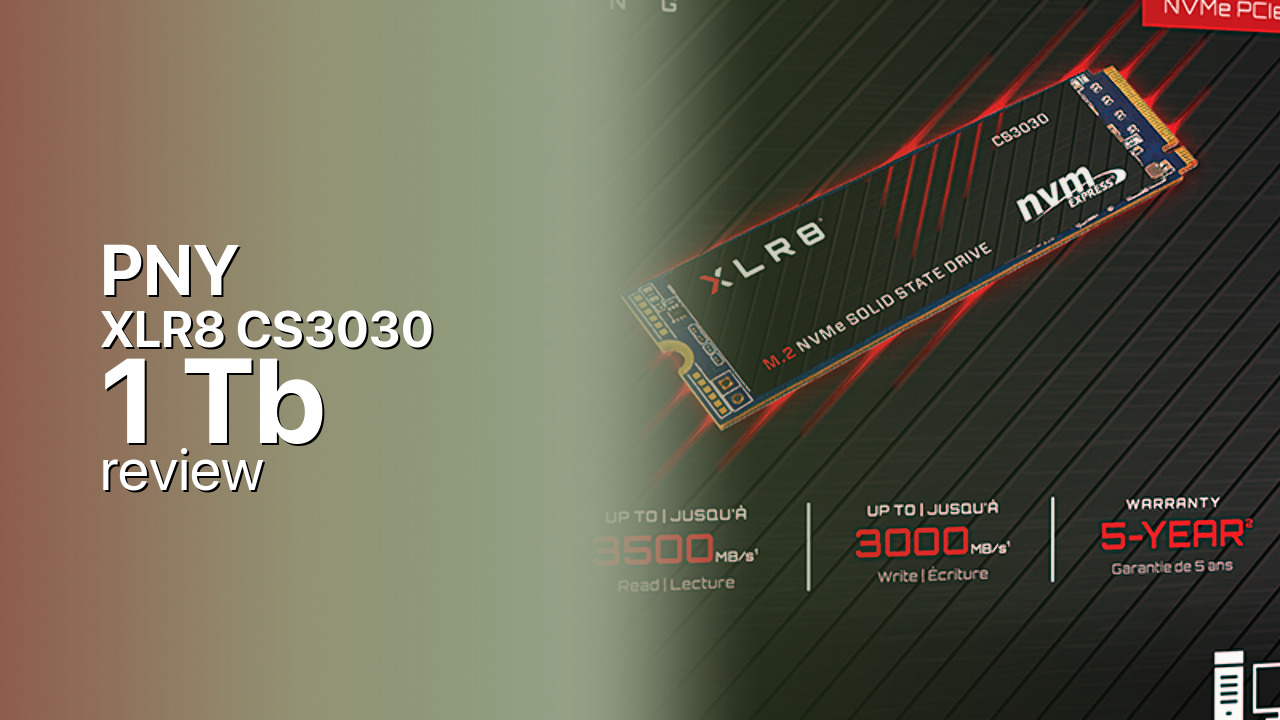
PNY designed the XLR8 CS3030 as a value-oriented performance NVMe drive. The 1TB model uses the Phison PS5012-E12 controller paired with Toshiba TLC NAND and LPDDR3/LPDDR4 DRAM, delivering 3,500 MB/s sequential reads and 3,000 MB/s writes. These speeds place it at the PCIe 3.0 x4 ceiling alongside the Samsung 970 EVO Plus and WD Black SN750.
The Phison E12 is one of the most widely used PCIe 3.0 controllers, found in drives from Sabrent, Corsair, Team Group, and many others. Its maturity means reliable firmware and consistent real-world performance. The CS3030 competes directly with the Sabrent Rocket 1TB and Silicon Power P34A80 1TB as they share the same controller platform.
The main weakness is endurance: the 1TB model is rated at only 192 TBW, significantly below competitors like the Samsung 970 EVO Plus (1,200 TBW) and WD Black SN750 (600 TBW). For typical consumer use this is adequate, but write-heavy users should take note. The drive carries a 5-year warranty.
Storage Comparisons:
XLR8 CS3030 Performance & Benchmarks
The PNY XLR8 CS3030 1TB is rated at 3,500 MB/s sequential reads and 3,000 MB/s sequential writes with 300,000 random read IOPS. These speeds match the best PCIe 3.0 drives available, confirming the Phison E12 platform as a top-tier Gen3 design. The 3,500 MB/s read speed hits the PCIe 3.0 x4 practical ceiling.
PNY XLR8 CS3030 1 TB vs M.2 3.0 x 4 peers
Switch between sequential throughput and random IOPS to see how this drive stacks up against other M.2 3.0 x 4 SSDs in our database. The highlighted bar is the drive on this page — click any other bar to open that drive.
- PNY XLR8 CS3030 1 TB (this drive): 3,500 MB/s read, 3,000 MB/s write
- ADATA SX 8800 Pro 512 GB: 3,500 MB/s read, 2,700 MB/s write
- ADATA SX 8800 Pro 1 TB: 3,500 MB/s read, 2,700 MB/s write
- ADATA XPG Spectrix S40G RGB 256 GB: 3,500 MB/s read, 3,000 MB/s write
- ADATA XPG Spectrix S40G RGB 512 GB: 3,500 MB/s read, 3,000 MB/s write
In real-world use, the CS3030 delivers performance consistent with other Phison E12 drives. Independent reviews at KitGuru, PCWorld, and TweakTown confirmed competitive benchmark results. The pseudo-SLC cache handles typical consumer write bursts, typically 20-40 GB at full speed before transitioning to native TLC speeds around 1,500-2,000 MB/s. The DRAM cache ensures consistent random I/O under mixed workloads.
For gaming, the CS3030 loads titles at speeds indistinguishable from the Samsung 970 EVO Plus. The 1TB capacity holds 8-10 modern AAA titles alongside Windows and applications. Large file transfers complete quickly within the SLC cache, and even post-cache TLC speeds are adequate for most consumer needs. The only scenario where the CS3030 may disappoint relative to competitors is in sustained write-heavy workloads where the low 192 TBW endurance rating suggests conservative NAND provisioning.
PNY XLR8 CS3030 vs Competitors
See how the XLR8 CS3030 stacks up against other M.2 3.0 x 4 drives in our database:
Compare with rival drives:
Endurance, TBW & Warranty
PNY backs the XLR8 CS3030 with a 5-year warranty. The 1TB model is rated at 192 TBW endurance, which is notably lower than competitors. The Samsung 970 EVO Plus 1TB offers 1,200 TBW and the WD Black SN750 1TB offers 600 TBW. Writing 20 GB per day would take over 26 years to reach 192 TBW, so typical consumer use is well within limits.
The 5-year warranty duration matches the industry standard. PNY handles warranty through its regional support network. The 2 million hour MTBF rating is standard for consumer drives. The low TBW relative to capacity suggests PNY may have reduced NAND over-provisioning to hit a lower price point, which is a reasonable trade-off for the target market.
PNY XLR8 CS3030 1 TB Specifications
| Category | Value |
|---|---|
| Capacity [?] | 1 TB |
| Interface [?] | M.2 3.0 x 4 |
| Controller [?] | Phison PS5012-E12 |
| Memory type [?] | Toshiba TLC |
| DRAM [?] | LPDDR3 or LPDDR4 |
| Read speed (MB/s) [?] | 3500 |
| Write speed (MB/s) [?] | 3000 |
| Read IOPS [?] | 300000 |
| Write IOPS [?] | 500000 |
| Endurance (TBW) [?] | 192 |
| MTBF (million hours) [?] | 2 |
| Warranty (years) [?] | 5 |
Verdict: Is the XLR8 CS3030 Worth It in 2026?
The PNY XLR8 CS3030 1TB delivers top-tier PCIe 3.0 performance at a competitive price. The 3,500/3,000 MB/s speeds match Samsung and WD, and the Phison E12 platform is proven and reliable. Buy it if you want near-maximum Gen3 speeds at the best price available and your workloads are typical consumer use.
Skip it if you need high endurance for write-heavy workloads like video editing or database use, because the 192 TBW rating is well below competitors. Consider the Sabrent Rocket 1TB or Samsung 970 EVO Plus for better endurance at a modest price premium. The CS3030 is an excellent value for gaming and general desktop use where the endurance limitation rarely matters.
+ Pros
- 3,500/3,000 MB/s at the PCIe 3.0 ceiling
- Phison E12 — proven, mature controller platform
- DRAM cache for consistent random I/O
- 5-year warranty
- Competitive pricing among performance NVMe drives
- Cons
- 192 TBW endurance well below competitors (600-1,200 TBW)
- Limited NAND over-provisioning for the price
- No dedicated SSD management software
- Write IOPS not specified by manufacturer
Buy this or similar SSD Storage:



Video Review
PNY XLR8 CS3030 review: An incredibly fast M.2 NVMe drive | TotallydubbedHD