Crucial P3 Plus 1TB Review — A Budget PCIe 4.0 QLC NVMe SSD (2026)
Quick answer
The Crucial P3 Plus 1 TB is the drive you buy when the budget is tight, the workload is read-heavy, and PCIe 4.0 on the box matters more than PCIe 4.0 in practice.
Read: 5000 MB/s Write: 3600 MB/s Endurance: 220 TBW Warranty: 5 years Interface: M.2 4.0 x 4
The Crucial P3 Plus 1 TB is a PCIe 4.0 drive built to a price, not a performance target — it uses QLC NAND and a DRAM-less HMB design to undercut TLC competitors, and that cost-saving calculus shapes everything about it.
Controller & Memory
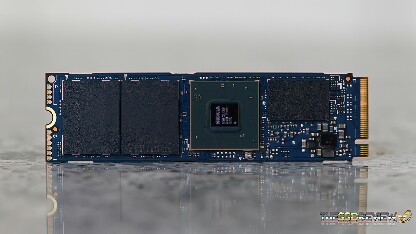
The Crucial P3 Plus uses the Phison PS5021-E21T controller — a DRAM-less, four-channel PCIe 4.0 design — paired with Micron 176-layer QLC (quad-level cell) NAND and no onboard DRAM. Instead of a dedicated buffer, the E21T relies on Host Memory Buffer (HMB) via NVMe 1.4, borrowing up to 64 MB of system RAM to store its flash translation layer mapping table. This is the same controller and NAND combination found in the Corsair MP600 Core XT, Silicon Power UD90, and other entry-level Gen4 drives. The P3 Plus uses a single-sided M.2 2280 PCB, which fits into thin laptops and ultrabooks — one of the few physical advantages it holds over double-sided alternatives.
Crucial markets the P3 Plus as an affordable PCIe 4.0 upgrade, and on read-heavy metrics it delivers: 5,000 MB/s sequential reads saturate PCIe 3.0 systems and provide a tangible improvement over SATA SSDs. The write side is where QLC and the four-channel controller show their limits. The rated 3,600 MB/s sequential write is a pSLC-cached burst figure — once the dynamic cache fills, which happens after roughly 100 to 280 GB depending on free space, direct-to-QLC writes collapse to approximately 100 to 200 MB/s. That is slower than a mechanical hard drive in sequential transfers, and it is the single most important limitation to understand before buying. For a game library drive where writes are dominated by large Steam downloads that fit within the cache, the P3 Plus is adequate. For an OS drive with constant background writes, a video editing scratch disk, or any workload that regularly exceeds the cache, it is the wrong tool.
The 1 TB P3 Plus carries a 220 TBW endurance rating — approximately one-third of what a comparable TLC drive like the WD Black SN770 (600 TBW) offers. This is the trade-off for QLC's higher bit density and lower manufacturing cost. Crucial backs it with a 5-year warranty, which is generous for the price tier, but the low TBW means heavy writers will exhaust the warranty endurance before the five years are up. The P3 Plus competes against the WD Black SN770 (TLC, DRAM-less, 5,150 MB/s, 600 TBW — a stronger buy at similar prices), the TeamGroup MP44L (TLC, DRAM-less, similar speed, 600 TBW), and the Samsung 990 EVO (TLC/QLC hybrid, DRAM-less, 5,000/4,200 MB/s, 600 TBW). Among these, the P3 Plus is rarely the best performer, but it is frequently the cheapest, and for a secondary storage drive that is mostly read from, cheap matters.
Storage Comparisons:
P3 Plus Performance & Benchmarks
The Crucial P3 Plus 1 TB is rated for 5,000 MB/s sequential reads and 3,600 MB/s sequential writes, with random performance of up to 650,000 IOPS reads and 800,000 IOPS writes. The read number is competitive for a budget Gen4 drive and fully saturates a PCIe 3.0 x4 link, which is the platform most P3 Plus buyers will be using. The write number is almost entirely dependent on the state of the pSLC cache: when the cache is available, writes sustain 3,600 MB/s for transfers up to roughly 100 to 280 GB (the dynamic cache size shrinks as the drive fills). Once the cache exhausts, direct-to-QLC writes drop sharply to approximately 100 to 200 MB/s — the inherent limitation of writing four bits per cell without the speed boost of pseudo-SLC buffering.
Crucial P3 Plus 1 TB vs M.2 4.0 x 4 peers
Switch between sequential throughput and random IOPS to see how this drive stacks up against other M.2 4.0 x 4 SSDs in our database. The highlighted bar is the drive on this page — click any other bar to open that drive.
- Patriot Viper PV593 1 TB: 14,500 MB/s read, 14,000 MB/s write
- Patriot Viper PV593 2 TB: 14,500 MB/s read, 14,000 MB/s write
- Patriot Viper PV593 4 TB: 14,500 MB/s read, 14,000 MB/s write
- Patriot Viper PV573 2 TB: 14,000 MB/s read, 12,000 MB/s write
- Crucial P3 Plus 1 TB (this drive): 5,000 MB/s read, 3,600 MB/s write
This cache-dependent behavior defines the P3 Plus experience. For a typical consumer workload — installing a game from Steam, copying a video file, migrating documents from an old drive — the cache is large enough that most transfers complete at full speed. The problem arises when the drive is more than roughly 75 percent full, at which point the dynamic cache shrinks and the QLC write cliff arrives sooner. Large sustained writes under those conditions can dip below hard-drive speeds, which is a poor experience for a drive marketed as PCIe 4.0. Independent reviewers at Tom's Hardware and PCMag characterized the P3 Plus as a competent drive for light-duty use that becomes frustrating under heavy write workloads. Thermally, the DRAM-less E21T runs cool — peak temperatures in the mid-60s Celsius without a heatsink — which makes it a good fit for laptops where power efficiency and thermal headroom are limited. For the PS5, the P3 Plus is technically compatible in terms of form factor, but the 5,000 MB/s read speed falls below Sony's 5,500 MB/s recommendation, so it may be flagged as potentially insufficient by the console's speed test.
Crucial P3 Plus vs Competitors
See how the P3 Plus stacks up against other M.2 4.0 x 4 drives in our database:
Compare with rival drives:
Endurance, TBW & Warranty
Crucial backs the P3 Plus 1 TB with a 5-year limited warranty and an endurance rating of 220 TBW. At 220 TBW, the drive is rated to absorb roughly 120 GB of writes per day for the five-year warranty period. This is low by TLC standards — the WD Black SN770 1 TB offers 600 TBW at a similar price, and even the entry-level TeamGroup MP44L manages 600 TBW — but it reflects the inherent write-endurance limitation of QLC NAND. At a typical consumer workload of 20 to 30 GB per day, the 220 TBW rating translates to roughly 20 to 30 years of usable life, so light-duty users will never approach the limit. Heavy writers — video editors, database users, anyone running VMs with significant write activity — should look to a TLC alternative. The TBW scales with capacity: 220 TBW for 1 TB, 440 TBW for 2 TB, and approximately 880 TBW for 4 TB. The MTBF is rated at 1.5 million hours. Crucial, as a Micron subsidiary, has robust warranty infrastructure, and the 5-year coverage period is longer than the 3 years offered by some budget competitors.
Crucial P3 Plus 1 TB Specifications
| Category | Value |
|---|---|
| Capacity [?] | 1 TB |
| Interface [?] | M.2 4.0 x 4 |
| Controller [?] | Phison E21T |
| Memory type [?] | Micron QLC |
| DRAM [?] | (HMB) |
| Read speed (MB/s) [?] | 5000 |
| Write speed (MB/s) [?] | 3600 |
| Read IOPS [?] | 650000 |
| Write IOPS [?] | 800000 |
| Endurance (TBW) [?] | 220 |
| MTBF (million hours) [?] | 1500000 |
| Warranty (years) [?] | 5 |
Verdict: Is the P3 Plus Worth It in 2026?
The Crucial P3 Plus 1 TB is the drive you buy when the budget is tight, the workload is read-heavy, and PCIe 4.0 on the box matters more than PCIe 4.0 in practice. It works well as a secondary game library, a media storage drive, or a boot drive for a light-use office PC where writes are infrequent and the 5-year Crucial warranty provides peace of mind. Skip it if your workload involves regular large writes — video editing, 4K capture, database work, or heavy swap — where the QLC write cliff and 220 TBW endurance ceiling become real problems. For similar or slightly more money, the WD Black SN770 1 TB offers TLC NAND, 5,150 MB/s reads, and 600 TBW endurance, making it a meaningfully better drive for most users. The P3 Plus's value is in being the cheapest PCIe 4.0 NVMe from a tier-one brand, and for buyers who understand and accept the QLC trade-offs, that is enough.
+ Pros
- 5,000 MB/s reads — enough to saturate PCIe 3.0 and feel fast in daily use
- Often the cheapest PCIe 4.0 NVMe from a tier-one brand
- 5-year warranty backed by Micron subsidiary Crucial
- Runs cool and power-efficient — good for laptops
- Single-sided PCB fits thin and light notebooks
- Available up to 4 TB for affordable high-capacity storage
- Cons
- QLC NAND: sustained writes drop to 100-200 MB/s after pSLC cache fills
- 220 TBW endurance is 2-3x lower than comparable TLC drives
- DRAM-less HMB design can cause stutters in write-heavy multitasking
- Performance degrades noticeably when drive exceeds 75% capacity
- Below Sony PS5 recommended speed — may fail console speed test
- WD Black SN770 and TeamGroup MP44L are objectively better at similar prices
Buy this or similar SSD Storage:



Video Review
$95 PCIe 4.0 NVMe SSD tested - Crucial P3 Plus 1TB Review