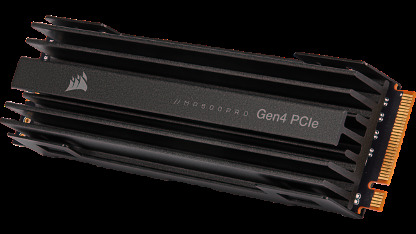
Smartbuy Impact E16 1TB SSD — In-Depth Review & Specs (2026)
Quick answer
The Smartbuy Impact E16 1TB is a capable first-generation PCIe 4.0 SSD that still holds its own in 2026 for everyday computing, gaming, and light content creation.
Read: 5000 MB/s Write: 4400 MB/s Endurance: 1650 TBW Warranty: 3 years Interface: M.2 4.0 x 4
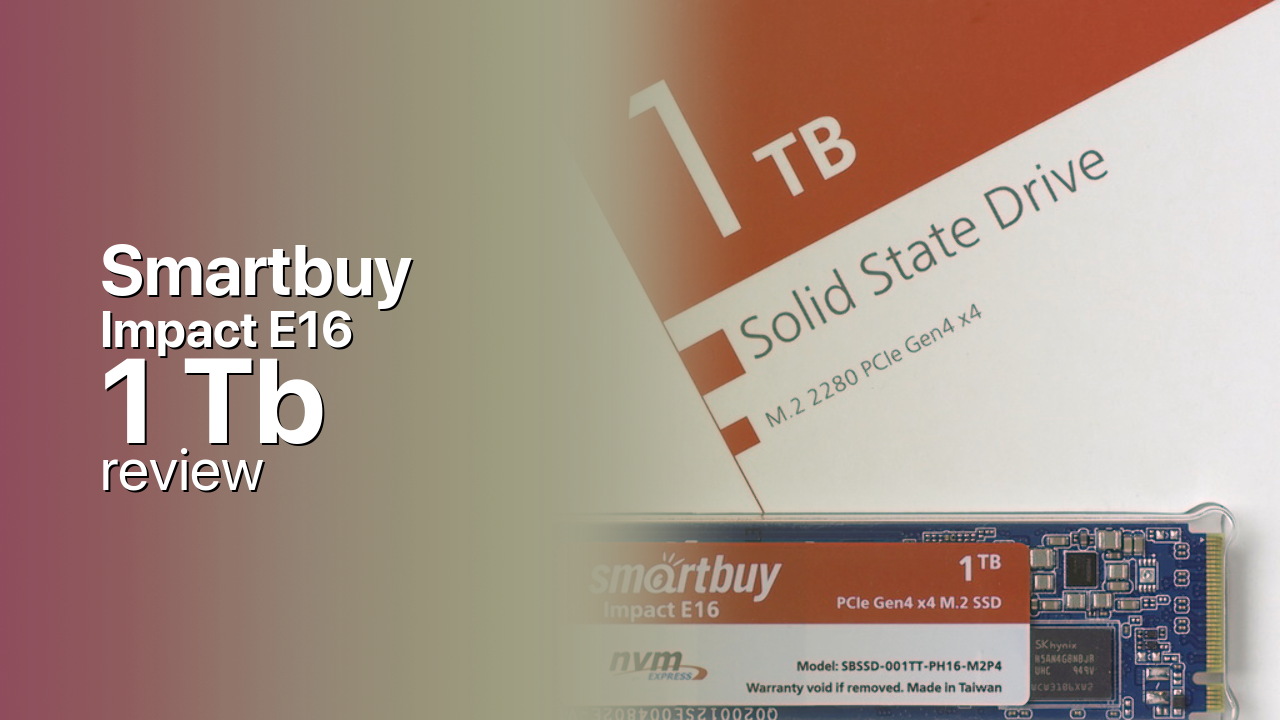
The Smartbuy Impact E16 1TB is the higher-capacity sibling in Smartbuy's first-generation PCIe 4.0 lineup. Built on the Phison PS5016-E16 reference platform with Kioxia 96-layer TLC NAND and a DDR4 DRAM buffer, it delivers up to 5,000 MB/s sequential reads and 4,400 MB/s writes — the ceiling of what the pioneering E16 controller can achieve. With 1,650 TBW of rated endurance and a single-sided M.2 2280 form factor, it is a solid entry-level Gen4 drive for the Russian and CIS markets.
Controller & Memory
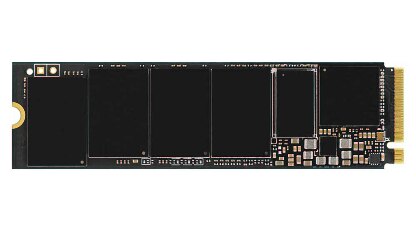
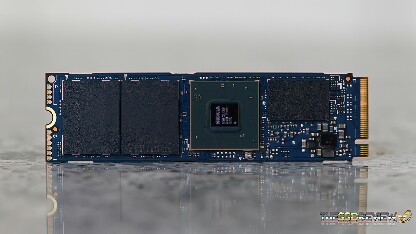
The Phison PS5016-E16 made history in 2019 as the first consumer PCIe 4.0 SSD controller. Built on a 28nm process with eight NAND channels, it broke the 3,500 MB/s Gen3 barrier but was itself limited to roughly 5,000 MB/s — a ceiling imposed by both its process node and the NVMe 1.3 protocol. The Smartbuy Impact E16 1TB pairs this controller with Kioxia (formerly Toshiba) BiCS4 96-layer TLC flash across all eight channels, plus a 1 GB DDR4 DRAM chip that caches the flash translation layer (FTL) mapping table for consistent low-latency random access. The result is a drive that feels genuinely fast in everyday use, even if it cannot touch the 7,000+ MB/s headline numbers of second-generation Gen4 controllers like the Phison E18.
Smartbuy is a household name in Russia and neighboring CIS countries, selling storage products across every form factor. The Impact E16 is not a custom design — it is a reference Phison E16 turnkey solution wearing a Smartbuy label, identical at the hardware level to the first-wave Sabrent Rocket 4.0, Corsair MP600, and Gigabyte Aorus Gen4 drives. Firmware tuning may differ slightly between brands, but the core performance envelope is the same. The 1TB model is the sweet spot of the E16 lineup: it has enough NAND dies to fully populate all eight controller channels, so both read and write speeds hit the platform maximum without the write-speed compromises seen on the 500GB variant.
Endurance is rated at 1,650 terabytes written (TBW), equivalent to roughly 0.9 drive writes per day over the 5-year warranty period. For context, a typical consumer writes 10–20 GB per day, which would take over 200 years to exhaust the rated endurance. The drive includes a graphene heat spreader and supports S.M.A.R.T. monitoring, TRIM, and secure erase.
Storage Comparisons:
Impact E16 Performance & Benchmarks
Sequential throughput lands at 5,000 MB/s read and 4,400 MB/s write in synthetic benchmarks — exactly what the E16 reference design promises. Real-world large-file transfers in Windows settle around 4,700–4,800 MB/s read and 4,000–4,200 MB/s write on a PCIe 4.0-capable platform. Random performance at 750,000 IOPS read and write slots the Impact E16 squarely into mid-pack Gen4 territory: faster than any Gen3 drive, but 20–30% behind DRAM-equipped E18-class drives in heavy queue-depth workloads.
Smartbuy Impact E16 1 TB vs M.2 4.0 x 4 peers
Switch between sequential throughput and random IOPS to see how this drive stacks up against other M.2 4.0 x 4 SSDs in our database. The highlighted bar is the drive on this page — click any other bar to open that drive.
- Patriot Viper PV593 1 TB: 14,500 MB/s read, 14,000 MB/s write
- Patriot Viper PV593 2 TB: 14,500 MB/s read, 14,000 MB/s write
- Patriot Viper PV593 4 TB: 14,500 MB/s read, 14,000 MB/s write
- Patriot Viper PV573 2 TB: 14,000 MB/s read, 12,000 MB/s write
- Smartbuy Impact E16 1 TB (this drive): 5,000 MB/s read, 4,400 MB/s write
For gaming, the drive is effectively indistinguishable from the fastest Gen4 SSDs on the market. Game level loads are overwhelmingly read-bound, and the E16's 5,000 MB/s reads are far beyond what any current game engine can saturate. The 1TB capacity is roomy enough for Windows, a suite of productivity applications, and five to eight modern AAA titles. Power consumption peaks at roughly 6.5 W under full sequential load and settles under 1 W at idle. The graphene heat spreader keeps the controller in the 65–72°C range during sustained writes, safely below the ~85°C thermal throttle threshold.
Smartbuy Impact E16 vs Competitors
See how the Impact E16 stacks up against other M.2 4.0 x 4 drives in our database:
Compare with rival drives:
Endurance, TBW & Warranty
Smartbuy typically provides a 3-year limited warranty for SSD products sold through authorized Russian and CIS distributors. Warranty coverage may not extend to purchases made outside these regions. The 1,650 TBW endurance rating serves as the warranty's write limit — exceeding it voids coverage. Verify warranty terms with your seller before purchasing, especially if buying internationally.
Smartbuy Impact E16 1 TB Specifications
| Category | Value |
|---|---|
| Capacity [?] | 1 TB |
| Interface [?] | M.2 4.0 x 4 |
| Controller [?] | Phison PS5016-E16 |
| Memory type [?] | Kioxia 96L TLC |
| DRAM [?] | DDR4 |
| Read speed (MB/s) [?] | 5000 |
| Write speed (MB/s) [?] | 4400 |
| Read IOPS [?] | 750000 |
| Write IOPS [?] | 750000 |
| Endurance (TBW) [?] | 1650 |
| MTBF (million hours) [?] | 1.7 |
| Warranty (years) [?] | 3 |
Verdict: Is the Impact E16 Worth It in 2026?
The Smartbuy Impact E16 1TB is a capable first-generation PCIe 4.0 SSD that still holds its own in 2026 for everyday computing, gaming, and light content creation. The Phison E16 platform is mature and well-tested, Kioxia NAND is top-tier, and the 1,650 TBW endurance rating means you will almost certainly retire the drive for capacity reasons long before it wears out. The main caveat is price — in 2026, a DRAM-less second-generation Gen4 drive like the WD Blue SN580 or Crucial P3 Plus can match or beat the Impact E16 in real-world performance while consuming less power and costing less. If you find the Impact E16 at a steep discount on the Russian market, it is a safe and dependable pick. If you are paying new-retail prices in any other region, there are better options available.
+ Pros
- Full 5,000/4,400 MB/s across all eight NAND channels
- DDR4 DRAM buffer ensures consistent random I/O latency
- Strong 1,650 TBW endurance rating
- Kioxia 96L TLC from a premier NAND manufacturer
- Single-sided M.2 2280 fits nearly any laptop or desktop
- Cons
- 28nm E16 controller is less efficient than modern 12nm alternatives
- Capped at ~5,000 MB/s — half the speed of current Gen4 flagships
- Limited warranty coverage outside Russia and CIS markets
- No hardware encryption support
- Graphene heat spreader is marginal for sustained heavy writes
Buy this or similar SSD Storage:



Video Review
SSD Smartbuy Impact E16 500Gb SBSSD-500GT-PH16-M2P4