Intel SSD 760P 1TB NVMe SSD Review (2026)
Quick answer
The Intel 760P 1 TB is a well-balanced mainstream NVMe SSD that combines enough capacity for a full OS-plus-games setup with competitive PCIe 3.0 speeds and a generous 576 TBW endurance rating.
Read: 3230 MB/s Write: 1625 MB/s Endurance: 576 TBW Warranty: 5 years Interface: M.2 3.0 x 4
The Intel 760P 1TB is the capacity where Intel's mainstream NVMe line becomes a genuine all-rounder, combining flagship-tier throughput with enough space for OS, applications, and a game library.
Controller & Memory
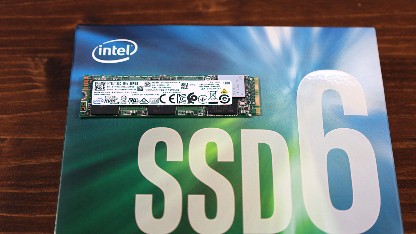
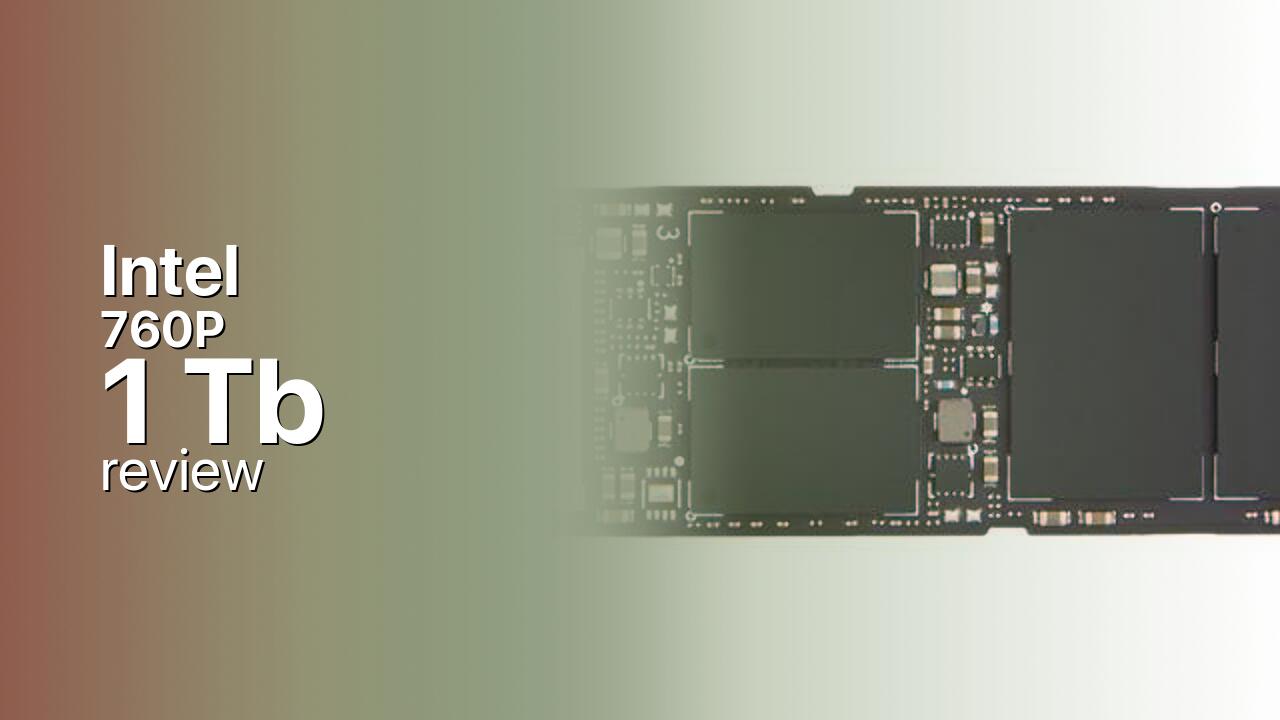
The 1 TB 760P uses the same Intel-customized Silicon Motion SM2262 eight-channel controller and 64-layer Intel 256 Gb 3D TLC NAND as the rest of the series. A Micron DDR3 DRAM chip serves the flash translation layer. Unlike the 512 GB and smaller models, the 1 TB uses a double-sided M.2 2280 PCB with NAND packages on both sides.
Sequential speeds match the 512 GB flagship at 3,230 MB/s reads and 1,625 MB/s writes, along with 340,000 read IOPS and 275,000 write IOPS. The extra capacity does not buy additional peak speed, but it does double the endurance to 576 TBW and provides a much larger SLC write cache for sustained transfers.
The 760P 1 TB competes with PCIe 3.0 mainstream drives like the Samsung 970 EVO 1 TB, ADATA SX8200 Pro 1 TB, and Western Digital Black SN750 1 TB. All of these drives offer similar peak reads; the differentiators are sustained write behavior, firmware maturity, and pricing at time of purchase.
Storage Comparisons:
760P Performance & Benchmarks
Sequential read throughput holds at 3,230 MB/s and writes at 1,625 MB/s, identical to the 512 GB model. The 1 TB does not gain peak speed from additional NAND dies -- the 512 GB already has enough parallelism to saturate the controller's capabilities. Where the extra capacity helps is in the SLC cache size: the 1 TB model allocates a much larger pseudo-SLC region, so sustained writes maintain peak speed for longer before dropping to native TLC throughput.
Intel 760P 1 TB vs M.2 3.0 x 4 peers
Switch between sequential throughput and random IOPS to see how this drive stacks up against other M.2 3.0 x 4 SSDs in our database. The highlighted bar is the drive on this page — click any other bar to open that drive.
- ADATA SX 8800 Pro 512 GB: 3,500 MB/s read, 2,700 MB/s write
- ADATA SX 8800 Pro 1 TB: 3,500 MB/s read, 2,700 MB/s write
- ADATA XPG Spectrix S40G RGB 256 GB: 3,500 MB/s read, 3,000 MB/s write
- ADATA XPG Spectrix S40G RGB 512 GB: 3,500 MB/s read, 3,000 MB/s write
- Intel 760P 1 TB (this drive): 3,230 MB/s read, 1,625 MB/s write
Random IOPS land at 340,000 reads and 275,000 writes, again matching the 512 GB. In practice, the 1 TB model is the better choice for anyone doing video editing, large game installs, or regular file transfers, not because it is faster at peak but because the larger cache delays the inevitable post-cache slowdown.
AnandTech's testing of the 512 GB 760P showed competitive performance against Samsung's 960 EVO across synthetic and real-world traces, and the 1 TB variant performs equivalently at peak.
Intel 760P vs Competitors
See how the 760P stacks up against other M.2 3.0 x 4 drives in our database:
Compare with rival drives:
Endurance, TBW & Warranty
Intel rates the 760P 1 TB at 576 TBW over its 5-year warranty. That translates to roughly 316 GB of writes per day for five years -- a figure that vastly exceeds what any typical consumer drive experiences. Even a heavy user writing 100 GB per day would not exhaust the endurance within the warranty window. The 1.5 million hour MTBF is a reliability estimate across a drive population, not an individual unit guarantee. Intel handles warranty claims through its standard RMA process.
Intel 760P 1 TB Specifications
| Category | Value |
|---|---|
| Capacity [?] | 1 TB |
| Interface [?] | M.2 3.0 x 4 |
| Controller [?] | Silicon Motion SM2262 |
| Memory type [?] | Intel TLC |
| DRAM [?] | Micron 256 - 1TB DDR3 |
| Read speed (MB/s) [?] | 3230 |
| Write speed (MB/s) [?] | 1625 |
| Read IOPS [?] | 340000 |
| Write IOPS [?] | 275000 |
| Endurance (TBW) [?] | 576 |
| MTBF (million hours) [?] | 1.5 |
| Warranty (years) [?] | 5 |
Verdict: Is the 760P Worth It in 2026?
The Intel 760P 1 TB is a well-balanced mainstream NVMe SSD that combines enough capacity for a full OS-plus-games setup with competitive PCIe 3.0 speeds and a generous 576 TBW endurance rating. Builders who want a single-drive solution without the cost premium of a Samsung 970 EVO Plus will find it a practical choice. The main caveat is age: the 760P design dates to early 2018, and newer drives at the same price point may offer better sustained write performance or PCIe 4.0 compatibility for future-proofing.
+ Pros
- 3,230 MB/s sequential reads
- 1,625 MB/s sequential writes
- 576 TBW endurance rating
- Larger SLC cache than smaller capacities
- DRAM cache (Micron DDR3)
- AES 256-bit hardware encryption
- 1 TB capacity fits OS plus game library
- Cons
- Double-sided PCB may not fit some laptops
- PCIe 3.0 only, no PCIe 4.0 upgrade path
- Older 2018 design surpassed by newer drives
- No included heatsink
Buy this or similar SSD Storage:



Video Review
Intel 760p NVMe M.2 SSD - Performance on a Budget - Review