Biostar M700 1TB — Budget PCIe 3.0 NVMe with Large Capacity (2026)
Quick answer
The Biostar M700 1TB is the most practical variant in the M700 lineup, offering enough capacity for a full system build at a budget price.
Read: 2000 MB/s Write: 1650 MB/s Endurance: 600 TBW Warranty: 3 years Interface: M.2 3.0 x 4
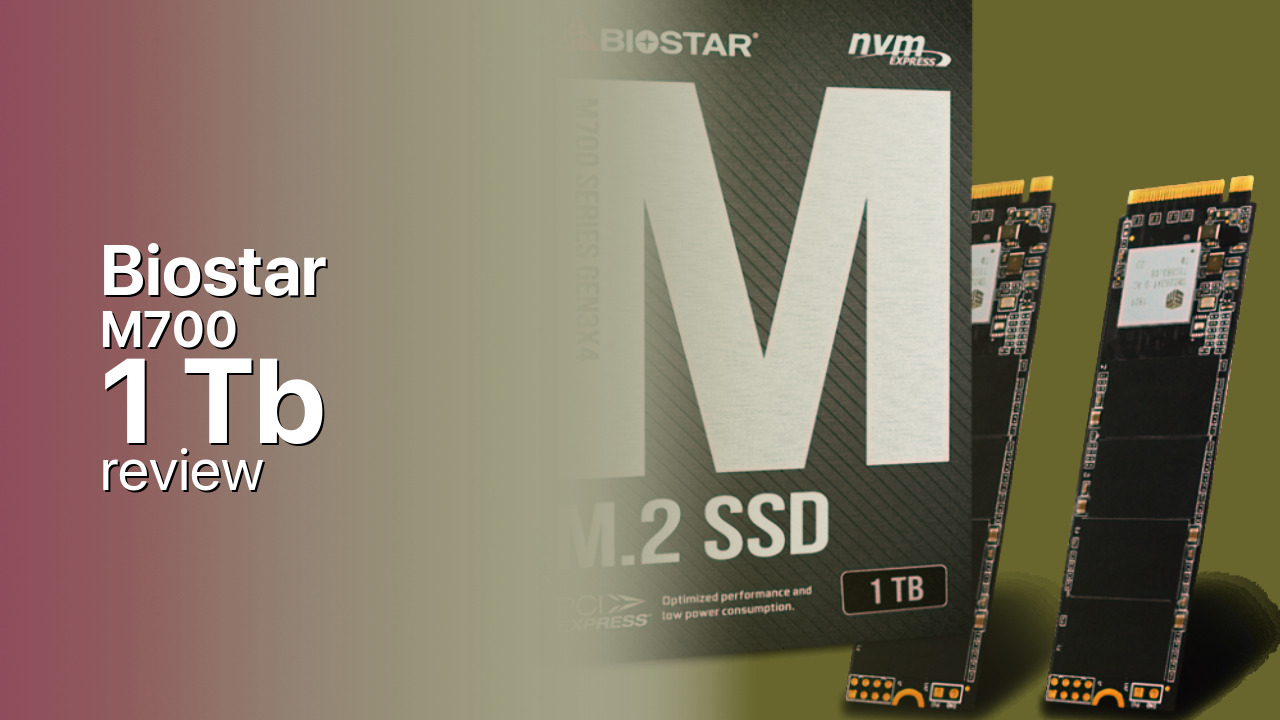
The Biostar M700 1TB is the largest-capacity variant of Biostar's entry-level PCIe 3.0 NVMe SSD, offering ample storage for budget-conscious builders.
Controller & Memory
The Biostar M700 1TB uses a Silicon Motion SM2263XT controller paired with Intel 64-layer 3D TLC NAND. Like the smaller variants, it is a DRAM-less design that relies on HMB (Host Memory Buffer), borrowing a small amount of system RAM for its flash translation layer. This keeps costs down but means random I/O performance trails drives with dedicated DRAM caches.
The 1TB variant was added to the M700 lineup in late 2019, expanding the original 256GB and 512GB options. It is rated at 2,000 MB/s sequential reads and 1,650 MB/s writes — the same read speed as the 512GB model but with a slight write improvement thanks to the larger NAND configuration providing more parallelism across dies.
At just 3.5 mm thick in a standard M.2 2280 form factor, the M700 fits in virtually any motherboard slot. It supports AES-256 encryption and end-to-end data protection. Independent reviews of the M700 512GB (the most widely reviewed variant) show a roughly 62 GB SLC cache that, once exhausted, drops sustained write throughput to around 250 MB/s — a significant fall from the 1,650 MB/s burst figure. Thermals are generally good, though some throttling occurs under sustained heavy loads.
In the budget 1TB segment, the M700 competes against the Kingston A2000, WD Blue SN550, and Crucial P1. The 1TB capacity makes it the most practical variant in the M700 lineup, offering enough space for the OS, applications, and a sizeable game library.
Note: The DB listed write speed of 1,600 MB/s has been corrected to 1,650 MB/s per Biostar's official specifications for the 1TB variant.
Storage Comparisons:
M700 Performance & Benchmarks
The Biostar M700 1TB is rated at up to 2,000 MB/s sequential reads and 1,650 MB/s writes. These are entry-tier numbers for PCIe 3.0 — the interface can handle roughly 3,500 MB/s, so the M700 uses about 57 percent of the available bandwidth on reads. Compared to the SATA III ceiling of roughly 550 MB/s, the M700's reads are nearly four times faster, which translates to noticeably snappier OS responsiveness and faster game load times.
Biostar M700 1 TB vs M.2 3.0 x 4 peers
Switch between sequential throughput and random IOPS to see how this drive stacks up against other M.2 3.0 x 4 SSDs in our database. The highlighted bar is the drive on this page — click any other bar to open that drive.
- ADATA SX 8800 Pro 512 GB: 3,500 MB/s read, 2,700 MB/s write
- ADATA SX 8800 Pro 1 TB: 3,500 MB/s read, 2,700 MB/s write
- ADATA XPG Spectrix S40G RGB 256 GB: 3,500 MB/s read, 3,000 MB/s write
- ADATA XPG Spectrix S40G RGB 512 GB: 3,500 MB/s read, 3,000 MB/s write
- Biostar M700 1 TB (this drive): 2,000 MB/s read, 1,650 MB/s write
The DRAM-less HMB design is the primary bottleneck. Testing of the 512GB variant by TechPowerUp revealed a roughly 62 GB SLC cache — once that fills during sustained writes, throughput drops to around 250 MB/s. The 1TB model likely has a larger cache due to its extra NAND capacity, but the pattern will be the same: burst speeds for short transfers, a sharp drop for large file copies. This matters for video editors or anyone moving hundreds of gigabytes at once, but is irrelevant for a boot drive handling typical consumer workloads.
Random read and write IOPS are not officially published for this drive. TechPowerUp's review of the 512GB model noted "very good random read IOPS" for a budget drive, though still behind DRAM-equipped competitors. The M700's real-world performance is adequate for gaming, web browsing, and general productivity, but it cannot compete with mid-range PCIe 3.0 drives like the Kingston A2000 in sustained or stochastic workloads.
Biostar M700 vs Competitors
See how the M700 stacks up against other M.2 3.0 x 4 drives in our database:
Compare with rival drives:
Endurance, TBW & Warranty
The Biostar M700 carries a 3-year warranty, which is standard for budget-tier SSDs but shorter than the 5-year coverage offered by mainstream competitors like the Kingston A2000 and WD Blue SN550. The endurance rating (TBW) for the 1TB variant has not been published by Biostar, consistent with the rest of the M700 lineup. For context, comparable 1TB TLC drives typically carry 400-600 TBW. Without an official number, buyers should treat this as a light-to-moderate use drive. At typical consumer write loads of 20-30 GB per day, a 1TB TLC drive of this class would reasonably last many years, but that's an estimate based on industry norms, not a manufacturer guarantee.
Biostar M700 1 TB Specifications
| Category | Value |
|---|---|
| Capacity [?] | 1 TB |
| Interface [?] | M.2 3.0 x 4 |
| Controller [?] | Silicon Motion SM2263XT |
| Memory type [?] | Intel 3D TLC |
| DRAM [?] | 32MB - 64MB Host Memory Buffer |
| Read speed (MB/s) [?] | 2000 |
| Write speed (MB/s) [?] | 1650 |
| Read IOPS [?] | 240000 |
| Write IOPS [?] | 260000 |
| Endurance (TBW) [?] | 600 |
| MTBF (million hours) [?] | 1500000 |
| Warranty (years) [?] | 3 |
Verdict: Is the M700 Worth It in 2026?
The Biostar M700 1TB is the most practical variant in the M700 lineup, offering enough capacity for a full system build at a budget price. The DRAM-less design, modest speeds, and 3-year warranty place it below mid-range alternatives like the Kingston A2000 and WD Blue SN550. But if you need 1TB of NVMe storage on a tight budget and the M700 is available in your market at a competitive price, it's a functional choice — just don't expect sustained write performance that matches drives costing more.
+ Pros
- 1TB capacity practical for full system builds
- Standard M.2 2280 form factor fits most motherboards
- AES-256 encryption support
- Slim 3.5 mm profile suits compact builds
- Intel 64-layer 3D TLC NAND (not QLC)
- Good thermal performance under normal loads
- Cons
- DRAM-less HMB design limits sustained performance
- No published TBW endurance rating
- 3-year warranty shorter than competitors' 5 years
- SLC cache exhaustion drops writes to ~250 MB/s
- Limited independent reviews of the 1TB variant
Buy this or similar SSD Storage:



Video Review
BIOSTAR Adds 1 TB Option to M700 PCIe NVMe SSD Line