Solidigm P44 Pro 512GB — PCIe 4.0 NVMe SSD Review (2026)
Quick answer
The 512 GB Solidigm P44 Pro is a premium OS drive for efficiency-conscious builders who want PCIe 4.0 performance without the thermal and power draw of hotter-running competitors.
Read: 7000 MB/s Write: 4700 MB/s Endurance: 500 TBW Warranty: 5 years Interface: M.2 4.0 x 4
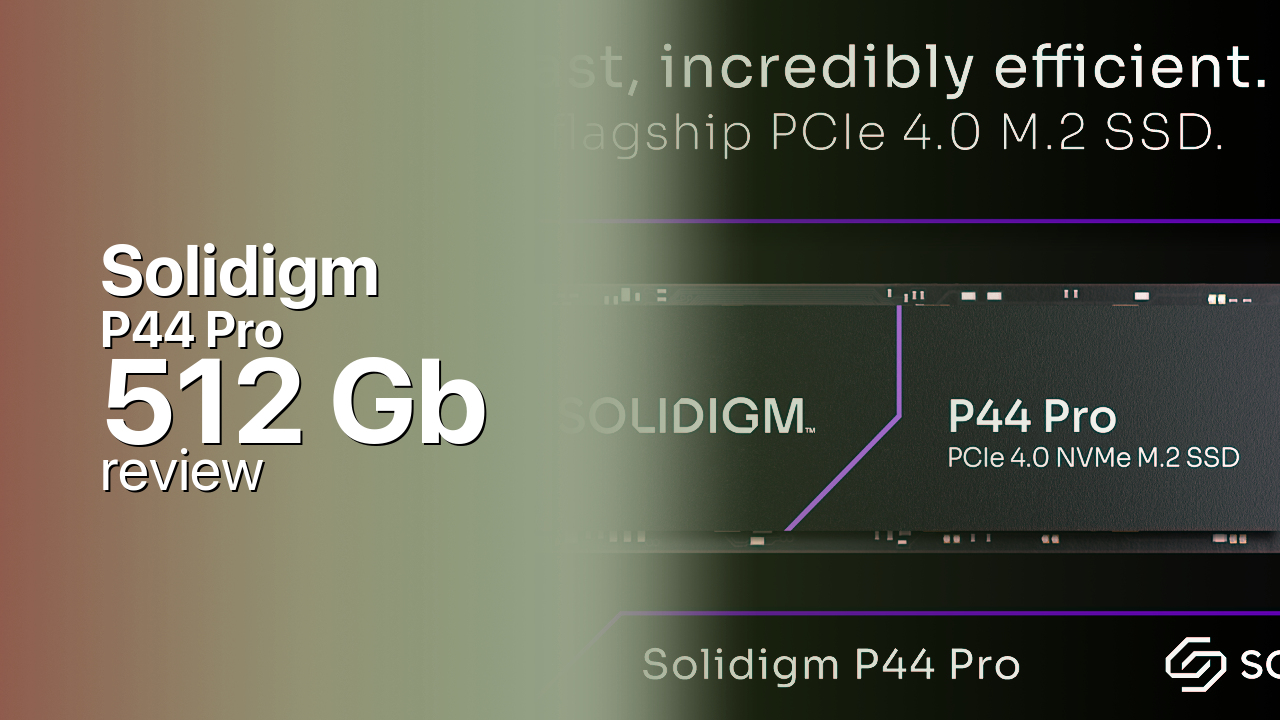
The Solidigm P44 Pro 512 GB is the platform sibling of the SK Hynix Platinum P41, sharing the same Aries controller and 176-layer TLC NAND under Solidigm branding with capacity-specific throughput that drops meaningfully from the larger variants.
Controller & Memory
Solidigm is the consumer SSD brand spun out of SK Hynix's acquisition of Intel's NAND and SSD business, and the P44 Pro represents the convergence of SK Hynix hardware with Solidigm's go-to-market strategy. Internally, the P44 Pro is identical to the SK Hynix Platinum P41: the Aries ACNS075 tri-core ARM controller on a 12 nm process, paired with SK Hynix 176-layer 3D TLC NAND and LPDDR4 DRAM. The P44 Pro and P41 are effectively the same drive sold under two brand names — a strategy that mirrors how Intel and SK Hynix co-existed in the SSD market before Intel's NAND business was fully absorbed.
The 512 GB variant is the entry point of the P44 Pro family, below the 1 TB and 2 TB capacities. Capacity scaling is significant on this platform: the 512 GB model is rated for 4,700 MB/s sequential writes versus 6,500 MB/s on the larger capacities, and random read IOPS drop from 1.4 million to 960,000. This is a direct consequence of fewer NAND dies populating the Aries controller's eight channels. The drive uses a single-sided M.2 2280 PCB with no factory heatsink — a design choice that prioritises laptop and PS5 compatibility. Endurance drops to 500 TBW on the 512 GB versus 750 TBW on the 1 TB and 1,200 TBW on the 2 TB.
The P44 Pro competes in a crowded premium PCIe 4.0 segment against the Samsung 990 Pro, WD Black SN850X, and its own SK Hynix-branded sibling. The key differentiator versus Samsung and WD is power efficiency: the Aries controller draws less power under sustained load than the Samsung Pascal or WD G2 controllers, which translates to less throttling in thermally constrained environments. Against the identically specced SK Hynix P41, the choice is purely brand and availability — Solidigm has broader distribution in some regions and occasionally more aggressive pricing as the newer brand builds market share.
Storage Comparisons:
P44 Pro Performance & Benchmarks
Solidigm rates the 512 GB P44 Pro at 7,000 MB/s sequential reads and 4,700 MB/s sequential writes, with random IOPS of 960,000 read and 1,000,000 write. The read figure matches the 1 TB and 2 TB variants because sequential reads are primarily limited by the PCIe 4.0 x4 interface rather than NAND parallelism; the Aries controller saturates the bus on all capacities. The write deficit is capacity scaling at work — fewer NAND dies to distribute writes across on the 512 GB model.
Solidigm P44 Pro 512 GB vs M.2 4.0 x 4 peers
Switch between sequential throughput and random IOPS to see how this drive stacks up against other M.2 4.0 x 4 SSDs in our database. The highlighted bar is the drive on this page — click any other bar to open that drive.
- Patriot Viper PV593 1 TB: 14,500 MB/s read, 14,000 MB/s write
- Patriot Viper PV593 2 TB: 14,500 MB/s read, 14,000 MB/s write
- Patriot Viper PV593 4 TB: 14,500 MB/s read, 14,000 MB/s write
- Patriot Viper PV573 2 TB: 14,000 MB/s read, 12,000 MB/s write
- Solidigm P44 Pro 512 GB (this drive): 7,000 MB/s read, 4,700 MB/s write
The Aries controller's efficiency advantage is the P44 Pro's standout trait. Under sustained sequential writes, independent reviews measure the P44 Pro drawing roughly 20% less power than Phison E18 competitors while delivering comparable throughput, resulting in measurably lower operating temperatures and less aggressive throttling in airflow-constrained builds. The pseudo-SLC cache on the 512 GB model is proportionally smaller than on the 1 TB variant but still comfortably absorbs typical consumer write bursts — OS updates, application installs, and game downloads rarely exceed it. For an OS and application drive, the 512 GB P44 Pro delivers premium Gen4 responsiveness with the efficiency needed for laptop deployments where every watt and degree matter.
Solidigm P44 Pro vs Competitors
See how the P44 Pro stacks up against other M.2 4.0 x 4 drives in our database:
Compare with rival drives:
Endurance, TBW & Warranty
Solidigm covers the P44 Pro 512 GB with a five-year warranty, limited by a 500 TBW endurance rating. At a typical 30 GB/day consumer write workload, the endurance budget spans roughly 46 years. The 1 TB model steps up to 750 TBW and the 2 TB reaches 1,200 TBW, maintaining approximately a 600-TBW-per-terabyte ratio. Solidigm's warranty infrastructure is backed by SK Hynix's global operations — the company benefits from the parent corporation's established supply chain and support channels while operating its own consumer-facing RMA portal. The drive carries the standard 1.5-million-hour MTBF rating common to drives using this controller platform.
Solidigm P44 Pro 512 GB Specifications
| Category | Value |
|---|---|
| Capacity [?] | 512 GB |
| Interface [?] | M.2 4.0 x 4 |
| Controller [?] | SK Hynix ACNS075 |
| Memory type [?] | SK Hynix 3D TLC |
| DRAM [?] | SK Hynix LPDDR4 |
| Read speed (MB/s) [?] | 7000 |
| Write speed (MB/s) [?] | 4700 |
| Read IOPS [?] | 960000 |
| Write IOPS [?] | 1000000 |
| Endurance (TBW) [?] | 500 |
| MTBF (million hours) [?] | 1500000 |
| Warranty (years) [?] | 5 |
Verdict: Is the P44 Pro Worth It in 2026?
The 512 GB Solidigm P44 Pro is a premium OS drive for efficiency-conscious builders who want PCIe 4.0 performance without the thermal and power draw of hotter-running competitors. Its Aries controller and 176-layer TLC deliver a polished, power-sipping experience that fits laptops and ITX builds particularly well. The 512 GB capacity imposes real constraints — 4,700 MB/s writes and 500 TBW endurance are meaningful step-downs from the 1 TB and 2 TB variants — so buyers who plan to write more than the occasional OS update or application install should strongly consider the 1 TB model. Against the Samsung 990 Pro and WD Black SN850X, the P44 Pro trades a small peak-throughput deficit for genuinely better efficiency, making it the smarter pick when thermals dictate sustained performance.
+ Pros
- 7,000 MB/s reads — PCIe 4.0 saturation on all capacities
- SK Hynix Aries controller — best-in-class power efficiency
- 176-layer TLC NAND with LPDDR4 DRAM — fully vertically integrated
- Single-sided M.2 2280 — compatible with thin laptops and PS5
- 5-year warranty backed by SK Hynix's global operations
- Cons
- 512 GB write speed capped at 4,700 MB/s vs 6,500 MB/s on larger capacities
- 500 TBW endurance — trails 1 TB and 2 TB variants proportionally
- No factory heatsink — third-party cooling needed for sustained desktop use
- Solidigm brand recognition trails Samsung and WD in consumer retail
Buy this or similar SSD Storage:



Video Review
Best SSDs for PC & Playstation 5