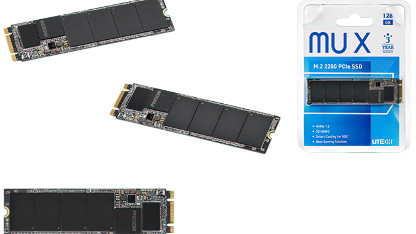
Team Group MP33 1TB - Budget PCIe 3.0 NVMe SSD (2026)
Quick answer
The Team Group MP33 1 TB is a sensible pick when budget is the dominant factor and capacity matters more than peak speed - typically as a boot or secondary drive in a value PC build, or as a replacement for a worn-out SATA SSD or hard drive in an older laptop or desktop.
Read: 1800 MB/s Write: 1500 MB/s Endurance: 240 TBW Warranty: 5 years Interface: M.2 3.0 x 4
The Team Group MP33 1TB is one of the cheapest PCIe 3.0 NVMe drives on the market - Phison PS5013-E13-31 DRAM-less controller, Toshiba 3D TLC NAND, 1,800 MB/s reads, and a five-year warranty at near-SATA SSD pricing.
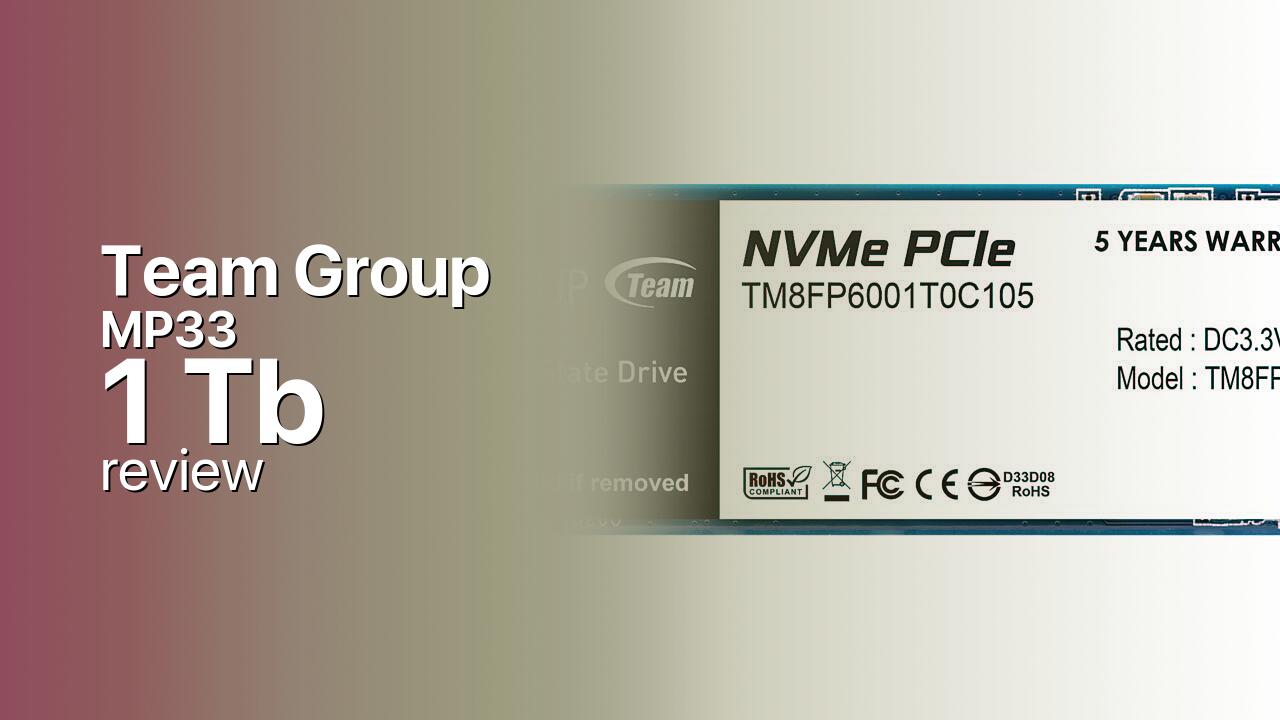
Controller & Memory
The Team Group MP33 1 TB pairs Phison's four-channel PS5013-E13-31 DRAM-less controller with Toshiba 3D TLC NAND. The E13T was Phison's budget PCIe 3.0 part - leaner and less power-hungry than the eight-channel PS5012-E12 that drove enthusiast drives of the era - and uses Host Memory Buffer (HMB) to borrow a small slice of system RAM for the logical-to-physical mapping table. The PCB is single-sided M.2 2280 which fits any modern motherboard slot. Team Group also sells an MP33 Pro variant with higher endurance and slightly different firmware; the plain MP33 on this page is the lower-cost option.
Team Group ships the MP33 in 128 GB, 256 GB, 512 GB, 1 TB, and 2 TB capacities. The 1 TB SKU on this page reaches the same 1,800 MB/s sequential read rating as the larger siblings, with random performance up to 220,000 read and 200,000 write IOPS. Team Group is a Taiwanese memory brand with strong global retail distribution through Amazon, Newegg, and major regional retailers, including a notable presence in budget gaming and DIY builder channels. The drive has been on the market since 2019 and remains in active production, which is unusual for a PCIe 3.0 budget NVMe in 2026.
The MP33 1 TB targets buyers replacing an older SATA SSD or hard drive with the cheapest possible NVMe upgrade. Its direct rivals at this capacity are the WD Blue SN570 1 TB (slightly faster, DRAM-less HMB), the Crucial P3 1 TB (PCIe 3.0 budget, slightly higher peak speeds), and the Kingston NV2 1 TB (Phison budget HMB, similar performance). Within that field the MP33 is among the lowest-cost options, with the trade-off that sequential speeds top out at 1,800 MB/s rather than the 3,000-3,500 MB/s class of the WD Blue SN570 or Samsung 970 EVO.
Storage Comparisons:
MP33 Performance & Benchmarks
Manufacturer ratings for the MP33 1 TB land at 1,800 MB/s sequential reads and 1,500 MB/s sequential writes, with random performance up to 220,000 read and 200,000 write IOPS. Those numbers sit well below the PCIe 3.0 x4 interface ceiling (around 3,500 MB/s) because the Phison E13T is a four-channel controller without the parallelism of higher-end eight-channel designs. The drive's peak read speed is roughly half of what a Samsung 970 EVO 1 TB delivers, though it remains roughly three times faster than any SATA SSD.
Team Group MP33 1 TB vs M.2 3.0 x 4 peers
Switch between sequential throughput and random IOPS to see how this drive stacks up against other M.2 3.0 x 4 SSDs in our database. The highlighted bar is the drive on this page — click any other bar to open that drive.
- ADATA SX 8800 Pro 512 GB: 3,500 MB/s read, 2,700 MB/s write
- ADATA SX 8800 Pro 1 TB: 3,500 MB/s read, 2,700 MB/s write
- ADATA XPG Spectrix S40G RGB 256 GB: 3,500 MB/s read, 3,000 MB/s write
- ADATA XPG Spectrix S40G RGB 512 GB: 3,500 MB/s read, 3,000 MB/s write
- Team Group MP33 1 TB (this drive): 1,800 MB/s read, 1,500 MB/s write
Sustained writes show the DRAM-less HMB design's expected limitation. The drive holds peak SLC-cached writes for roughly 50-80 GB of continuous transfer on a near-empty 1 TB before the cache exhausts, after which writes drop into TLC direct-write territory around 500-700 MB/s. For boot, application, and gaming workloads that profile is invisible. For sustained capture or large file moves the limit is meaningful; the WD Blue SN570 1 TB and Crucial P3 1 TB both hold higher sustained speeds. The MP33's main strength is its consistently low retail price - typically the cheapest 1 TB NVMe on Amazon and Newegg in any given month - rather than peak performance. DirectStorage operates at PCIe 3.0 speeds well below current PCIe 4.0 alternatives.
Team Group MP33 vs Competitors
See how the MP33 stacks up against other M.2 3.0 x 4 drives in our database:
Compare with rival drives:
Endurance, TBW & Warranty
Team Group backs the MP33 1 TB with a five-year limited warranty and a 240 TBW endurance budget per the manufacturer's official spec sheet. At a typical 10-20 GB/day desktop write workload that budget lasts roughly 33-65 years, well past the warranty period and any realistic service life. The Team Group MP33 Pro sibling carries a substantially higher 600+ TBW rating at the same capacity, useful for write-heavy workloads where the plain MP33's endurance feels tight. The published MTBF is 1.5 million hours, a population statistic across a fleet rather than a per-drive promise. Team Group handles consumer RMA through global retailer channels and the company's own support process at teamgroupinc.com - the experience is functional but slower than tier-one Western support. The five-year warranty matches the industry standard at this tier.
Team Group MP33 1 TB Specifications
| Category | Value |
|---|---|
| Capacity [?] | 1 TB |
| Interface [?] | M.2 3.0 x 4 |
| Controller [?] | Phison PS5013-E13-31 |
| Memory type [?] | Toshiba 3D TLC |
| DRAM [?] | No (HMB) |
| Read speed (MB/s) [?] | 1800 |
| Write speed (MB/s) [?] | 1500 |
| Read IOPS [?] | 220000 |
| Write IOPS [?] | 200000 |
| Endurance (TBW) [?] | 240 |
| MTBF (million hours) [?] | 1.5 |
| Warranty (years) [?] | 5 |
Verdict: Is the MP33 Worth It in 2026?
The Team Group MP33 1 TB is a sensible pick when budget is the dominant factor and capacity matters more than peak speed - typically as a boot or secondary drive in a value PC build, or as a replacement for a worn-out SATA SSD or hard drive in an older laptop or desktop. Buyers who can spend slightly more should look at the WD Blue SN570 1 TB or Crucial P3 1 TB instead - both PCIe 3.0 DRAM-less designs that offer higher peak read speeds (3,000-3,500 MB/s versus 1,800 MB/s) for typically only a small price premium. Skip the MP33 if your workload includes sustained writes greater than around 80 GB at a time, or if you need DRAM-equipped reliability under heavy random workloads. As a basic PCIe 3.0 NVMe at the lowest possible price the MP33 1 TB does the job with a five-year warranty.
+ Pros
- Among the cheapest 1 TB NVMe drives in any month
- 5-year limited warranty
- Phison PS5013-E13-31 controller, mature firmware
- 1.5 million-hour MTBF rating
- Single-sided 2280 PCB fits any laptop M.2 slot
- Low power consumption typical of four-channel HMB design
- Cons
- 1,800 MB/s reads roughly half of WD Blue SN570 1 TB
- 240 TBW endurance below most current peers
- DRAM-less HMB lags DRAM-equipped peers on random writes
- Sustained writes drop to ~600 MB/s after small SLC cache
- PCIe 3.0 only, two generations behind current drives
Buy this or similar SSD Storage:



Video Review
TeamGroup MP33 M.2 NVMe SSD Review