TEAMGROUP T-Force Cardea Zero 240GB Review (2026)
Quick answer
The TEAMGROUP T-Force Cardea Zero 240GB is a solid option for desktop builders seeking a reliable PCIe 3.0 NVMe upgrade from SATA, particularly if thermal management is a concern.
Read: 2600 MB/s Write: 1400 MB/s Endurance: 335 TBW Warranty: 3 years Interface: PCIe 3.0 x 4
The TEAMGROUP T-Force Cardea Zero 240GB was one of the earliest consumer PCIe 3.0 NVMe drives to prioritize thermal management with an oversized aluminum heatsink.
Controller & Memory
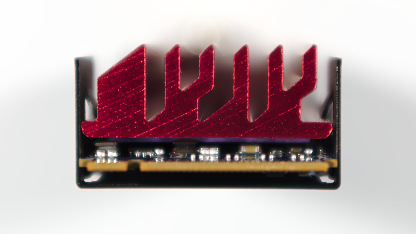
Launched in 2017 as Teamgroup's first entry into the PCIe NVMe market, the Cardea Zero 240GB pairs a Phison PS5007-11 controller with Toshiba MLC NAND. The distinguishing feature is the substantial aluminum heatsink pre-installed, which addresses one of the earliest concerns with M.2 NVMe drives: thermal throttling under sustained load. This cooling solution adds significant height, making the drive incompatible with laptops and slim M.2 slots, but it ensures consistent performance in desktop environments where vertical clearance is available.
Internally, the drive uses Nanya DDR3-1600 as DRAM cache for the controller's mapping tables. The 240GB capacity sits at the entry-level of the Cardea Zero lineup, which also included 480GB and 960GB variants. This capacity uses the same Phison PS5007-11 controller across the range, though sequential write speeds and endurance scale with higher capacities. The heatsink design is functional rather than aesthetic—it extends well beyond the PCB edges to maximize surface area for passive cooling.
The Cardea Zero targets desktop builders upgrading from SATA SSDs who want a significant performance jump without worrying about thermal management. In the 2017 market context, this was a sensible value proposition. Today, the PCIe 3.0 x4 interface remains perfectly adequate for OS boot drives, gaming libraries, and general productivity workloads. Competitors like the Samsung 960 EVO and Western Digital Black series offered similar performance without the bulky heatsink, but those drives ran warmer and were more prone to throttling in poorly ventilated cases.
Storage Comparisons:
T-Force Cardea Zero Performance & Benchmarks
The 240GB Cardea Zero is rated for up to 2,600 MB/s sequential reads and 1,400 MB/s sequential writes over a PCIe 3.0 x4 connection. This represents roughly four times the throughput of the fastest SATA SSDs, which top out around 550 MB/s. Random performance is rated at 180,000 IOPS reads and 150,000 IOPS writes, sufficient for OS responsiveness and multitasking scenarios.
Team Group T-Force Cardea Zero 240 GB vs PCIe 3.0 x 4 peers
Switch between sequential throughput and random IOPS to see how this drive stacks up against other PCIe 3.0 x 4 SSDs in our database. The highlighted bar is the drive on this page — click any other bar to open that drive.
- Asura Genesis Xtreme 256 GB: 3,400 MB/s read, 3,000 MB/s write
- Asura Genesis Xtreme 512 GB: 3,400 MB/s read, 3,000 MB/s write
- Asura Genesis Xtreme 1 TB: 3,400 MB/s read, 3,000 MB/s write
- Asura Genesis Xtreme 2 TB: 3,400 MB/s read, 3,000 MB/s write
- Team Group T-Force Cardea Zero 240 GB (this drive): 2,600 MB/s read, 1,400 MB/s write
Real-world usage shows the drive delivers on its advertised figures for burst transfers and typical consumer workloads. The Phison PS5007-11 controller was a mature, proven design in 2017, offering consistent performance without the aggressive SLC caching behavior seen in later TLC-based drives. The MLC NAND here provides more sustained write performance than TLC alternatives, as it does not rely on a small SLC cache that would exhaust during large file transfers.
For gaming, the difference between this drive and a SATA SSD is measurable but often imperceptible in actual gameplay—load times improve by seconds, not minutes. Video editors working with 4K media will see more substantial benefits from the sequential throughput. The primary performance advantage over SATA comes in file transfers, OS operations, and applications that can queue multiple I/O operations simultaneously. The heatsink ensures these performance figures remain consistent even during extended write sessions.
Team Group T-Force Cardea Zero vs Competitors
See how the T-Force Cardea Zero stacks up against other PCIe 3.0 x 4 drives in our database:
Compare with rival drives:
Endurance, TBW & Warranty
TEAMGROUP backs the Cardea Zero 240GB with a 3-year warranty and rates it for 335 TBW (terabytes written) endurance. At a typical consumer workload of 20 GB per day, this would take roughly 45 years to exhaust—far longer than the warranty coverage and the useful life of the drive. Even at a heavier 50 GB/day workload, the endurance would last around 18 years.
The 2 million hour MTBF rating is a population statistic indicating mean time between failures across a large batch of drives, not a guarantee for any individual unit. This is a standard MTBF figure for consumer NVMe SSDs from this era. The warranty terms are standard for the price segment, though premium competitors like Samsung and WD often offered 5-year warranties on similar drives.
TEAMGROUP's warranty process typically requires RMA through the retailer of purchase, depending on regional distribution agreements. The endurance rating is the limiting factor—if you exceed 335 TBW within the 3-year period, the warranty coverage ends regardless of time elapsed. For the 240GB capacity, this is a generous endurance figure thanks to the MLC NAND, which inherently handles more write cycles than TLC or QLC alternatives.
Team Group T-Force Cardea Zero 240 GB Specifications
| Category | Value |
|---|---|
| Capacity [?] | 240 GB |
| Interface [?] | PCIe 3.0 x 4 |
| Controller [?] | Phison PS5007-11 |
| Memory type [?] | Toshiba MLC |
| DRAM [?] | Nanya DDR3-1600 |
| Read speed (MB/s) [?] | 2600 |
| Write speed (MB/s) [?] | 1400 |
| Read IOPS [?] | 180000 |
| Write IOPS [?] | 150000 |
| Endurance (TBW) [?] | 335 |
| MTBF (million hours) [?] | 2 |
| Warranty (years) [?] | 3 |
Verdict: Is the T-Force Cardea Zero Worth It in 2026?
The TEAMGROUP T-Force Cardea Zero 240GB is a solid option for desktop builders seeking a reliable PCIe 3.0 NVMe upgrade from SATA, particularly if thermal management is a concern. The pre-installed heatsink ensures consistent performance without extra purchases. However, the bulk makes this drive unsuitable for laptops or compact builds, and modern PCIe 4.0 drives offer significantly better performance for similar pricing today. Buyers looking for a compact boot drive should consider a heatsink-less alternative, while those upgrading an older desktop will find this drive perfectly adequate for daily use.
+ Pros
- Pre-installed aluminum heatsink prevents thermal throttling
- Toshiba MLC NAND offers better endurance than TLC alternatives
- 335 TBW endurance rating is generous for the capacity
- Phison PS5007-11 controller provides consistent performance
- Four times faster sequential reads than SATA SSDs
- Cons
- Bulky heatsink incompatible with laptops and slim M.2 slots
- Only 3-year warranty while competitors offered 5 years
- PCIe 3.0 interface is now surpassed by PCIe 4.0 and 5.0 drives
- 240GB capacity has lower write speeds than larger variants
Buy this or similar SSD Storage:



Video Review
Best Bang for Buck PCIe 3.0 NVMe SSD? ⏩ T-Force Cardea z340 SSD Review