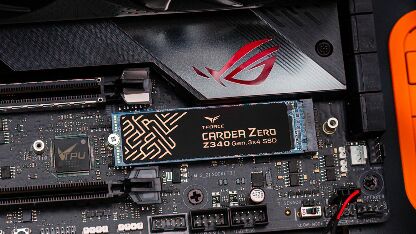
Netac 930E 240GB — Entry-Level TLC PCIe 3.0 NVMe Boot Drive (2026)
Quick answer
The Netac 930E 240 GB earns its place as a budget PCIe 3.0 boot drive by making the right call on NAND: TLC at a price where competitors are increasingly shipping QLC.
Read: 2000 MB/s Write: 1500 MB/s Endurance: 160 TBW Warranty: 3 years Interface: M.2 3.0 x 4
The Netac 930E 240GB makes a more practical case than its 120 GB sibling, offering enough TLC-backed NVMe storage to serve as a comfortable Windows boot drive without the QLC compromises found at this price point.
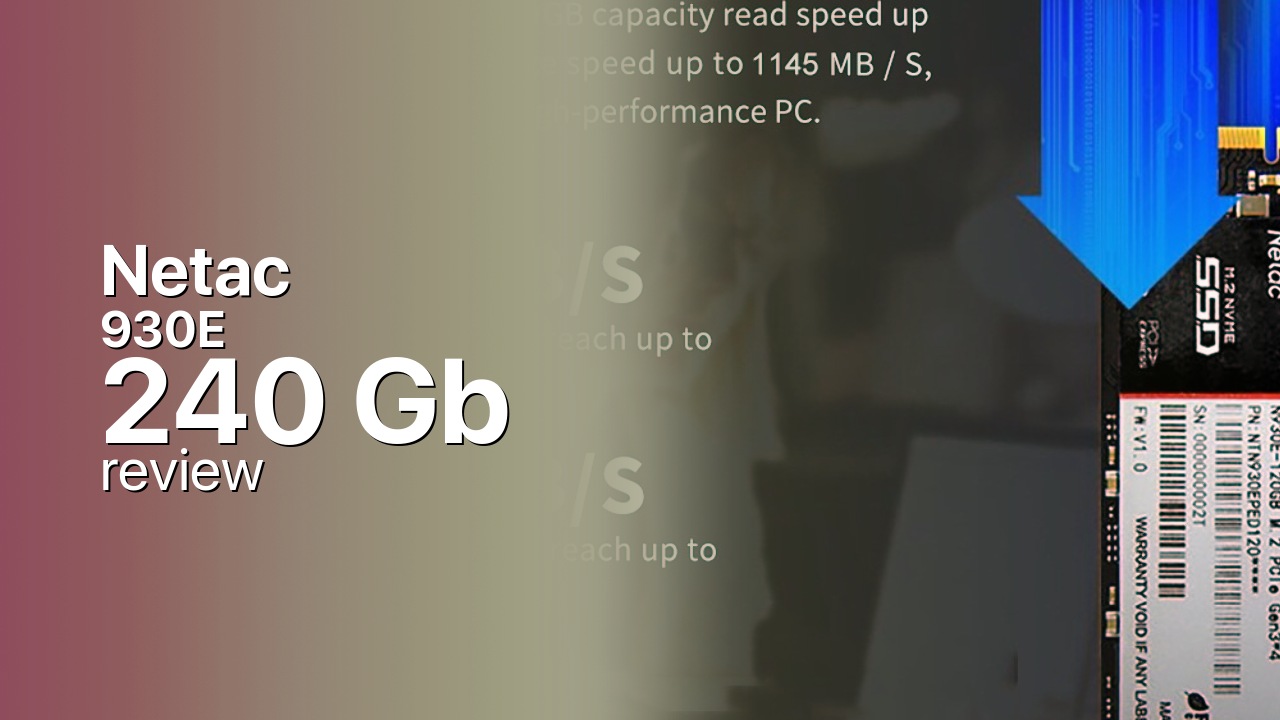
Controller & Memory
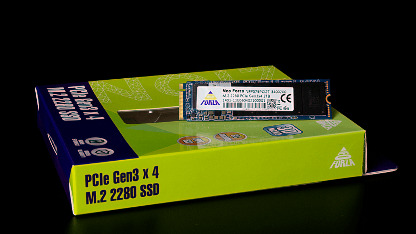
The Netac 930E (also sold as the N930E PRO) is an entry-level M.2 2280 NVMe SSD built around 3D TLC NAND and a DRAM-less controller that relies on the Host Memory Buffer for its mapping table. Netac does not publicly disclose the controller model, and independent documentation is sparse — at this price tier the controller is almost certainly a commodity four-channel design. The 240 GB capacity is the mid-range SKU in a lineup that spans 120 GB, 240 GB, 512 GB, and 1 TB. The drive uses a single-sided PCB, which ensures compatibility with thin laptops and any standard M.2 slot.
At 240 GB, formatted capacity comes to roughly 223 GB in Windows. This is enough for the operating system, essential applications, and a modest amount of user data — a workable single-drive configuration for a basic productivity machine. Users who need room for a game library or media collection should consider the 512 GB or 1 TB variants. The TLC NAND is the 930E's strongest selling point at this price tier: it avoids the severe write slowdown that QLC-based budget drives like the WD Green SN350 exhibit once their SLC cache fills, and it provides better endurance than QLC alternatives even though Netac does not publish a specific TBW rating.
In the entry-level NVMe segment the 930E competes against the Kingston NV2 250 GB, Silicon Power P34A60 256 GB, and Team Group MP33 256 GB. Against these, the 930E's 2,000 MB/s reads are lower than the NV2's 3,500 MB/s and the MP33's 1,800 MB/s depending on capacity, but the consistent TLC NAND gives it an advantage in sustained write scenarios over drives that mix TLC and QLC across production batches. The primary trade-off is brand support: Netac's warranty infrastructure is less established than Kingston's or Team Group's, and the 3-year warranty trails the competition. For a budget build where price is the overriding factor and the drive will serve as a basic system disk, the 930E 240 GB is a defensible choice built around the right NAND type for the job.
Storage Comparisons:
930E Performance & Benchmarks
Netac rates the 240 GB 930E at up to 2,000 MB/s sequential reads and 1,500 MB/s sequential writes on the PCIe 3.0 x4 interface. These figures sit well above SATA III's 560 MB/s ceiling and deliver a tangible improvement in boot times, application launches, and file transfer speeds for anyone upgrading from a SATA SSD or hard drive. Random IOPS are not published by Netac, which is typical for drives in this price bracket and generally indicates adequate rather than exceptional 4K random performance.
Netac 930E 240 GB vs M.2 3.0 x 4 peers
Switch between sequential throughput and random IOPS to see how this drive stacks up against other M.2 3.0 x 4 SSDs in our database. The highlighted bar is the drive on this page — click any other bar to open that drive.
- ADATA SX 8800 Pro 512 GB: 3,500 MB/s read, 2,700 MB/s write
- ADATA SX 8800 Pro 1 TB: 3,500 MB/s read, 2,700 MB/s write
- ADATA XPG Spectrix S40G RGB 256 GB: 3,500 MB/s read, 3,000 MB/s write
- ADATA XPG Spectrix S40G RGB 512 GB: 3,500 MB/s read, 3,000 MB/s write
- Netac 930E 240 GB (this drive): 2,000 MB/s read, 1,500 MB/s write
The 240 GB capacity provides enough NAND dies to sustain the rated sequential speeds for typical consumer workloads. Sustained write performance past the SLC write cache will settle at native TLC speeds, but for a boot drive — where writes come in short bursts during updates, installs, and file saves — the cache rarely exhausts in day-to-day use. The TLC NAND gives the 930E a meaningful advantage over QLC competitors like the WD Green SN350 after the cache fills, as QLC native write speeds can dip below 100 MB/s while TLC typically stays above 500 MB/s.
For its intended role as a budget system disk, the 930E's performance is appropriate. Windows responsiveness is driven primarily by random read latency, not peak sequential throughput, and any PCIe 3.0 NVMe drive clears the bar for a snappy user experience. The real upgrade path from the 930E is not to a faster PCIe 3.0 drive but to a 500 GB or larger SSD that provides more spare area for the controller to manage wear leveling efficiently.
Netac 930E vs Competitors
See how the 930E stacks up against other M.2 3.0 x 4 drives in our database:
Compare with rival drives:
Endurance, TBW & Warranty
Netac provides a 3-year limited warranty on the 930E, which is shorter than the 5-year coverage standard among mid-range SSD manufacturers. The TBW endurance rating is not published by Netac for this drive — a common omission for entry-level products from smaller brands that leaves buyers without a guaranteed write endurance ceiling. For a 240 GB boot drive with typical daily writes of 10 to 20 GB, the TLC NAND is unlikely to approach its endurance limit during the warranty period. The MTBF is also not published. Warranty claims go through Netac's support channels; buyers should register the product and retain proof of purchase, as the 3-year period runs from the original sale date. Given Netac's limited retail presence outside Asia, warranty turnaround times may be longer than with more established brands. Buyers who prioritize warranty coverage should consider the Kingston NV2 with its 3-year warranty and published TBW ratings.
Netac 930E 240 GB Specifications
| Category | Value |
|---|---|
| Capacity [?] | 240 GB |
| Interface [?] | M.2 3.0 x 4 |
| Controller [?] | Silicon Motion SM2263XT |
| Memory type [?] | TLC |
| DRAM [?] | HMB |
| Read speed (MB/s) [?] | 2000 |
| Write speed (MB/s) [?] | 1500 |
| Read IOPS [?] | 150000 |
| Write IOPS [?] | 200000 |
| Endurance (TBW) [?] | 160 |
| MTBF (million hours) [?] | 1500000 |
| Warranty (years) [?] | 3 |
Verdict: Is the 930E Worth It in 2026?
The Netac 930E 240 GB earns its place as a budget PCIe 3.0 boot drive by making the right call on NAND: TLC at a price where competitors are increasingly shipping QLC. It delivers the core NVMe experience — faster boots, snappier loads — without the write-cliff penalty that makes QLC system disks frustrating to live with. Skip it if you can stretch to a 500 GB-class drive with a 5-year warranty and published endurance, or if you need a single drive to handle both OS and a game library. Alternatives worth considering at a small premium include the Kingston NV2 250 GB and Team Group MP33 256 GB, both of which offer more complete documentation. For a web-browsing, document-editing PC built to a hard budget, the 930E 240 GB provides exactly what it promises: TLC-backed NVMe at the entry price.
+ Pros
- TLC NAND avoids the QLC write cliff at this price
- 2,000 MB/s sequential reads, triple SATA III speeds
- 240 GB capacity provides comfortable OS and app headroom
- Single-sided M.2 2280 PCB fits most laptops
- HMB support mitigates DRAM-less controller latency
- Cons
- Endurance TBW rating not published by manufacturer
- 3-year warranty shorter than 5-year industry standard
- No dedicated DRAM cache on any capacity
- Limited retail and warranty support outside of Asia
- Write speed modest at 1,500 MB/s for PCIe 3.0
Buy this or similar SSD Storage:



Video Review
Netac PCIe NVMe SSD - N930E PRO