PNY XLR8 CS3030 250GB NVMe SSD Review (2026)
Quick answer
The PNY XLR8 CS3030 250GB is a budget NVMe SSD with a real DRAM cache and Toshiba BiCS TLC — features that distinguish it from cheaper DRAM-less drives in the same price bracket.
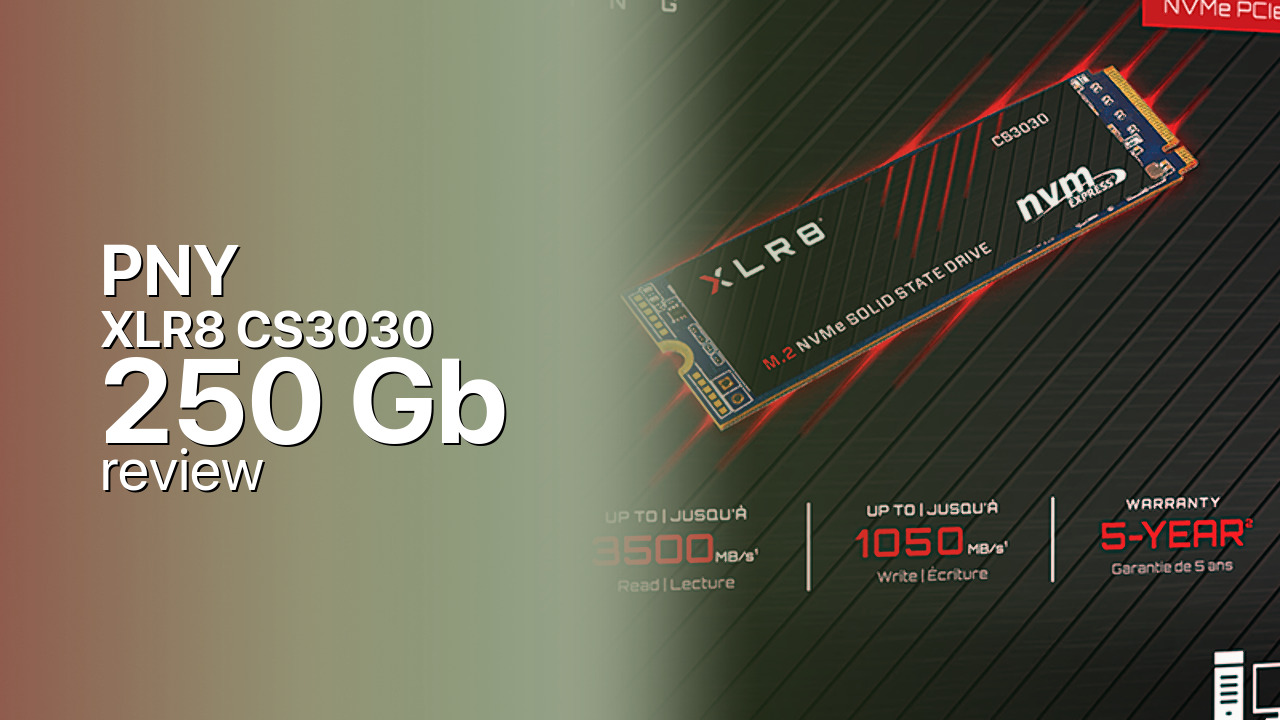
Read: 3500 MB/s Write: 1050 MB/s Endurance: 380 TBW Warranty: 5 years Interface: M.2 3.0 x 4
The PNY XLR8 CS3030 250GB pairs a Phison E12 controller with Toshiba 64L BiCS TLC to deliver 3,500 MB/s reads — a budget PCIe 3.0 NVMe drive with DRAM cache and five-year warranty.
Controller & Memory
The CS3030 250GB uses the Phison PS5012-E12 controller alongside Toshiba 64-layer BiCS3 TLC NAND and LPDDR3 DRAM. The E12 is a well-established controller that has appeared in numerous value-oriented NVMe drives, and PNY customized the firmware beyond the standard Phison reference design. The drive uses a double-sided PCB, spreading components across both sides of the board to improve thermal distribution.
The 250GB is the entry capacity in a line spanning 250GB, 500GB, 1TB, and 2TB. All capacities share the same 3,500 MB/s read speed, but writes scale sharply with capacity: the 250GB manages just 1,050 MB/s, while the 1TB and 2TB hit 3,000 MB/s. The 380 TBW endurance for 250GB is generous for the capacity. The five-year warranty is competitive for the price tier.
At launch, the CS3030 competed against other Phison E12 drives like the MyDigitalSSD BPX Pro, as well as the Samsung 970 EVO and WD Black. The E12 platform delivers strong value per dollar, even if it does not quite match the Samsung in peak performance.
Storage Comparisons:
XLR8 CS3030 Performance & Benchmarks
PNY rates the CS3030 250GB at up to 3,500 MB/s sequential reads and 1,050 MB/s sequential writes. PNY does not publish random IOPS specifications for the CS3030 series. The 1,050 MB/s write speed is the lowest in the CS3030 family — roughly one-third of the 1TB and 2TB models' 3,000 MB/s.
PNY XLR8 CS3030 250 GB vs M.2 3.0 x 4 peers
Switch between sequential throughput and random IOPS to see how this drive stacks up against other M.2 3.0 x 4 SSDs in our database. The highlighted bar is the drive on this page — click any other bar to open that drive.
- PNY XLR8 CS3030 250 GB (this drive): 3,500 MB/s read, 1,050 MB/s write
- ADATA SX 8800 Pro 512 GB: 3,500 MB/s read, 2,700 MB/s write
- ADATA SX 8800 Pro 1 TB: 3,500 MB/s read, 2,700 MB/s write
- ADATA XPG Spectrix S40G RGB 256 GB: 3,500 MB/s read, 3,000 MB/s write
- ADATA XPG Spectrix S40G RGB 512 GB: 3,500 MB/s read, 3,000 MB/s write
TweakTown's testing of the CS3030 platform found the Phison E12 delivering strong burst sequential writes and competitive random read performance at high queue depths. The controller scales well under load, posting higher IOPS at QD32 and above than some competing drives. However, the newer E12 firmware on the CS3030 showed slightly reduced sustained write performance compared to early E12 products, and the drive took longer to recover full speed after heavy workloads. For everyday desktop use, the CS3030 250GB is responsive and fast; the write speed limitation only shows during large file transfers.
PNY XLR8 CS3030 vs Competitors
See how the XLR8 CS3030 stacks up against other M.2 3.0 x 4 drives in our database:
Compare with rival drives:
Endurance, TBW & Warranty
The PNY XLR8 CS3030 250GB carries a 380 TBW endurance rating backed by a five-year limited warranty. At a typical consumer write volume of 20 to 40 GB per day, the endurance ceiling is roughly 26 to 52 years away. The 2 million hour MTBF is standard for consumer NVMe drives. The five-year warranty is strong for a budget-tier NVMe SSD and matches more expensive drives like the Samsung 970 EVO.
PNY XLR8 CS3030 250 GB Specifications
| Category | Value |
|---|---|
| Capacity [?] | 250 GB |
| Interface [?] | M.2 3.0 x 4 |
| Controller [?] | Phison PS5012-E12 |
| Memory type [?] | Toshiba TLC |
| DRAM [?] | LPDDR3 or LPDDR4 |
| Read speed (MB/s) [?] | 3500 |
| Write speed (MB/s) [?] | 1050 |
| Read IOPS [?] | 300000 |
| Write IOPS [?] | 400000 |
| Endurance (TBW) [?] | 380 |
| MTBF (million hours) [?] | 2 |
| Warranty (years) [?] | 5 |
Verdict: Is the XLR8 CS3030 Worth It in 2026?
The PNY XLR8 CS3030 250GB is a budget NVMe SSD with a real DRAM cache and Toshiba BiCS TLC — features that distinguish it from cheaper DRAM-less drives in the same price bracket. Its 1,050 MB/s write speed limits it to light workloads, but the 380 TBW endurance and five-year warranty provide durability. For a boot drive on a budget build, it is a solid pick. Buyers needing more write throughput should step up to the 500GB model at 2,000 MB/s writes or the 1TB at 3,000 MB/s.
+ Pros
- 3,500 MB/s sequential reads on PCIe 3.0
- DRAM cache (LPDDR3) — rare at this price
- Toshiba 64L BiCS3 TLC NAND
- 380 TBW endurance with five-year warranty
- Phison E12 with custom PNY firmware
- Cons
- 1,050 MB/s writes — less than half the 500GB model
- Double-sided PCB may not fit some thin laptops
- PNY does not publish random IOPS specs
- Sustained write recovery slower than early E12 drives
Buy this or similar SSD Storage:



Video Review
PNY XLR8 CS3030 250GB REVIEW ★ The best cheap NVMe in 2019!