Kioxia Exceria 250GB NVMe SSD Review (2026)
Quick answer
The Kioxia Exceria 250GB is a competent entry-level NVMe SSD that delivers 1,700 MB/s reads — a genuine upgrade from SATA — with TLC NAND and DRAM cache at a budget price.
Read: 1700 MB/s Write: 1600 MB/s Endurance: 100 TBW Warranty: 5 years Interface: M.2 3.0 x 4
The Kioxia Exceria 250GB is a mainstream PCIe 3.0 NVMe SSD built on Kioxia's own controller and Toshiba 96-layer BiCS5 TLC NAND, offering 1,700 MB/s reads at the entry-level NVMe price tier.
Controller & Memory
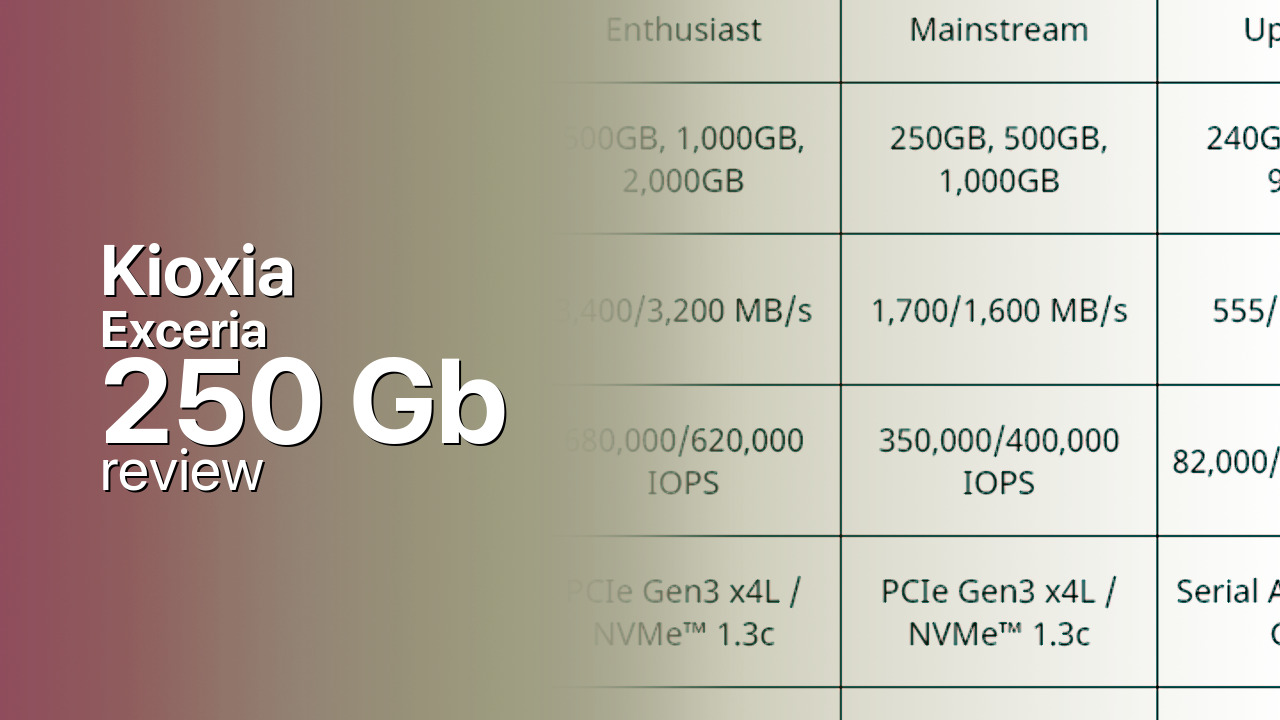
The Exceria uses Kioxia's TC58NC1202GST in-house controller — a different chip from the faster TC58NC1201GST found in the Exceria Plus. It is paired with Toshiba BiCS5 96-layer 3D TLC NAND and a 1 GB DDR4 DRAM cache with SLC caching. The mainstream positioning means lower peak speeds than the Exceria Plus: 1,700 MB/s sequential reads and 1,600 MB/s sequential writes, compared to 3,400/3,200 MB/s on the Plus model.
The 250GB model is the smallest capacity in the Exceria NVMe range, which also includes 500GB and 1TB variants. Endurance scales with capacity: 100 TBW for the 250GB model, 200 TBW for the 500GB, and 400 TBW for the 1TB. All capacities carry a five-year warranty.
At 250GB, this drive is a budget boot-drive upgrade for systems coming from SATA storage. The 1,700 MB/s read speed is roughly three times faster than SATA's 550 MB/s ceiling, which is a noticeable improvement for OS boot and application launch times. Competitors include the Kingston A2000 250GB and the Crucial P2 250GB. The Exceria's TLC NAND and DRAM cache give it an advantage over QLC-based competitors at similar prices.
Storage Comparisons:
Exceria Performance & Benchmarks
The Kioxia Exceria 250GB is rated for 1,700 MB/s sequential reads and 1,600 MB/s sequential writes, with 350K random read IOPS and 400K random write IOPS. These are entry-level PCIe 3.0 NVMe speeds — roughly three times faster than SATA in sequential reads but well below the 3,200+ MB/s that higher-end PCIe 3.0 drives achieve.
Kioxia Exceria 250 GB vs M.2 3.0 x 4 peers
Switch between sequential throughput and random IOPS to see how this drive stacks up against other M.2 3.0 x 4 SSDs in our database. The highlighted bar is the drive on this page — click any other bar to open that drive.
- ADATA SX 8800 Pro 512 GB: 3,500 MB/s read, 2,700 MB/s write
- ADATA SX 8800 Pro 1 TB: 3,500 MB/s read, 2,700 MB/s write
- ADATA XPG Spectrix S40G RGB 256 GB: 3,500 MB/s read, 3,000 MB/s write
- ADATA XPG Spectrix S40G RGB 512 GB: 3,500 MB/s read, 3,000 MB/s write
- Kioxia Exceria 250 GB (this drive): 1,700 MB/s read, 1,600 MB/s write
The SLC cache absorbs short burst writes at full speed. On the 250GB model, the cache is small (roughly 10–20 GB), and sustained writes after cache exhaustion settle at native TLC rates around 600–900 MB/s. For a boot drive that handles mostly reads and short writes, the cache handles the workload without issue. Random IO performance is adequate for desktop use, with the DRAM cache providing consistency that DRAM-less drives lack. Gaming load times are improved over SATA but not as fast as higher-tier NVMe drives.
Kioxia Exceria vs Competitors
See how the Exceria stacks up against other M.2 3.0 x 4 drives in our database:
Compare with rival drives:
Endurance, TBW & Warranty
Kioxia rates the Exceria 250GB at 100 TBW with a five-year limited warranty. At a typical boot-drive workload of 10–15 GB per day, the endurance budget covers 18 to 27 years. The 1.5 million hour MTBF is a population-level reliability statistic. Warranty service is handled through Kioxia's RMA process or the retailer.
Kioxia Exceria 250 GB Specifications
| Category | Value |
|---|---|
| Capacity [?] | 250 GB |
| Interface [?] | M.2 3.0 x 4 |
| Controller [?] | Toshiba TC58NC1202GST |
| Memory type [?] | Toshiba 96L 3D TLC |
| DRAM [?] | 1GB DDR4 SLC-Cache |
| Read speed (MB/s) [?] | 1700 |
| Write speed (MB/s) [?] | 1600 |
| Read IOPS [?] | 350000 |
| Write IOPS [?] | 400000 |
| Endurance (TBW) [?] | 100 |
| MTBF (million hours) [?] | 1.5 |
| Warranty (years) [?] | 5 |
Verdict: Is the Exceria Worth It in 2026?
The Kioxia Exceria 250GB is a competent entry-level NVMe SSD that delivers 1,700 MB/s reads — a genuine upgrade from SATA — with TLC NAND and DRAM cache at a budget price. The main limitation is capacity: 250GB is suitable for a boot drive and a handful of applications, but tight for game storage. The Exceria's TLC NAND is a real advantage over QLC competitors at similar prices, ensuring consistent write performance. Budget builders who can stretch to the 500GB model gain more usable space and doubled endurance. For the tightest budget where any NVMe upgrade from SATA is the goal, the Exceria 250GB gets the job done.
+ Pros
- 1,700 MB/s reads — three times faster than SATA
- TLC NAND with DRAM cache at a budget price
- In-house Kioxia controller with native BiCS5 NAND
- 100 TBW endurance with 5-year warranty
- DDR4 DRAM ensures consistent IO performance
- Cons
- 1,700 MB/s reads — entry-level NVMe speed
- 250GB fills quickly — boot drive only
- Small SLC cache on the 250GB model
- Outpaced by the Exceria Plus (3,400 MB/s) for modest price difference
- PCIe 3.0 — surpassed by Gen4 drives
Buy this or similar SSD Storage:



Video Review
KIOXIA EXCERIA NVME SSD - Best Value NVME SSD?