Zadak TWSG4S 512GB PCIe 4.0 NVMe SSD Review (2026)
Quick answer
The Zadak TWSG4S 512GB is best suited to enthusiasts who want a full-fat Phison E18 drive with DRAM cache at the smallest capacity that makes the platform feel honest.
Read: 7400 MB/s Write: 7000 MB/s Endurance: 350 TBW Warranty: 5 years Interface: M.2 4.0 x 4
The Zadak TWSG4S 512GB is a Phison E18 enthusiast drive squeezed into the entry capacity, where the marquee 7,400 MB/s read rating is intact but the write headroom and TBW allowance are not.
Controller & Memory
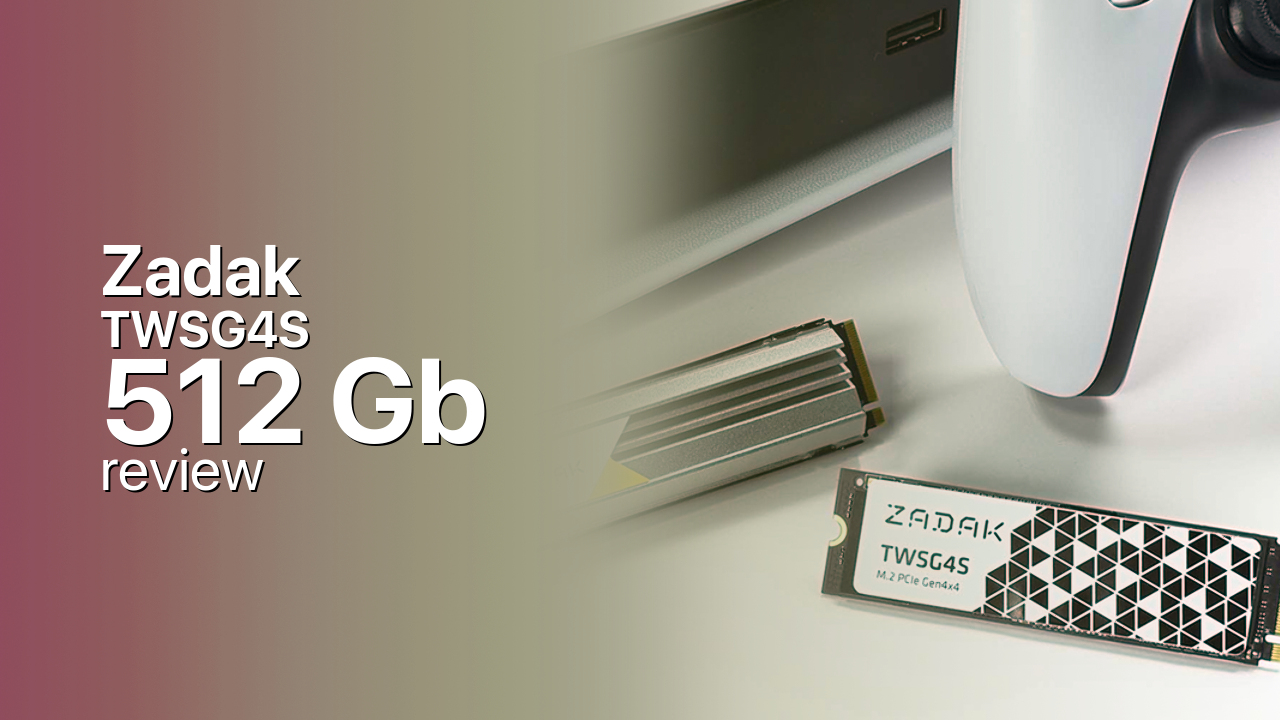
Inside the Zadak TWSG4S is the flagship Phison PS5018-E18 eight-channel NVMe controller, the same silicon that powered most of the fastest PCIe 4.0 drives at the height of that generation. Phison pairs the controller with Micron's 176-layer 3D TLC NAND and a dedicated DDR4 DRAM cache on the PCB, so this drive is in a different architectural class to DRAM-less HMB rivals like the WD Black SN770. The TWSG4S ships in M.2 2280 form factor with a thin aluminum or graphene heatsink option, which makes PS5 fitment easier than on truly bare drives.
The TWSG4S is offered in 512 GB, 1 TB, and 2 TB capacities, and this 512 GB SKU is the smallest of the family. Zadak rates every capacity at the same headline 7,400 MB/s sequential reads, 7,000 MB/s sequential writes, and 1,000,000 random read and write IOPS — the controller is the bottleneck, not the NAND count, so the spec sheet looks identical across sizes. What changes between capacities is endurance: the 512 GB carries 350 TBW, the 1 TB carries 700 TBW, and the 2 TB carries 1,400 TBW. Sustained write behavior also shifts with capacity, because there are fewer NAND dies to interleave on the 512 GB die layout.
At this tier the TWSG4S 512GB lines up against other Phison E18 drives — Kingston Fury Renegade 500GB, Seagate FireCuda 530 500GB, Corsair MP600 Pro, Sabrent Rocket 4 Plus — and against in-house controller flagships like the Samsung 990 Pro 500GB and WD Black SN850X 500GB. Among the E18 cohort the TWSG4S is the more niche, enthusiast-marketed brand, but the underlying silicon is identical to its more famous siblings.
Storage Comparisons:
TWSG4S Performance & Benchmarks
Zadak rates the TWSG4S 512GB at up to 7,400 MB/s sequential reads and 7,000 MB/s sequential writes, with 1,000,000 IOPS on both random reads and random writes. These are the same headline numbers that appear on the 1 TB and 2 TB SKUs because they are controller-limited — the E18 saturates the PCIe 4.0 x4 link well before the NAND would. In practice this translates to near-instant application launches, game loads that close most of the gap to RAM-resident assets, and DirectStorage-ready throughput for next-generation titles. Against a SATA SSD the difference is enormous; against an entry Gen4 drive like the SN770 it is meaningful but visible mostly in heavy workloads.
Zadak TWSG4S 512 GB vs M.2 4.0 x 4 peers
Switch between sequential throughput and random IOPS to see how this drive stacks up against other M.2 4.0 x 4 SSDs in our database. The highlighted bar is the drive on this page — click any other bar to open that drive.
- Patriot Viper PV593 1 TB: 14,500 MB/s read, 14,000 MB/s write
- Patriot Viper PV593 2 TB: 14,500 MB/s read, 14,000 MB/s write
- Patriot Viper PV593 4 TB: 14,500 MB/s read, 14,000 MB/s write
- Patriot Viper PV573 2 TB: 14,000 MB/s read, 12,000 MB/s write
- Zadak TWSG4S 512 GB (this drive): 7,400 MB/s read, 7,000 MB/s write
The trade-off at 512 GB is sustained write behavior. Like every TLC NVMe, the TWSG4S uses an SLC cache to absorb burst writes, and the smaller die count on the 512 GB SKU gives it a smaller pseudo-SLC pool than the 1 TB or 2 TB versions. Independent reviewers consistently find that E18-based 512 GB drives drop into native TLC writes after the cache fills, settling in the low gigabyte-per-second range — still respectable, but far below the 7,000 MB/s headline figure. For boot, gaming, and short file transfers the cached burst is what you feel; for routinely copying 100+ GB at once, the cache wall is real. The DDR4 DRAM cache keeps mixed and queued random workloads consistent in a way DRAM-less rivals cannot match.
Zadak TWSG4S vs Competitors
See how the TWSG4S stacks up against other M.2 4.0 x 4 drives in our database:
Compare with rival drives:
Endurance, TBW & Warranty
Zadak backs the TWSG4S 512GB with a 5-year limited warranty and a 350 TBW endurance allowance. Coverage ends at whichever boundary is reached first: five years on the calendar or 350 TBW of host writes. In practical terms 350 TBW is roughly 190 GB of writes every single day for five straight years, which is well beyond what any typical desktop, laptop, or gaming workload generates. Even content creators who routinely shuttle multi-gigabyte video projects through this drive will struggle to approach the TBW ceiling before the warranty expires by time.
Zadak quotes an MTBF of 1,600,000 hours for the TWSG4S family. As always, MTBF is a fleet-level statistical projection rather than a per-drive lifetime promise. RMA is generally handled through the original retailer or distributor because Zadak's direct support footprint is smaller than the mainstream brands, so buyers should keep proof of purchase and check return paths before committing. The TBW allowance scales sharply with capacity: 700 TBW on the 1 TB and 1,400 TBW on the 2 TB, so heavy-write users get noticeably more headroom by stepping up a size.
Zadak TWSG4S 512 GB Specifications
| Category | Value |
|---|---|
| Capacity [?] | 512 GB |
| Interface [?] | M.2 4.0 x 4 |
| Controller [?] | Phison PS5018-E18 |
| Memory type [?] | Micron 176-L TLC |
| DRAM [?] | Yes |
| Read speed (MB/s) [?] | 7400 |
| Write speed (MB/s) [?] | 7000 |
| Read IOPS [?] | 1000000 |
| Write IOPS [?] | 1000000 |
| Endurance (TBW) [?] | 350 |
| MTBF (million hours) [?] | 1.6 |
| Warranty (years) [?] | 5 |
Verdict: Is the TWSG4S Worth It in 2026?
The Zadak TWSG4S 512GB is best suited to enthusiasts who want a full-fat Phison E18 drive with DRAM cache at the smallest capacity that makes the platform feel honest. It is the right pick for a fast boot drive or a small scratch volume on a Gen4 motherboard. Heavy creators, anyone planning very large sustained transfers, or buyers who care about long-term value should step up to the 1 TB TWSG4S — it doubles the TBW allowance and tends to hold its SLC cache longer. Mainstream shoppers who do not need DRAM and want a longer support tail are better served by a Samsung 990 Pro 500GB or a Kingston Fury Renegade 500GB, both of which sit on the same E18-or-equivalent tier with broader retail availability.
+ Pros
- 7,400 MB/s rated PCIe 4.0 reads
- Phison PS5018-E18 controller with DDR4 DRAM
- 1,000,000 IOPS random read and write rating
- Micron 176-layer 3D TLC NAND
- 5-year warranty with 350 TBW endurance
- Cons
- 350 TBW is the lowest in the TWSG4S family
- Smaller SLC cache than the 1 TB or 2 TB SKUs
- Niche brand with limited retail and RMA reach
- No DirectStorage advantage over cheaper E18 drives
Buy this or similar SSD Storage:



Video Review
SSD M.2 NVME ZADAK TWSG3 1TB! VALE APENA? Unboxing + Teste