Seagate BarraCuda 510 512GB Review — PCIe 3.0 NVMe SSD (2026)
Quick answer
The Seagate BarraCuda 510 512GB is a competent mainstream PCIe 3.0 NVMe drive that checks all the right boxes: proven Phison E12 controller, DRAM cache, TLC NAND, and a 5-year warranty.
Read: 3400 MB/s Write: 2100 MB/s Endurance: 320 TBW Warranty: 5 years Interface: M.2 3.0 x 4
The Seagate BarraCuda 510 512GB represents Seagate's entry into the mainstream PCIe 3.0 NVMe market, pairing the proven Phison E12 controller with Toshiba TLC NAND and a full 512 MB of DRAM cache.
Controller & Memory
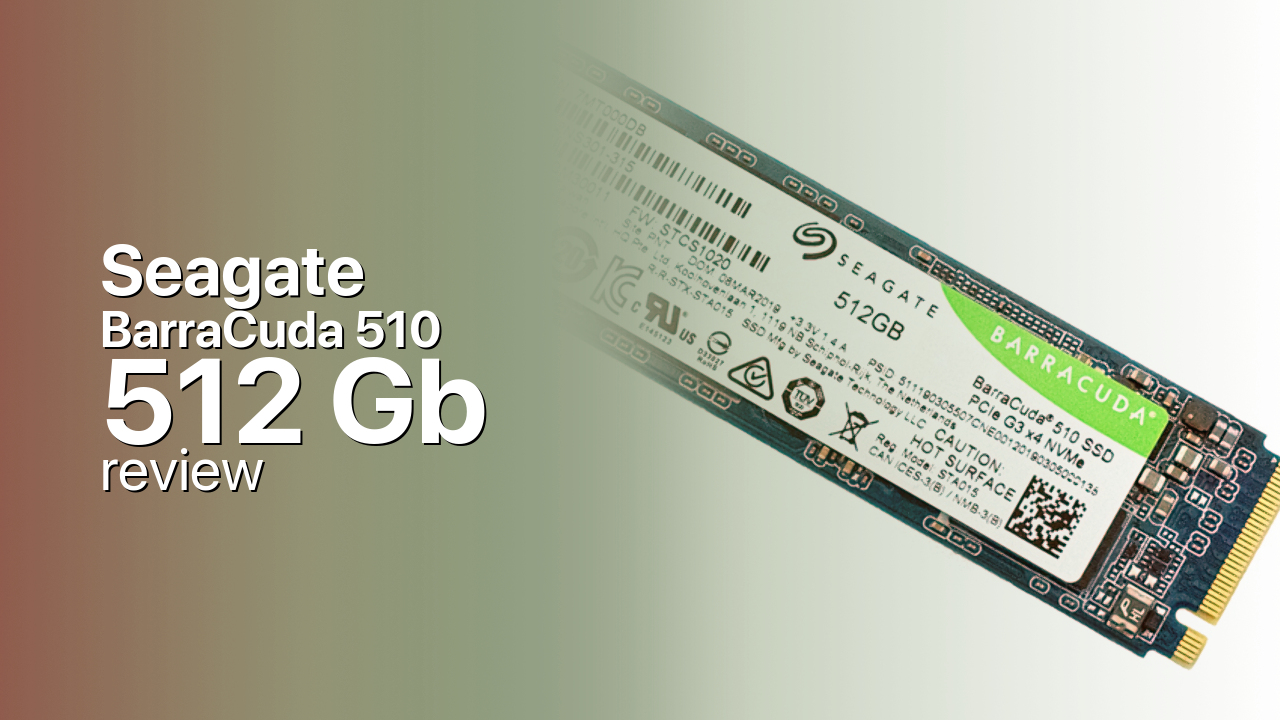
Inside the Seagate BarraCuda 510 512GB beats the Phison E12 controller, a flagship-grade PCIe 3.0 x4 NVMe controller that powers many of the best Gen3 drives from this era. Seagate pairs it with Toshiba 3D TLC NAND and a substantial 512 MB SK Hynix DDR4 DRAM cache, which keeps the drive responsive even as the SLC cache fills during sustained writes. The drive ships in the standard M.2 2280 form factor with a single-sided PCB layout that works in most laptops and desktops. No heatsink is included, so users planning heavy sustained workloads should plan for motherboard or aftermarket cooling.
The BarraCuda 510 family launched in 2019 alongside the gaming-focused FireCuda 510, with Seagate positioning this model as the everyday workhorse. The 512 GB capacity sits in the middle of the lineup between 256 GB and 1 TB/2 TB options. This specific capacity delivers the full 3,400 MB/s sequential read speed that the Phison E12 is capable of, though write speeds scale across capacities. The drive competes directly with the WD Blue SN570, Samsung 970 EVO, and Crucial P5, all of which target the same PCIe 3.0 mainstream slot with similar NAND configurations. For most users upgrading from SATA SSDs, the jump to 3,400 MB/s reads is transformative for OS boot, game loads, and application launches.
Power efficiency is another area where the Phison E12 shines. The controller supports NVMe power states including DevSleep and ASPM, making the BarraCuda 510 a reasonable choice for laptop users who need both performance and battery life. Seagate also includes SeaTools software for monitoring drive health, firmware updates, and performance optimization. While the drive lacks the hardware encryption found on some enterprise-oriented drives, this is rarely a concern for mainstream users who rely on software encryption like BitLocker or FileVault 2. The BarraCuda 510 does not set any records, but it covers the fundamentals competently and pairs proven components with a strong warranty.
Storage Comparisons:
BarraCuda 510 Performance & Benchmarks
The Seagate BarraCuda 510 512GB is rated for up to 3,400 MB/s sequential reads and 2,100 MB/s sequential writes, matching the typical Phison E12 performance profile. Random 4K performance comes in at up to 350,000 read IOPS and 530,000 write IOPS, which handles mixed workloads like gaming, content creation, and daily computing without bottlenecks. In real-world use, you are looking at OS boot times under 15 seconds and game load improvements of 30-50% over SATA SSDs, though diminishing returns set in when compared to other high-end PCIe 3.0 drives.
Seagate BarraCuda 510 512 GB vs M.2 3.0 x 4 peers
Switch between sequential throughput and random IOPS to see how this drive stacks up against other M.2 3.0 x 4 SSDs in our database. The highlighted bar is the drive on this page — click any other bar to open that drive.
- ADATA SX 8800 Pro 512 GB: 3,500 MB/s read, 2,700 MB/s write
- ADATA SX 8800 Pro 1 TB: 3,500 MB/s read, 2,700 MB/s write
- ADATA XPG Spectrix S40G RGB 256 GB: 3,500 MB/s read, 3,000 MB/s write
- ADATA XPG Spectrix S40G RGB 512 GB: 3,500 MB/s read, 3,000 MB/s write
- Seagate BarraCuda 510 512 GB (this drive): 3,400 MB/s read, 2,100 MB/s write
The drive uses an SLC caching algorithm that treats a portion of the TLC NAND as faster SLC NAND for burst writes. Most Phison E12 implementations in this capacity class offer roughly 20-30 GB of SLC cache before dropping to direct-to-TLC write speeds, typically around 1,000-1,200 MB/s. For typical consumer workloads—OS operations, game installs, document editing—you rarely exhaust the cache. Video editors transferring 50+ GB files or game library movers may notice the step-down, though the sustained write floor remains well above SATA. Independent reviewers consistently found the BarraCuda 510 performs within a few percentage points of other Phison E12 drives, making it a solid if not class-leading performer.
Seagate BarraCuda 510 vs Competitors
See how the BarraCuda 510 stacks up against other M.2 3.0 x 4 drives in our database:
Compare with rival drives:
Endurance, TBW & Warranty
Seagate backs the BarraCuda 510 512GB with a 5-year limited warranty, which is the industry standard for mainstream NVMe drives. The endurance rating is 320 TBW (terabytes written), meaning Seagate guarantees the drive can write 320 terabytes of data before the warranty expires. At a typical enthusiast workload of 50 GB per day, that is roughly 17 years of use, though the warranty ends at year five regardless of TBW consumed. The MTBF rating is 1.8 million hours, which is a statistical projection for large drive populations rather than a promise for any single unit. Seagate handles warranty claims directly in most regions, though some regions may require returns through the original retailer. The 512 GB model's 320 TBW sits slightly below some competitors at this capacity, but remains more than adequate for all but the heaviest write-intensive workloads.
Seagate BarraCuda 510 512 GB Specifications
| Category | Value |
|---|---|
| Capacity [?] | 512 GB |
| Interface [?] | M.2 3.0 x 4 |
| Controller [?] | Phison E12 |
| Memory type [?] | Toshiba TLC |
| DRAM [?] | SK Hynix 512MB DDR4 |
| Read speed (MB/s) [?] | 3400 |
| Write speed (MB/s) [?] | 2100 |
| Read IOPS [?] | 350000 |
| Write IOPS [?] | 530000 |
| Endurance (TBW) [?] | 320 |
| MTBF (million hours) [?] | 1.8 |
| Warranty (years) [?] | 5 |
Verdict: Is the BarraCuda 510 Worth It in 2026?
The Seagate BarraCuda 510 512GB is a competent mainstream PCIe 3.0 NVMe drive that checks all the right boxes: proven Phison E12 controller, DRAM cache, TLC NAND, and a 5-year warranty. It is well-suited for gamers and general users upgrading from SATA who want reliable performance without paying PCIe 4.0 premiums. Buyers seeking the absolute fastest Gen3 drive should consider the Samsung 970 EVO Plus or WD Black SN750X, which edge this one out in sustained write performance. Those on tighter budgets might look at DRAM-less alternatives like the WD Blue SN570, though the BarraCuda 510's full DRAM cache makes it the safer choice for heavy workloads. The drive lacks PS5-specific marketing but meets Sony's requirements for PCIe Gen3 expansion, though the absence of an included heatsink means you will need to factor one into the build.
+ Pros
- Phison E12 controller — proven, high-end Gen3 silicon
- Full 512 MB SK Hynix DDR4 DRAM cache
- 5-year warranty with 320 TBW endurance rating
- Single-sided M.2 2280 form factor fits most laptops
- 3,400 MB/s sequential reads matches Phison E12 peak
- Cons
- No included heatsink for thermal management
- Write speeds lower than some Phison E12 competitors
- Launched in 2019 — aging platform vs newer Gen3 drives
- SLC cache exhausts during large file transfers
Buy this or similar SSD Storage:



Video Review
Seagate 512GB BarraCuda 510 NVMe M.2 SSD Unboxing w/Benchmarks ZP512CM30011