ADATA XPG Gammix S50 1TB Review - Original Phison E16 PCIe 4.0 NVMe (2026)
Quick answer
The ADATA XPG Gammix S50 1 TB makes sense today only at a heavy discount and only as a budget upgrade slot - a budget AM4 or Z490 desktop where 5,000 MB/s reads are a real step up from SATA, or a secondary game library where modern Gen4 throughput is overkill.
Read: 5000 MB/s Write: 4400 MB/s Endurance: 3600 TBW Warranty: 5 years Interface: M.2 4.0 x 4
The ADATA XPG Gammix S50 1 TB is a first-wave PCIe 4.0 NVMe built on the Phison E16 reference design - historically important, but long since outpaced by every modern Gen4 flagship.
Controller & Memory
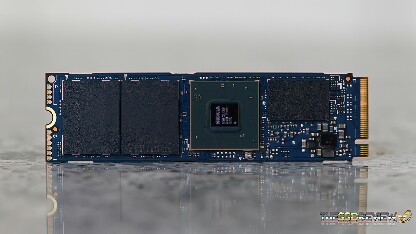
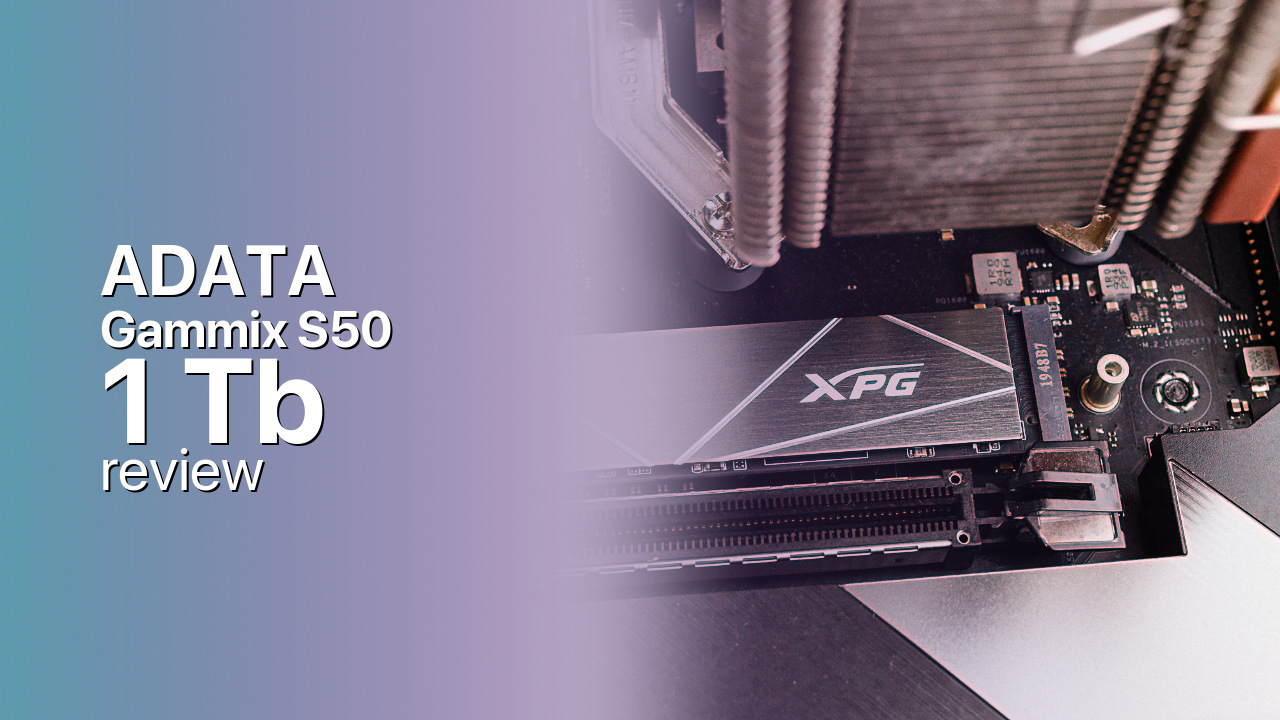
ADATA launched the Gammix S50 alongside the first batch of PCIe 4.0 drives in 2019, all of which were built on the same Phison PS5016-E16 eight-channel controller, Toshiba (now Kioxia) BiCS4 96-layer 3D TLC NAND and a DDR4 DRAM cache buffer. Siblings in that wave included the Corsair MP600, Gigabyte Aorus NVMe Gen4, Sabrent Rocket NVMe 4.0 and Seagate FireCuda 520 - all functionally near-identical drives under the hood, distinguished mainly by heatsink design and bundled software. The S50 ships in a flat black aluminium heatspreader that does the job in a standard motherboard M.2 slot, although it adds enough height that it can foul some compact ITX builds and is too tall for the PS5's storage bay without removal.
The 1 TB model sits between 512 GB and 2 TB siblings and uses a single-sided M.2 2280 PCB. At launch it was a genuine flagship; by 2026 it is firmly an entry-to-mainstream PCIe 4.0 option that has been comprehensively outclassed by second-generation E18 drives like the ADATA Gammix S70 Blade, Samsung 990 Pro and WD Black SN850X on every sequential and random metric. The selling point today is the original drive's rock-solid Phison firmware, the still-useful 5,000 MB/s read ceiling and a five-year warranty that, for early adopters, has often outlived the drive's relevance.
Storage Comparisons:
XPG Gammix S50 Performance & Benchmarks
ADATA rates the 1 TB Gammix S50 at 5,000 MB/s sequential reads and 4,400 MB/s sequential writes, with up to 750,000 IOPS for both random reads and random writes. Those numbers were headline-grabbing in 2019 and remain comfortably faster than any SATA SSD or PCIe 3.0 NVMe, but they sit well below the 7,000+ MB/s ceiling of modern Gen4 flagships like the Samsung 990 Pro, WD Black SN850X or the in-house ADATA Gammix S70 Blade.
ADATA XPG Gammix S50 1 TB vs M.2 4.0 x 4 peers
Switch between sequential throughput and random IOPS to see how this drive stacks up against other M.2 4.0 x 4 SSDs in our database. The highlighted bar is the drive on this page — click any other bar to open that drive.
- Patriot Viper PV593 1 TB: 14,500 MB/s read, 14,000 MB/s write
- Patriot Viper PV593 2 TB: 14,500 MB/s read, 14,000 MB/s write
- Patriot Viper PV593 4 TB: 14,500 MB/s read, 14,000 MB/s write
- Patriot Viper PV573 2 TB: 14,000 MB/s read, 12,000 MB/s write
- ADATA XPG Gammix S50 1 TB (this drive): 5,000 MB/s read, 4,400 MB/s write
In practical terms the Gammix S50 still feels snappy as a boot drive, loads modern games at sub-2-second cold-start times comparable to a PCIe 3.0 970 EVO Plus, and finishes 30-50 GB Steam installs in well under a minute. The Phison E16 pseudo-SLC cache absorbs the first 80-150 GB of sustained writes near full speed before dropping to a native-TLC floor in the low-thousand MB/s range - perfectly fine for everyday workloads but visible on multi-hundred-gigabyte video transfers. Heat is the real Gen1 E16 quirk: independent reviewers have found these drives can exceed 70 C under sustained writes without supplementary airflow, which the bundled heatspreader manages adequately in an open desktop case but struggles with in cramped builds.
ADATA XPG Gammix S50 vs Competitors
See how the XPG Gammix S50 stacks up against other M.2 4.0 x 4 drives in our database:
Compare with rival drives:
Endurance, TBW & Warranty
ADATA backs the Gammix S50 with a five-year limited warranty, with the endurance budget specified in the table on the page. As a Phison E16 reference design paired with Toshiba BiCS4 TLC the drive uses the same flash-management algorithms as its siblings, so wear-levelling behaviour is well-characterised: even under heavy desktop use the warranty period typically expires long before the NAND wear-out limit is approached. MTBF is rated as manufacturer-standard for this class of drive, treated as a population-level statistic rather than an individual-drive promise. RMA service goes through ADATA's regional warranty network and requires proof of purchase plus the drive serial number; in practice most claims are handled via the original retailer within the first year and direct with ADATA after that.
ADATA XPG Gammix S50 1 TB Specifications
| Category | Value |
|---|---|
| Capacity [?] | 1 TB |
| Interface [?] | M.2 4.0 x 4 |
| Controller [?] | Phison PS5016-E16 |
| Memory type [?] | Toshiba 3D TLC |
| DRAM [?] | DDR4 |
| Read speed (MB/s) [?] | 5000 |
| Write speed (MB/s) [?] | 4400 |
| Read IOPS [?] | 750000 |
| Write IOPS [?] | 750000 |
| Endurance (TBW) [?] | 3600 |
| MTBF (million hours) [?] | 2000000 |
| Warranty (years) [?] | 5 |
Verdict: Is the XPG Gammix S50 Worth It in 2026?
The ADATA XPG Gammix S50 1 TB makes sense today only at a heavy discount and only as a budget upgrade slot - a budget AM4 or Z490 desktop where 5,000 MB/s reads are a real step up from SATA, or a secondary game library where modern Gen4 throughput is overkill. Anyone building a new PCIe 4.0 system in 2026 should skip it: the same money buys a Crucial P3 Plus, WD Blue SN580 or even a discounted Samsung 990 EVO that will run cooler, write faster and last longer at sustained workloads. The natural step-up alternative inside ADATA's own lineup is the Gammix S70 Blade or the newer Legend 960 Max, both of which dramatically outclass the original S50 on every modern metric. The headline judgment: historically significant first-generation Gen4 hardware, comprehensively superseded.
+ Pros
- 5,000 MB/s reads on PCIe 4.0 interface
- 750K IOPS random read and write rating
- DDR4 DRAM cache buffer included
- 5-year limited warranty backing
- Aluminium heatspreader bundled in the box
- Single-sided M.2 2280 PCB design
- Cons
- Outclassed by every E18-era PCIe 4.0 flagship
- Phison E16 controller runs hot under sustained writes
- Heatspreader too tall for the PS5 storage bay
- No hardware encryption support on this SKU
- SLC cache exhaustion drops writes well below rated speed
Buy this or similar SSD Storage:



Video Review
Are Budget PCIe 4 SSDs Worth It?? - ADATA XPG GAMMIX S50 Lite