Transcend PCIe SSD 110S 1TB Review — Entry-Level NVMe (2026)
Quick answer
Buy the Transcend 110S 1 TB if you are upgrading a laptop or desktop from a hard drive or SATA SSD and want a dependable, warranty-backed NVMe drive at the lowest reasonable price.
Read: 1700 MB/s Write: 1500 MB/s Endurance: 400 TBW Warranty: 5 years Interface: PCIe 3.0 x 4
The Transcend 110S 1 TB is the drive you buy when you want to leave SATA behind without paying for PCIe 4.0 hardware you will never saturate.
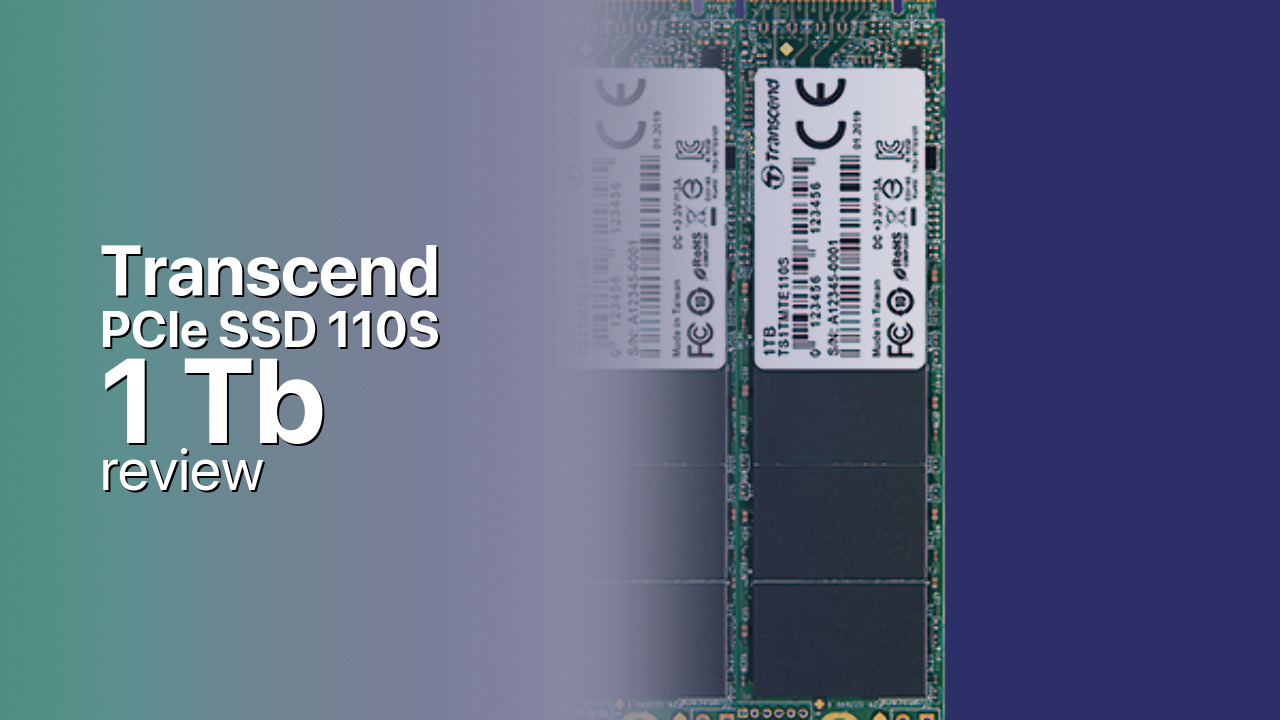
Controller & Memory
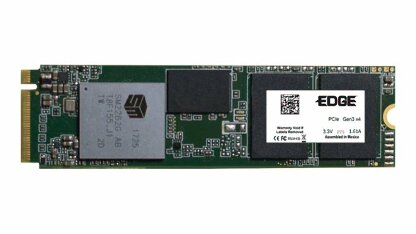
The 110S is built around the Silicon Motion SM2263XT, a four-channel DRAM-less controller that relies on NVMe Host Memory Buffer (HMB) to borrow a slice of system RAM for the flash translation layer. It pairs that controller with 3D TLC NAND — Transcend does not disclose the NAND vendor, but the part marked THGDU3B-1D03 seen in teardowns is consistent with third-party 3D TLC supply. The absence of a DRAM package keeps the bill of materials low, and Transcend passes those savings on in the form of a drive that often undercuts name-brand alternatives by a meaningful margin.
Transcend offers the 110S in 128 GB, 256 GB, 512 GB, 1 TB, and 2 TB capacities, all in a standard single-sided M.2 2280 form factor. Sequential throughput is rated at up to 1,700 MB/s reads and 1,400 MB/s writes, with the 1 TB variant delivering the lineup's best sustained write performance thanks to greater NAND parallelism. The 2 TB version reaches the same rated sequential speeds. All capacities share the same 5-year warranty and are covered for 400 TBW per terabyte — a competitive endurance figure for a DRAM-less budget drive.
The 110S competes in the crowded entry-level NVMe segment against the WD Blue SN550 (TLC, DRAM-less, similar speeds), the Crucial P2 (QLC lottery on newer batches), the Kingston NV1, and the Silicon Power A60. Against a SATA SSD, the 110S delivers roughly 3x the sequential throughput and lower random access latency. Against fellow DRAM-less NVMe drives, the differentiators are price and warranty — Transcend's 5-year coverage outlasts the 3-year terms common on budget alternatives, and the 400 TBW endurance per terabyte is near the top of the DRAM-less TLC class.
Storage Comparisons:
PCIe SSD 110S Performance & Benchmarks
The 110S is rated for 1,700 MB/s sequential reads and 1,400 MB/s sequential writes — figures that land well short of the PCIe 3.0 x4 ceiling but still triple what any SATA SSD can manage. In independent CrystalDiskMark testing, a 1 TB review sample recorded 1,784 MB/s reads and 1,516 MB/s writes, slightly exceeding the rated numbers in both directions. ATTO Disk Benchmark results corroborate the findings at 1,801 MB/s read and 1,532 MB/s write.
Transcend PCIe SSD 110S 1 TB vs PCIe 3.0 x 4 peers
Switch between sequential throughput and random IOPS to see how this drive stacks up against other PCIe 3.0 x 4 SSDs in our database. The highlighted bar is the drive on this page — click any other bar to open that drive.
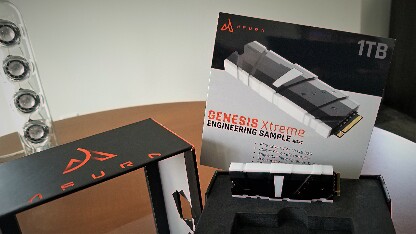
- Asura Genesis Xtreme 256 GB: 3,400 MB/s read, 3,000 MB/s write
- Asura Genesis Xtreme 512 GB: 3,400 MB/s read, 3,000 MB/s write
- Asura Genesis Xtreme 1 TB: 3,400 MB/s read, 3,000 MB/s write
- Asura Genesis Xtreme 2 TB: 3,400 MB/s read, 3,000 MB/s write
- Transcend PCIe SSD 110S 1 TB (this drive): 1,700 MB/s read, 1,500 MB/s write
Random 4K performance is adequate for an OS and application drive. The SM2263XT controller leverages HMB to manage the mapping table without the latency penalty of on-the-fly NAND translation, and in practice the 110S delivers boot times and application launches indistinguishable from more expensive DRAM-equipped PCIe 3.0 drives. The one performance caveat noted in independent reviews is a throughput decline once the drive passes roughly 50 percent capacity — a common characteristic of DRAM-less controllers whose HMB allocation cannot scale to accommodate the full mapping table of a near-full drive. For a budget OS disk that never exceeds half capacity this is irrelevant; for a game library that will be filled to the brim, a DRAM-equipped alternative will hold its performance envelope more consistently.
Transcend PCIe SSD 110S vs Competitors
See how the PCIe SSD 110S stacks up against other PCIe 3.0 x 4 drives in our database:
Compare with rival drives:
Endurance, TBW & Warranty
Transcend rates the 110S 1 TB for 400 TBW of endurance and backs it with a 5-year limited warranty. At a typical consumer workload of 20 to 50 GB written per day, that endurance ceiling translates to approximately 22 to 55 years of service — comfortably beyond the useful life of the host system. The 400 TBW figure is competitive for a DRAM-less TLC drive in this price band; many budget alternatives in the same segment carry 200 to 300 TBW ratings for their 1 TB variants. Transcend also includes its SSD Scope software suite for drive monitoring, health checks, and secure erase, which adds practical value for users who want visibility into drive health without installing third-party tools. Warranty service is handled through Transcend's global RMA network rather than through the original retailer.
Transcend PCIe SSD 110S 1 TB Specifications
| Category | Value |
|---|---|
| Capacity [?] | 1 TB |
| Interface [?] | PCIe 3.0 x 4 |
| Controller [?] | Silicon Motion SM2263XT |
| Memory type [?] | 3D TLC NAND |
| DRAM [?] | SLC Caching and Host Memory Buffer |
| Read speed (MB/s) [?] | 1700 |
| Write speed (MB/s) [?] | 1500 |
| Read IOPS [?] | 150000 |
| Write IOPS [?] | 250000 |
| Endurance (TBW) [?] | 400 |
| MTBF (million hours) [?] | 2000000 |
| Warranty (years) [?] | 5 |
Verdict: Is the PCIe SSD 110S Worth It in 2026?
Buy the Transcend 110S 1 TB if you are upgrading a laptop or desktop from a hard drive or SATA SSD and want a dependable, warranty-backed NVMe drive at the lowest reasonable price. The 5-year warranty and 400 TBW endurance remove the gamble that comes with lesser-known budget brands, and the single-sided PCB fits every standard M.2 slot without clearance issues. Skip it if your workload involves sustained writes or if you plan to keep the drive near full capacity — the DRAM-less HMB design loses performance headroom above 50 percent fill, and the 1,400 MB/s write ceiling will bottleneck video editing or large data-set workflows. For those use cases, spend the extra on a DRAM-equipped drive like the WD Black SN750 or the Transcend 112S, which adds a DRAM cache and doubles the sequential speeds within the same product family. For everyone else — OS boot drive, office PC, secondary game library — the 110S is a quiet workhorse that asks very little and delivers exactly what it promises.
+ Pros
- Affordable entry point to NVMe from SATA or HDD
- 5-year warranty outlasts most budget competitors
- 400 TBW endurance per terabyte for a DRAM-less TLC drive
- Single-sided PCB fits all standard M.2 2280 slots
- 3D TLC NAND — no QLC lottery unlike some competitors
- Includes Transcend SSD Scope monitoring software
- Cons
- DRAM-less HMB design loses performance above 50 percent capacity
- 1,400 MB/s write ceiling is low for PCIe 3.0 x4
- No included heatsink or thermal pad
- NAND vendor not disclosed — may vary between production batches
- Sequential speeds trail other DRAM-less TLC drives in the same price band
Buy this or similar SSD Storage:
Video Review
Best Budget NVMe SSD? - Transcend MTE220S Review