Sabrent Rocket Q4 1TB — PCIe 4.0 QLC NVMe SSD Review (2026)
Quick answer
The Sabrent Rocket Q4 1 TB is a budget PCIe 4.0 option where the savings come from QLC NAND and a last-generation controller.
Read: 4700 MB/s Write: 1800 MB/s Endurance: 200 TBW Warranty: 5 years Interface: M.2 4.0 x 4
The Sabrent Rocket Q4 1 TB pairs Phison's E16 controller with Micron 96L QLC NAND for PCIe 4.0 reads at a low price, but the 1 TB capacity carries significant write-speed compromises.
Controller & Memory
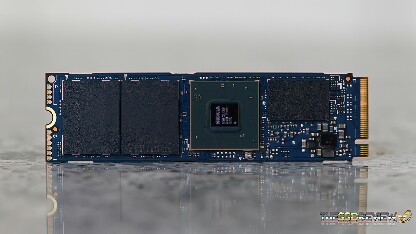
The Rocket Q4 uses Phison's PS5016-E16 8-channel controller — the same silicon that launched the PCIe 4.0 SSD market — paired with Micron 96-layer QLC NAND and DDR4 DRAM. It is essentially the QLC counterpart to Sabrent's TLC-based Rocket NVMe 4.0 series. The E16 is built on a 28 nm process, which is less power-efficient than newer 12 nm controllers like the E18, but it is mature and reliable.
The series spans 1 TB, 2 TB, and 4 TB capacities, and performance scales dramatically with size. The 1 TB is the slowest: at 1,800 MB/s writes, it is outpaced by many PCIe 3.0 TLC drives. The 2 TB model doubles that to 3,600 MB/s, and the 4 TB reaches 3,500 MB/s. The M.2 2280 form factor is single-sided at 1 TB, fitting any M.2 slot.
Competitors include the Corsair MP600 Core 1 TB (same Phison E16 + Micron QLC platform, nearly identical specs) and budget TLC alternatives like the Crucial P3 1 TB (DRAM-less QLC, PCIe 3.0). The Sabrent differentiates with an optional heatsink and Sabrent's typical Amazon-heavy distribution, which often means competitive pricing.
The absence of a factory heatsink is worth noting. The Phison E16 controller runs warm under sustained workloads, and without motherboard-provided cooling or Sabrent's optional add-on heatsink, thermal throttling can reduce performance. For desktop builds with integrated M.2 heatsinks, this is a non-issue; for bare-slot installations, plan for aftermarket cooling.
Storage Comparisons:
Rocket Q4 Performance & Benchmarks
The Rocket Q4 1 TB is rated at 4,700 MB/s sequential reads and 1,800 MB/s sequential writes, with 200K random read IOPS and 350K random write IOPS. AnandTech's testing found that the QLC NAND, combined with the E16 controller's limitations, produces read speeds that justify the PCIe 4.0 interface but write speeds that are comparable to SATA SSDs in some scenarios after the SLC cache exhausts.
Sabrent Rocket Q4 1 TB vs M.2 4.0 x 4 peers
Switch between sequential throughput and random IOPS to see how this drive stacks up against other M.2 4.0 x 4 SSDs in our database. The highlighted bar is the drive on this page — click any other bar to open that drive.
- Patriot Viper PV593 1 TB: 14,500 MB/s read, 14,000 MB/s write
- Patriot Viper PV593 2 TB: 14,500 MB/s read, 14,000 MB/s write
- Patriot Viper PV593 4 TB: 14,500 MB/s read, 14,000 MB/s write
- Patriot Viper PV573 2 TB: 14,000 MB/s read, 12,000 MB/s write
- Sabrent Rocket Q4 1 TB (this drive): 4,700 MB/s read, 1,800 MB/s write
The pseudo-SLC write cache on the 1 TB model is relatively small — roughly 20–40 GB — and once it fills, native QLC writes drop to 80–150 MB/s. This means sustained file transfers of any significant size will be dramatically slower than burst transfers. For bursty workloads (OS booting, application launches, game loads), the drive reads at full PCIe 4.0 speed and feels fast. For sustained writes (large file copies, game installations), the QLC penalty is real and noticeable. The 200K random read IOPS on the 1 TB model is the lowest in the Q4 series, reflecting the limited NAND parallelism available at this capacity. For desktop workloads dominated by reads, the deficit is negligible in practice.
Sabrent Rocket Q4 vs Competitors
See how the Rocket Q4 stacks up against other M.2 4.0 x 4 drives in our database:
Compare with rival drives:
Endurance, TBW & Warranty
Sabrent rates the Rocket Q4 1 TB at 200 TBW endurance, with a five-year warranty that requires product registration within 90 days of purchase — otherwise coverage drops to one year. At 200 TBW, the rated endurance equals approximately 109 GB of writes per day over five years, which is adequate for light desktop use (20–40 GB/day) but tighter than the 1 TB model probably warrants. For comparison, TLC PCIe 4.0 drives at 1 TB typically offer 600–800 TBW. The QLC endurance is the trade-off for the lower price-per-GB. S.M.A.R.T. health monitoring is supported for tracking endurance consumption.
Sabrent Rocket Q4 1 TB Specifications
| Category | Value |
|---|---|
| Capacity [?] | 1 TB |
| Interface [?] | M.2 4.0 x 4 |
| Controller [?] | Phison PS5016-E16 |
| Memory type [?] | Micron 96L QLC |
| DRAM [?] | DDR4 |
| Read speed (MB/s) [?] | 4700 |
| Write speed (MB/s) [?] | 1800 |
| Read IOPS [?] | 200000 |
| Write IOPS [?] | 350000 |
| Endurance (TBW) [?] | 200 |
| MTBF (million hours) [?] | 1800000 |
| Warranty (years) [?] | 5 |
Verdict: Is the Rocket Q4 Worth It in 2026?
The Sabrent Rocket Q4 1 TB is a budget PCIe 4.0 option where the savings come from QLC NAND and a last-generation controller. The 4,700 MB/s reads are genuinely fast, but the 1,800 MB/s writes and 200 TBW endurance are significant compromises. This drive makes sense as a read-heavy secondary storage or media drive where sustained writes are rare. For a primary boot drive or gaming drive where you regularly install and update large games, a TLC alternative like the Sabrent Rocket 4 Plus 1 TB — even at a higher price — will provide a noticeably better experience during writes and long-term reliability.
+ Pros
- 4,700 MB/s sequential reads on PCIe 4.0
- DDR4 DRAM cache (not DRAM-less)
- Single-sided PCB fits all M.2 slots
- Mature Phison E16 controller
- Micron 96L QLC NAND with proven reliability
- Cons
- Only 1,800 MB/s writes — slower than many PCIe 3.0 TLC drives
- 200 TBW endurance is low for a 1 TB drive
- QLC write cliff drops to 80–150 MB/s after SLC cache fills
- Small SLC cache (~20–40 GB) exhausts quickly
- Warranty drops to 1 year without registration
Buy this or similar SSD Storage:



Video Review
Sabrent Rocket Q4 2TB PCIe 4.0 SSD Review, Benchmarks And Unboxing