Team Group T-Force Cardea 240 GB Review — PCIe 3.0 NVMe (2026)
Quick answer
The Team Group T-Force Cardea 240 GB is the right pick only in a specific scenario: a workstation, embedded, or industrial PCIe 3.0 build where MLC endurance and a known Phison E7 + Toshiba platform are worth more than absolute speed.
Read: 2600 MB/s Write: 1400 MB/s Endurance: 335 TBW Warranty: 3 years Interface: PCIe 3.0 x 4
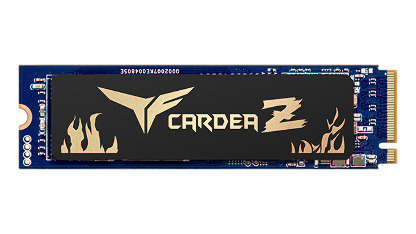
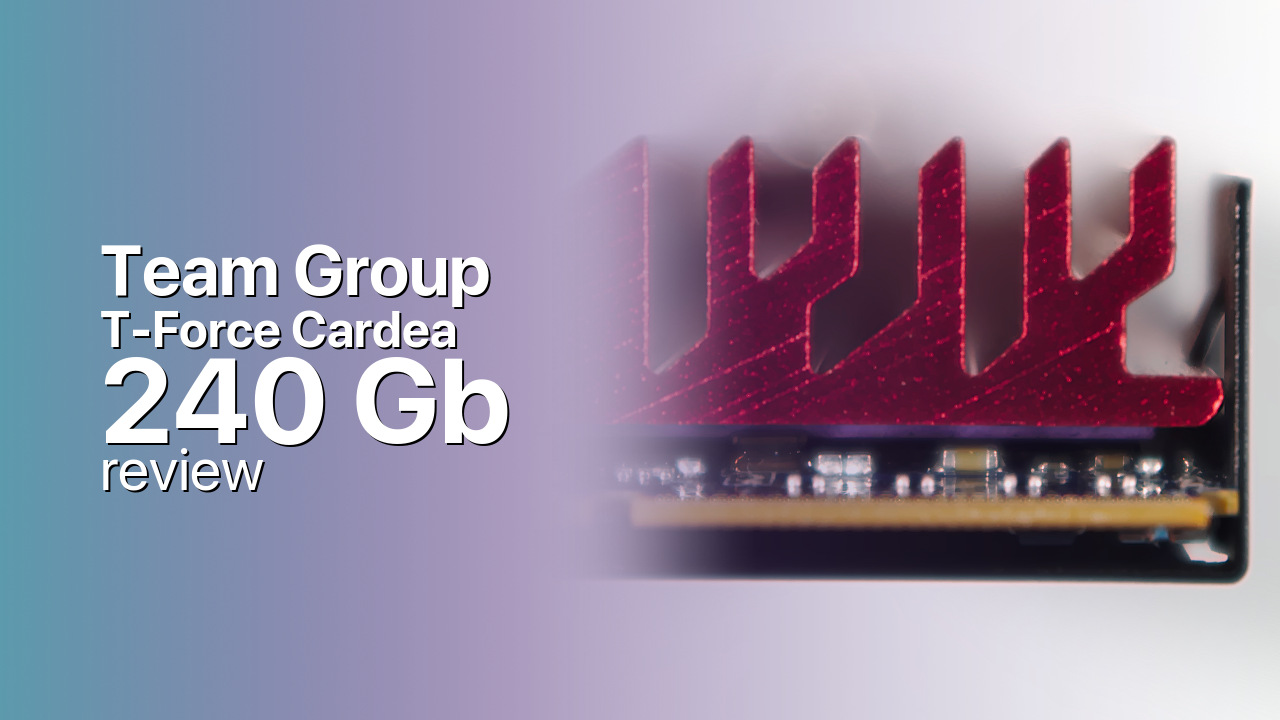
The Team Group T-Force Cardea 240 GB is one of the last consumer MLC NVMe drives \xe2\x80\x94 a Phison E7-based PCIe 3.0 SSD with a finned aluminium heat-spreader and a 335 TBW warranty.
Controller & Memory
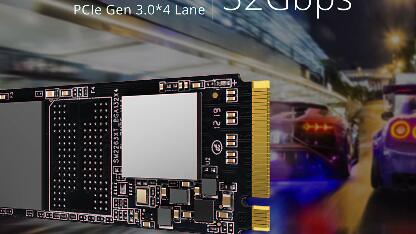
The Team Group T-Force Cardea 240 GB is an older mainstream PCIe 3.0 NVMe drive that has aged into a niche: it is one of the last consumer SSDs built with planar MLC NAND rather than 3D TLC. The drive pairs the Phison PS5007-E7 controller — a four-channel design that defined the first generation of consumer NVMe SSDs — with four 15 nm Toshiba MLC packages and a 256 MB Nanya DDR3 DRAM cache, all on a single-sided M.2 2280 PCB topped with a thin black aluminium heatspreader.
At 240 GB the Cardea is rated for up to 2,600 MB/s sequential reads, 1,400 MB/s sequential writes, and 180,000 random read IOPS — numbers that were competitive at launch in 2017 and that today sit below entry-tier modern Gen 3 NVMe drives. The drive ships in 240 GB, 480 GB, and 960 GB capacities; the 240 GB is the slowest of the lineup on writes because the smaller NAND pool gives the Phison E7 fewer channels to interleave. There is no current direct rival because MLC has been replaced by 3D TLC and 3D QLC across the consumer market. The honest comparisons are the WD Blue SN570 250 GB or Samsung 970 EVO Plus 250 GB — newer TLC drives that beat the Cardea on every sequential and random number, but with lower endurance ratings.
The target audience is narrow: a Windows boot drive in an older PCIe 3.0 desktop or workstation where the MLC bill of materials is the selling point, and a known-quantity Phison platform is worth more than raw speed. It is not the right pick for a modern build, and the 240 GB ceiling rules it out for any gaming workload.
Storage Comparisons:
T-Force Cardea Performance & Benchmarks
Team Group rates the T-Force Cardea 240 GB at up to 2,600 MB/s sequential reads and 1,400 MB/s sequential writes, with random performance of up to 180,000 IOPS read and 150,000 IOPS write. Those numbers are typical for a Phison E7 + MLC platform of its generation and place the Cardea inside the upper-mid PCIe 3.0 envelope at the time of launch — well above any SATA SSD on sequential reads, and competitive with the Samsung 960 EVO that was its launch rival. In real-world testing reviewers measured the rated sequential and 4K random scores essentially at face value, with the integrated heatspreader keeping the controller cool enough to avoid thermal throttling during sustained workloads.
Team Group T-Force Cardea 240 GB vs PCIe 3.0 x 4 peers
Switch between sequential throughput and random IOPS to see how this drive stacks up against other PCIe 3.0 x 4 SSDs in our database. The highlighted bar is the drive on this page — click any other bar to open that drive.
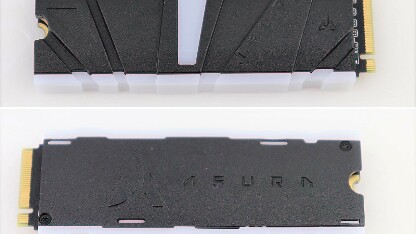
- Asura Genesis Xtreme 256 GB: 3,400 MB/s read, 3,000 MB/s write
- Asura Genesis Xtreme 512 GB: 3,400 MB/s read, 3,000 MB/s write
- Asura Genesis Xtreme 1 TB: 3,400 MB/s read, 3,000 MB/s write
- Asura Genesis Xtreme 2 TB: 3,400 MB/s read, 3,000 MB/s write
- Team Group T-Force Cardea 240 GB (this drive): 2,600 MB/s read, 1,400 MB/s write
The MLC NAND is the part of the drive that has aged best. Unlike contemporary TLC and QLC drives, MLC stores two bits per cell and has both faster native write speeds and higher write endurance per cell. The Cardea’s SLC cache is correspondingly smaller because direct-mode MLC writes are already fast, and independent reviewers consistently find post-cache sustained writes are markedly steadier than on a comparable TLC drive of the era. For boot, OS, and small-file workloads on a PCIe 3.0 platform the Cardea still feels responsive in 2026; it simply cannot match a modern Gen 4 drive on absolute throughput.
Team Group T-Force Cardea vs Competitors
See how the T-Force Cardea stacks up against other PCIe 3.0 x 4 drives in our database:
Compare with rival drives:
Endurance, TBW & Warranty
Team Group rates the T-Force Cardea 240 GB at 335 TBW (terabytes written) over a 3-year limited warranty, whichever limit is reached first. That endurance figure is unusually high for a 240 GB drive \xe2\x80\x94 a direct consequence of using true MLC NAND rather than TLC or QLC \xe2\x80\x94 and corresponds to roughly 305 GB of host writes per day for the full warranty window. At a more realistic 20 to 30 GB/day workload the rated 335 TBW corresponds to roughly 30 to 45 years of nominal life before the counter is exhausted, far beyond the 3-year warranty. The published MTBF figure is 2 million hours, which is a statistical population metric rather than a guaranteed lifespan for any individual drive. Warranty service is handled directly via Team Group RMA with proof of purchase. Compared with modern TLC NVMe drives at the same capacity, the Cardea\xe2\x80\x99s TBW-per-gigabyte ratio is roughly double, which is the main reason it has retained niche appeal in workstation and embedded applications.
Team Group T-Force Cardea 240 GB Specifications
| Category | Value |
|---|---|
| Capacity [?] | 240 GB |
| Interface [?] | PCIe 3.0 x 4 |
| Controller [?] | Phison PS5007-E7 |
| Memory type [?] | Toshiba MLC |
| DRAM [?] | Nanya 256MB DDR3 |
| Read speed (MB/s) [?] | 2600 |
| Write speed (MB/s) [?] | 1400 |
| Read IOPS [?] | 180000 |
| Write IOPS [?] | 150000 |
| Endurance (TBW) [?] | 335 |
| MTBF (million hours) [?] | 2 |
| Warranty (years) [?] | 3 |
Verdict: Is the T-Force Cardea Worth It in 2026?
The Team Group T-Force Cardea 240 GB is the right pick only in a specific scenario: a workstation, embedded, or industrial PCIe 3.0 build where MLC endurance and a known Phison E7 + Toshiba platform are worth more than absolute speed. Skip it for any modern desktop or laptop build, because every current entry-tier TLC NVMe like the WD Blue SN570 250 GB or Samsung 970 EVO Plus 250 GB beats it on read and write speed by a wide margin and ships with a 5-year warranty rather than 3. The closest current alternative for a boot drive is the WD Blue SN570 250 GB, which is faster but lower endurance; the cleaner step up for users who specifically want a high-TBW drive is a 500 GB or larger modern TLC NVMe. Overall the Cardea 240 GB is a legacy pick rather than a competitive one in 2026.
+ Pros
- 2,600 MB/s sequential reads on PCIe 3.0
- Genuine Toshiba 15 nm MLC NAND
- 335 TBW endurance for the capacity tier
- 256 MB Nanya DDR3 DRAM cache on board
- Aluminium heatspreader keeps controller cool
- 2 million hour MTBF rating
- Cons
- 1,400 MB/s writes lag modern entry NVMe
- 240 GB ceiling too small for modern workloads
- 3-year warranty trails modern 5-year norms
- No PCIe 4.0 upgrade path on Phison E7
- No PS5 compatibility on this interface
Buy this or similar SSD Storage:
Video Review
Best Bang for Buck PCIe 3.0 NVMe SSD? ⏩ T-Force Cardea z340 SSD Review