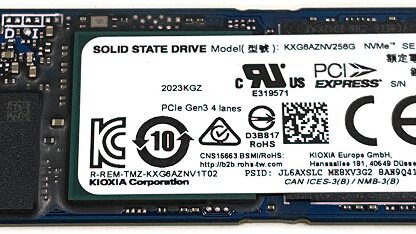
Corsair Force MP510 240GB TLC NVMe SSD (2026)
Quick answer
Budget builders looking for a reliable TLC NVMe boot drive with strong endurance and hardware encryption will find the Corsair Force MP510 240 GB a solid, dependable choice for OS and application duty.
Read: 3100 MB/s Write: 1050 MB/s Endurance: 400 TBW Warranty: 5 years Interface: M.2 3.0 x 4
The Corsair Force MP510 240 GB is the entry point of Corsair's TLC NVMe lineup, using the Phison E12 controller with Toshiba 64-layer TLC NAND and class-leading endurance in a single-sided M.2 2280 design.
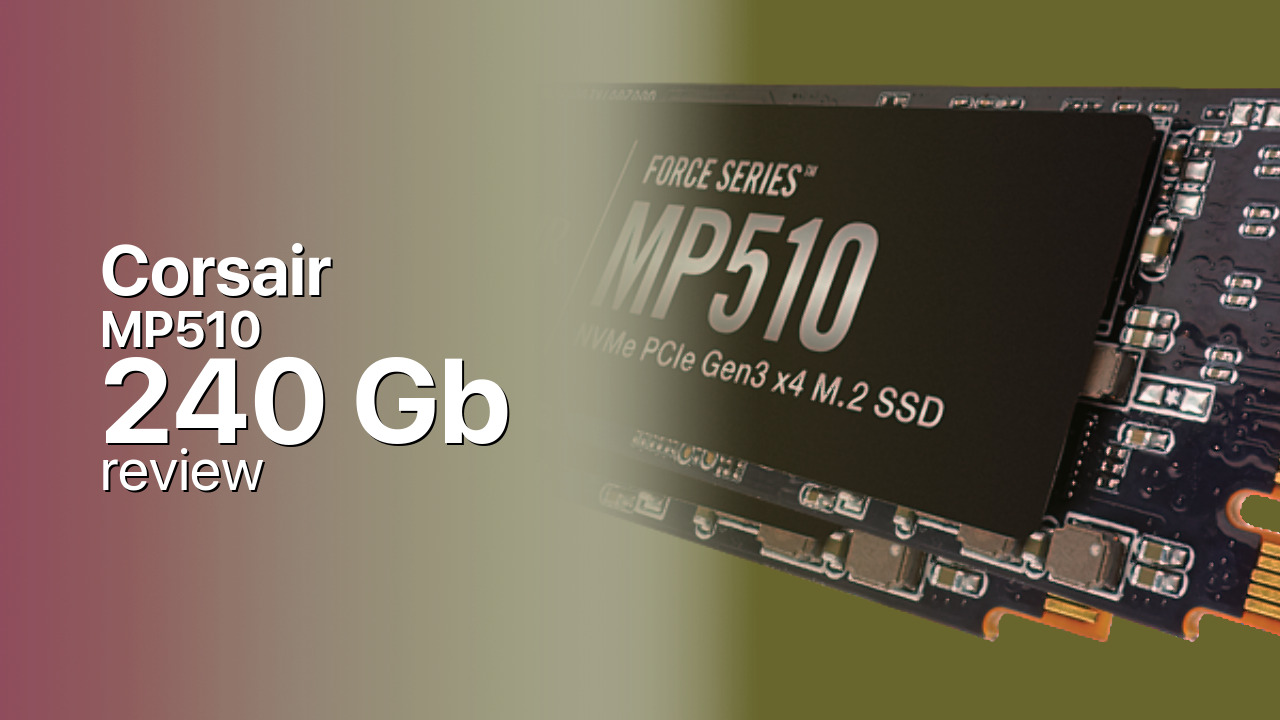
Controller & Memory
The MP510 240GB is built around the Phison PS5012-E12 controller, an eight-channel PCIe 3.1 x4 NVMe 1.3 design with two Arm Cortex R5 cores, dual CoXProcessor 2.0 co-processors, and an SK Hynix DDR4 DRAM cache. The E12 is paired with Toshiba BiCS3 64-layer 3D TLC NAND, which stores three bits per cell and delivers substantially better endurance than the QLC NAND used in the Corsair MP400 series.
At 240 GB, the MP510 is the smallest capacity in the lineup, which also includes 480 GB, 960 GB, and 1,920 GB (2 TB) variants. The 240 GB uses a single-sided PCB, making it compatible with thin laptops and compact systems. However, the small NAND footprint limits performance: the 240 GB reads at 3,100 MB/s and writes at only 1,050 MB/s, well below the 960 GB model at 3,480/3,000 MB/s. Random performance also scales down to 180K/240K IOPS, less than a third of the 960 GB ratings.
The MP510 competes with other PCIe 3.0 TLC drives like the Samsung 970 EVO, WD Black SN750, and Intel SSD 760p. Its standout feature is endurance: at 400 TBW, the 240 GB matches drives twice its size on absolute endurance. The MP510 also supports AES 256 hardware encryption and TCG Opal, though it is not compatible with Windows BitLocker eDrive. For a boot drive, the 240 GB is more than adequate.
Storage Comparisons:
MP510 Performance & Benchmarks
Corsair rates the Force MP510 240 GB at 3,100 MB/s sequential read and 1,050 MB/s sequential write, with up to 180,000 random read IOPS and 240,000 random write IOPS. These are the lowest figures in the MP510 family, reflecting the limited NAND die count on the 240 GB capacity where fewer dies means less interleaving and reduced sequential and random throughput across the eight controller channels.
Corsair MP510 240 GB vs M.2 3.0 x 4 peers
Switch between sequential throughput and random IOPS to see how this drive stacks up against other M.2 3.0 x 4 SSDs in our database. The highlighted bar is the drive on this page — click any other bar to open that drive.
- ADATA SX 8800 Pro 512 GB: 3,500 MB/s read, 2,700 MB/s write
- ADATA SX 8800 Pro 1 TB: 3,500 MB/s read, 2,700 MB/s write
- ADATA XPG Spectrix S40G RGB 256 GB: 3,500 MB/s read, 3,000 MB/s write
- ADATA XPG Spectrix S40G RGB 512 GB: 3,500 MB/s read, 3,000 MB/s write
- Corsair MP510 240 GB (this drive): 3,100 MB/s read, 1,050 MB/s write
The E12 controller implements a dynamic SLC cache that adapts to available NAND space. On the 240 GB model the cache is relatively small, so sustained writes exceed the cache faster than on larger capacities. Independent reviewers note that the MP510 real-world application performance is slightly below average for PCIe 3.0 NVMe drives, even though synthetic benchmarks show competitive sequential speeds. The drive thermal management throttles performance by 50 MB/s for every degree above 80 degrees Celsius, though the E12 runs cool enough that throttling is rarely triggered during normal desktop use.
Corsair MP510 vs Competitors
See how the MP510 stacks up against other M.2 3.0 x 4 drives in our database:
Compare with rival drives:
Endurance, TBW & Warranty
Corsair covers the Force MP510 240 GB with a five-year limited warranty, ending at 400 TBW of writes or the warranty period, whichever comes first. The 400 TBW rating on a 240 GB drive is impressive, representing roughly 1.8 drive writes per day over the five-year warranty. At a typical consumer workload of 20 GB per day, the endurance translates to roughly 54 years of use. The MP510 features Phison's StrongECC, SmartRefresh, and SmartFlush technologies that work to monitor, refresh, and reconstruct data in NAND pages to ensure stability and reliability. The five-year warranty is an upgrade over the previous-generation MP500, which carried only a three-year warranty.
Corsair MP510 240 GB Specifications
| Category | Value |
|---|---|
| Capacity [?] | 240 GB |
| Interface [?] | M.2 3.0 x 4 |
| Controller [?] | Phison PS5012-E12 |
| Memory type [?] | Toshiba 64L TLC |
| DRAM [?] | SK Hynix DDR4 |
| Read speed (MB/s) [?] | 3100 |
| Write speed (MB/s) [?] | 1050 |
| Read IOPS [?] | 180000 |
| Write IOPS [?] | 240000 |
| Endurance (TBW) [?] | 400 |
| MTBF (million hours) [?] | 1.8 |
| Warranty (years) [?] | 5 |
Verdict: Is the MP510 Worth It in 2026?
Budget builders looking for a reliable TLC NVMe boot drive with strong endurance and hardware encryption will find the Corsair Force MP510 240 GB a solid, dependable choice for OS and application duty. The 1,050 MB/s write speed is the trade-off for choosing the smallest capacity in the lineup, and anyone moving beyond basic boot-drive workloads should step up to the 480 GB or 960 GB model for significantly higher write throughput. For the price-sensitive builder who just needs a fast OS drive with excellent longevity ratings, the MP510 240 GB delivers where it counts and will outlast the system it boots.
+ Pros
- 400 TBW endurance at 240 GB capacity
- Toshiba 64L TLC NAND with DRAM cache
- Single-sided M.2 2280 fits thin laptops
- AES 256 hardware encryption support
- 5-year warranty coverage
- Phison E12 proven controller platform
- Cons
- Only 1,050 MB/s sequential write speed
- 180K/240K IOPS below larger capacities
- Small SLC cache fills quickly
- Below-average real-world application performance
- Not BitLocker eDrive compatible
Buy this or similar SSD Storage:
Video Review
Corsair Force Series MP510 240GB NVMe M.2 SSD Testing