Zadak Spark 1TB Review — Phison E12 PCIe 3.0 NVMe SSD (2026)
Quick answer
The Zadak Spark 1 TB is a solid choice for gamers and general users who want a fast PCIe 3.0 drive with RGB lighting to match a build theme.
Read: 3400 MB/s Write: 3000 MB/s Endurance: 482 TBW Warranty: 5 years Interface: M.2 3.0 x 4
The Zadak Spark 1 TB is a Phison E12-powered PCIe 3.0 NVMe that holds its own among the flagship Gen3 drives, with RGB lighting and a 5-year warranty backing its 482 TBW endurance rating.
Controller & Memory
Zadak is a gaming-focused brand owned by SilverStone, and the Spark series represents their flagship PCIe 3.0 NVMe lineup. Inside the 1 TB model sits the Phison PS5012-E12 controller — a premium Gen3 controller that powered many of the top drives in 2019-2021 — paired with Micron 3D TLC NAND. A full 1 GB of SK Hynix DDR4-2400 DRAM handles mapping data, which is notably more generous than the DRAM-less or HMB-based designs common at the lower end of the market.
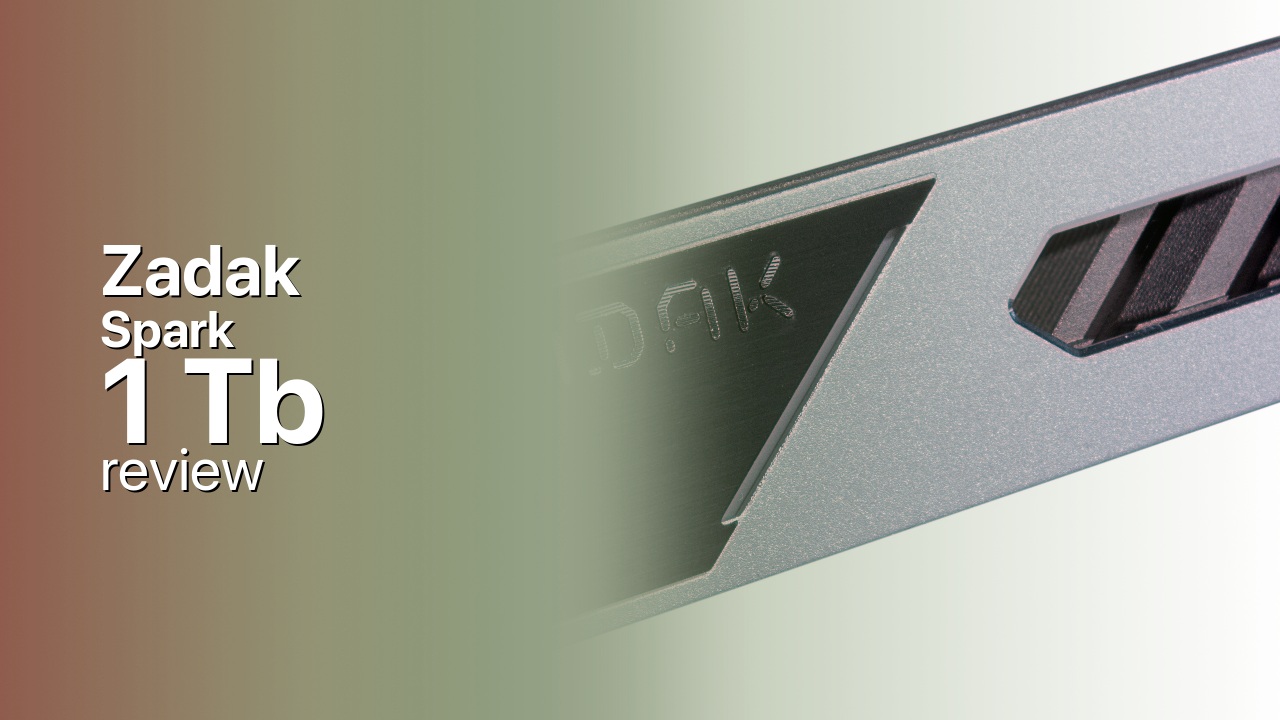
The Spark"s distinguishing feature is its RGB lighting strip along the top edge, controllable via major motherboard software suites. Physically, it uses a standard M.2 2280 form factor with a double-sided PCB layout. The drive also ships in 512 GB and 2 TB capacities, though the 1 TB sweet spot offers the best balance of price, performance, and endurance.
As a PCIe 3.0 x4 drive, the Spark is compatible with virtually any modern motherboard or laptop that has an M.2 slot. It meets Sony"s PS5 requirements in theory — the 3,400 MB/s sequential read rating handily exceeds the 5,500 MB/s recommended floor — but buyers should add a third-party heatsink, as the Spark runs warm under sustained writes and the stock RGB heat spreader is relatively thin.
Storage Comparisons:
Spark Performance & Benchmarks
Zadak rates the Spark 1 TB at 3,400 MB/s sequential reads and 3,000 MB/s sequential writes, with up to 560,000 IOPS for both random reads and writes. These numbers place the drive squarely in the upper tier of PCIe 3.0 performance — the Phison E12 was the flagship Gen3 controller before PCIe 4.0 arrived, and it shows.
Zadak Spark 1 TB vs M.2 3.0 x 4 peers
Switch between sequential throughput and random IOPS to see how this drive stacks up against other M.2 3.0 x 4 SSDs in our database. The highlighted bar is the drive on this page — click any other bar to open that drive.
- ADATA SX 8800 Pro 512 GB: 3,500 MB/s read, 2,700 MB/s write
- ADATA SX 8800 Pro 1 TB: 3,500 MB/s read, 2,700 MB/s write
- ADATA XPG Spectrix S40G RGB 256 GB: 3,500 MB/s read, 3,000 MB/s write
- ADATA XPG Spectrix S40G RGB 512 GB: 3,500 MB/s read, 3,000 MB/s write
- Zadak Spark 1 TB (this drive): 3,400 MB/s read, 3,000 MB/s write
In real-world use, the Spark behaves like most TLC-based NVMe drives with an SLC cache. Burst writes are fast until the cache (a portion of the NAND operating in SLC mode) fills, after which sustained writes drop to the NAND"s native speed. Independent testing of E12-based drives consistently shows cache exhaustion in the 20-40 GB range on the 1 TB capacity, after which writes settle in the 800-1,200 MB/s range. For gaming loads, OS boot, and typical application launches — all of which are read-heavy and fit well within the cache — the difference between this drive and a PCIe 4.0 model is imperceptible. The performance gap only materializes in sustained write workflows like large file transfers or video editing scratch disk usage.
Zadak Spark vs Competitors
See how the Spark stacks up against other M.2 3.0 x 4 drives in our database:
Compare with rival drives:
Endurance, TBW & Warranty
Zadak backs the Spark 1 TB with a 5-year warranty, which is standard for flagship SSDs. The endurance rating is 482 TBW, meaning Zadak guarantees the drive can write 482 terabytes of data before the warranty expires. For perspective: at a relatively heavy 50 GB/day write workload, that translates to roughly 26 years of use — far beyond the warranty period. Even at 100 GB/day, you"re looking at over a decade. The drive also carries a 1.8 million hour MTBF rating, which is a population statistic rather than a promise for any individual unit, but it indicates solid reliability engineering from the Phison E12 platform and Micron NAND combination.
Zadak Spark 1 TB Specifications
| Category | Value |
|---|---|
| Capacity [?] | 1 TB |
| Interface [?] | M.2 3.0 x 4 |
| Controller [?] | Phison PS5012-E12 |
| Memory type [?] | Micron 3D TLC |
| DRAM [?] | SK Hynix 1GB DDR4-2400 |
| Read speed (MB/s) [?] | 3400 |
| Write speed (MB/s) [?] | 3000 |
| Read IOPS [?] | 560000 |
| Write IOPS [?] | 560000 |
| Endurance (TBW) [?] | 482 |
| MTBF (million hours) [?] | 1.8 |
| Warranty (years) [?] | 5 |
Verdict: Is the Spark Worth It in 2026?
The Zadak Spark 1 TB is a solid choice for gamers and general users who want a fast PCIe 3.0 drive with RGB lighting to match a build theme. It"s not worth upgrading from a halfway-decent Gen3 drive, but if you"re building a new gaming PC or upgrading from SATA, the Spark delivers flagship-level performance at its generation. PS5 owners should consider the Sabrent Rocket Q or WD Black SN850 instead for Sony"s compatibility list and included heatsink, but on standard PCs, the Spark holds its own. The RGB branding adds a price premium, and the heatsink could be more substantial for sustained workloads, but the core Phison E12 + Micron TLC + full DRAM package is proven and reliable.
+ Pros
- Phison E12 controller — flagship PCIe 3.0 performance
- Full 1 GB SK Hynix DDR4 DRAM cache
- 482 TBW endurance with 5-year warranty
- RGB lighting compatible with major motherboard software
- Standard M.2 2280 form factor fits most systems
- Cons
- RGB markup drives price above non-RGB E12 drives
- Stock heatsink is thin for sustained write workloads
- PCIe 3.0 is now a generation behind PCIe 4.0/5.0
- SLC cache exhaustion on large file transfers
Buy this or similar SSD Storage:



Video Review
✅ZADAK SPARK PCIe GEN 3X4 M.2 RGB 1TB SSD Review