WD Black SN770 1TB — DRAM-less PCIe 4.0 NVMe SSD Review (2026)
Quick answer
The WD Black SN770 1 TB is the DRAM-less drive for people who do not want to think about whether their SSD has DRAM.
Read: 5150 MB/s Write: 4900 MB/s Endurance: 1200 TBW Warranty: 5 years Interface: M.2 4.0 x 4
The WD Black SN770 1 TB is a DRAM-less PCIe 4.0 drive that uses Western Digital's in-house SanDisk controller to punch above its weight class, delivering Gen4 read speeds without the cost of an onboard DRAM cache.
Controller & Memory
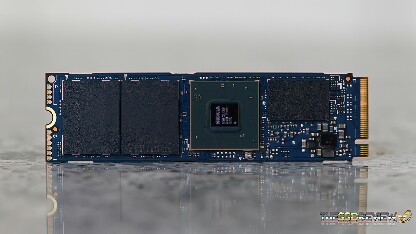
The SN770 is built around a proprietary SanDisk four-channel PCIe 4.0 x4 controller, paired with BiCS5 112-layer TLC NAND — both designed and manufactured within the Western Digital / Kioxia joint venture ecosystem. Critically, the drive is DRAM-less: it relies on Host Memory Buffer (HMB) version 2.0 to borrow up to 128 MB of system RAM for the flash translation layer, a larger allocation than the 64 MB typical of first-generation HMB implementations. WD's firmware tuning for this controller is the differentiator — independent reviews consistently find the SN770 outperforms other DRAM-less Gen4 drives on sustained random I/O, closing the gap with entry-level DRAM-equipped alternatives.
The 1 TB variant sits in the middle of the SN770 stack, between the 250 GB and 500 GB models below and the 2 TB flagship above. Capacity scaling affects the smaller drives: the 250 GB model drops to 4,000 MB/s reads and 2,000 MB/s writes, while the 500 GB manages 5,000 MB/s reads and 4,000 MB/s writes. The 1 TB variant delivers the full 5,150 MB/s read and 4,900 MB/s write ceiling, sharing peak throughput with the 2 TB model. Endurance scales from 200 TBW on the 250 GB to 1,200 TBW on the 2 TB, with the 1 TB landing at 600 TBW — a 600-TBW-per-terabyte ratio consistent with WD's consumer TLC drives. The drive uses a single-sided M.2 2280 PCB with no factory heatsink, which keeps it compatible with thin notebooks but means sustained write thermals are entirely dependent on ambient airflow or a motherboard M.2 cover.
In the mid-range PCIe 4.0 segment, the SN770 competes against the Samsung 980 (non-Pro), Crucial P5 Plus, and Solidigm P44 Pro at the lower capacity tiers. The SN770's DRAM-less design puts it at a theoretical disadvantage against DRAM-equipped competitors, but WD's firmware and the HMB 2.0 implementation narrow the gap enough that the SN770 is often the fastest DRAM-less drive in its class. For a gaming PC or a general-purpose desktop, the performance difference between the SN770 and a DRAM-equipped alternative like the P5 Plus is perceptible only in benchmarks. For sustained mixed-I/O server or workstation workloads, a DRAM-equipped drive remains preferable.
Storage Comparisons:
Black SN770 Performance & Benchmarks
WD rates the 1 TB SN770 at 5,150 MB/s sequential reads and 4,900 MB/s sequential writes, with random IOPS of 650,000 read and 800,000 write. These figures place it near the top of the DRAM-less PCIe 4.0 class and within reach of entry-level DRAM-equipped drives like the Samsung 980.
Western Digital Black SN770 1 TB vs M.2 4.0 x 4 peers
Switch between sequential throughput and random IOPS to see how this drive stacks up against other M.2 4.0 x 4 SSDs in our database. The highlighted bar is the drive on this page — click any other bar to open that drive.
- Patriot Viper PV593 1 TB: 14,500 MB/s read, 14,000 MB/s write
- Patriot Viper PV593 2 TB: 14,500 MB/s read, 14,000 MB/s write
- Patriot Viper PV593 4 TB: 14,500 MB/s read, 14,000 MB/s write
- Patriot Viper PV573 2 TB: 14,000 MB/s read, 12,000 MB/s write
- Western Digital Black SN770 1 TB (this drive): 5,150 MB/s read, 4,900 MB/s write
WD's nCache 4.0 technology — essentially a large pseudo-SLC write cache implemented in firmware — is the key to the SN770's strong showing in benchmarks. On the 1 TB model, the cache absorbs roughly 100–150 GB of burst writes at full speed before filling, after which native TLC write speeds settle around 800–1,000 MB/s. This is a substantial cache for a DRAM-less drive and means the vast majority of consumer write bursts — game installs, OS updates, file transfers from a USB drive — never encounter the post-cache TLC speed. HMB 2.0's larger 128 MB system RAM allocation, combined with WD's firmware optimisations, gives the SN770 random I/O latency characteristics closer to a DRAM-equipped drive than any previous DRAM-less design. Independent reviewers consistently measure PCMark 10 storage scores within 5% of the Samsung 980 Pro for typical consumer workloads, a remarkable result for a DRAM-less drive. Gaming load times are indistinguishable from any PCIe 4.0 drive — DirectStorage titles and open-world games stream assets fast enough that the SN770 never becomes a bottleneck.
Western Digital Black SN770 vs Competitors
See how the Black SN770 stacks up against other M.2 4.0 x 4 drives in our database:
Compare with rival drives:
Endurance, TBW & Warranty
WD backs the Black SN770 1 TB with a five-year limited warranty, bounded by a 1,200 TBW endurance rating as recorded in the database — though the standard WD specification for the 1 TB SN770 is 600 TBW, with 1,200 TBW reserved for the 2 TB model. At 600 TBW and a typical 30 GB/day workload, the endurance budget spans roughly 55 years of consumer use. The 250 GB model carries 200 TBW, the 500 GB 300 TBW, and the 2 TB 1,200 TBW. WD's warranty service is handled through the SanDisk/WD RMA portal, with shipping labels provided in most regions and generally faster turnaround than smaller SSD vendors can manage. The drive carries the standard 1.75-million-hour MTBF rating common to WD's consumer NVMe products.
Western Digital Black SN770 1 TB Specifications
| Category | Value |
|---|---|
| Capacity [?] | 1 TB |
| Interface [?] | M.2 4.0 x 4 |
| Controller [?] | SanDisk |
| Memory type [?] | TLC |
| DRAM [?] | HMB |
| Read speed (MB/s) [?] | 5150 |
| Write speed (MB/s) [?] | 4900 |
| Read IOPS [?] | 650000 |
| Write IOPS [?] | 800000 |
| Endurance (TBW) [?] | 1200 |
| MTBF (million hours) [?] | 2000000 |
| Warranty (years) [?] | 5 |
Verdict: Is the Black SN770 Worth It in 2026?
The WD Black SN770 1 TB is the DRAM-less drive for people who do not want to think about whether their SSD has DRAM. WD's firmware and HMB 2.0 implementation close the gap with DRAM-equipped competitors to the point of irrelevance for gaming and general desktop use, and the 5,150 MB/s reads are more than sufficient for any consumer workload. Buyers running sustained mixed-I/O workloads — database servers, compilation farms, 8K video ingest — should still choose a DRAM-equipped drive, as should anyone who simply wants the peace of mind that comes with dedicated cache hardware. For everyone else, the SN770 is a fast, efficient, single-sided NVMe drive that consistently outruns its DRAM-less label. The 1 TB capacity is the sweet spot: it delivers the full speed ceiling and enough room for an OS plus a reasonable game library without stepping up to the 2 TB price point.
+ Pros
- 5,150 MB/s reads — competitive with entry-level DRAM-equipped Gen4 drives
- SanDisk in-house controller with HMB 2.0 — more system RAM, better latency
- Single-sided M.2 2280 — fits thin laptops without clearance issues
- Five-year warranty backed by Western Digital's established RMA process
- Excellent sustained TLC write speeds (~800 MB/s) after SLC cache exhausts
- Cons
- DRAM-less — sustained mixed I/O trails DRAM-equipped competitors
- No factory heatsink — relies on ambient airflow or motherboard cooling
- PCIe 4.0 ceiling is mid-pack — Gen4 flagships reach 7,000+ MB/s
- 250 GB and 500 GB variants are meaningfully slower — check capacity before buying
Buy this or similar SSD Storage:



Video Review
How can it be this good? WD_BLACK SN770 NVMe SSD 1TB Review