CFD Gaming PG5NFZ 1TB PCIe 5.0 NVMe SSD Specifications (2026)
Quick answer
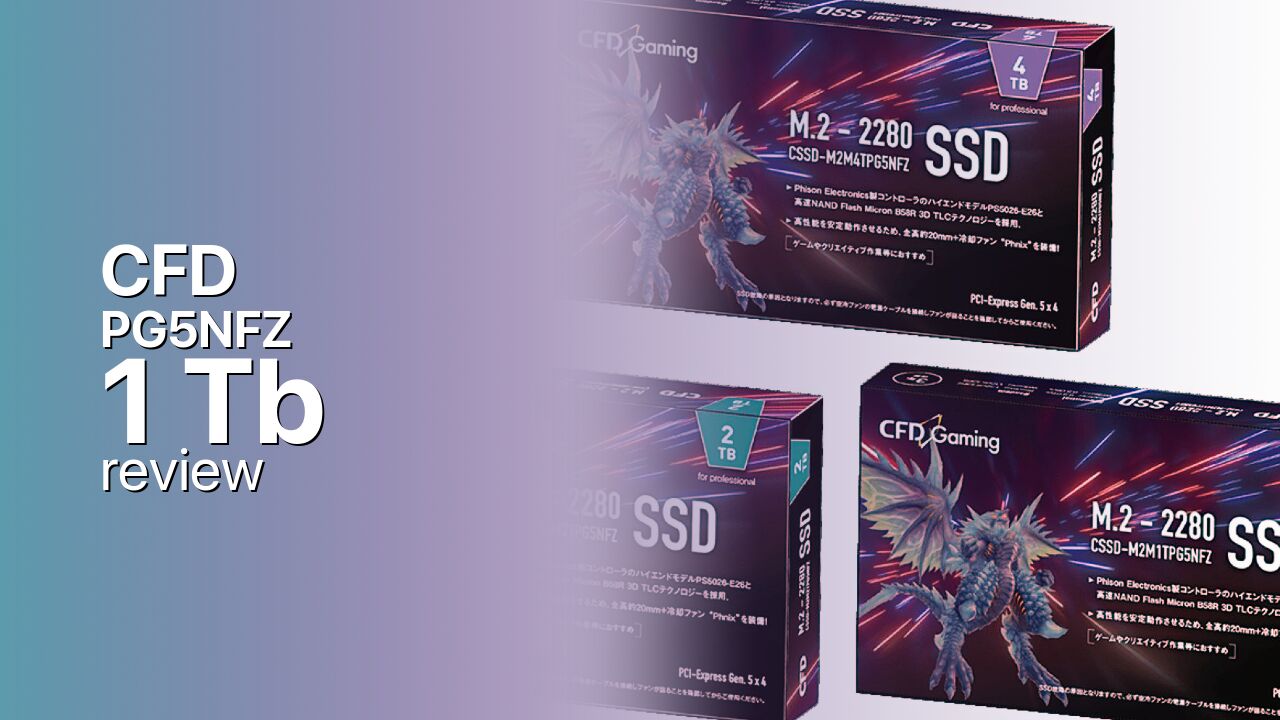
The CFD Gaming PG5NFZ 1TB was among the first consumer PCIe 5.0 SSDs to reach the market, combining the Phison PS5026-E26 controller with Micron 3D TLC NAND and an innovative active cooling solution.
Read: 9500 MB/s Write: 8500 MB/s Endurance: 700 TBW Warranty: 3 years Interface: M.2 5.0
CFD Gaming PG5NFZ 1TB combines a Phison E26 controller, Micron 3D TLC NAND, and active Phnix cooling to deliver PCIe Gen5 reads of 9,500 MB/s with writes of 8,500 MB/s.
Controller & Memory
CFD Gaming entered the PCIe 5.0 storage market with the PG5NFZ, a high-performance M.2 2280 SSD built around the Phison PS5026-E26 controller. This controller is the first consumer PCIe 5.0 NVMe design from Phison, offering double the per-lane bandwidth of its Gen4 predecessor. Paired with Micron 3D TLC NAND flash (B58R dies), the 1TB model achieves sequential read speeds up to 9,500 MB/s and writes up to 8,500 MB/s.
The standout feature of the PG5NFZ is its integrated Phnix cooling system, a 20mm tall aluminum heatsink with a built-in high-speed fan. PCIe 5.0 SSDs generate significantly more heat than Gen4 drives due to the doubled data rates and the power-hungry controller. The active cooling solution allows the PG5NFZ to maintain peak sustained performance without thermal throttling, something that passive heatsinks struggle with on early Gen5 drives.
Random 4K performance reaches 1.5 million IOPS for reads and 1.25 million IOPS for writes, reflecting the E26 controller improved parallelism and queue depth handling over previous generations. The drive supports NVMe 2.0 specification and uses a DDR4 DRAM cache for efficient NAND mapping table management.
CFD launched the PG5NFZ lineup in late 2022 with 1TB, 2TB, and 4TB capacity options, with the 2TB model shipping first. The drive uses the M.2 2280-D2-M form factor, meaning it is double-sided and may not fit in ultra-thin laptops or devices with single-sided M.2 slot clearance restrictions.
Storage Comparisons:
PG5NFZ Performance & Benchmarks
The 1TB PG5NFZ delivers 9,500 MB/s sequential read and 8,500 MB/s write throughput over its PCIe 5.0 x4 interface. These figures place it among the first wave of consumer Gen5 SSDs, trailing the absolute maximum of approximately 14 GB/s that later E26-based drives achieve but still offering a substantial generational improvement over PCIe 4.0.
CFD PG5NFZ 1 TB vs M.2 5.0 peers
Switch between sequential throughput and random IOPS to see how this drive stacks up against other M.2 5.0 SSDs in our database. The highlighted bar is the drive on this page — click any other bar to open that drive.
- Corsair MP700 Pro XT 1 TB: 14,900 MB/s read, 14,200 MB/s write
- Corsair MP700 Pro XT 2 TB: 14,900 MB/s read, 14,500 MB/s write
- Corsair MP700 Pro XT 4 TB: 14,900 MB/s read, 14,400 MB/s write
- Crucial T710 1 TB: 14,900 MB/s read, 13,800 MB/s write
- CFD PG5NFZ 1 TB (this drive): 9,500 MB/s read, 8,500 MB/s write
Random 4K performance of 1.5 million read IOPS and 1.25 million write IOPS reflects the architectural advantages of the Phison E26 controller. In real-world desktop use, this translates to near-instant system boot times, rapid application launches, and snappy file operations. Under sustained heavy writes the SLC cache will eventually exhaust, at which point write speeds fall to the native TLC pace of the Micron B58R NAND.
The Phnix active cooler is the key differentiator for sustained performance. Passive Gen5 drives often throttle after several minutes of heavy transfer as the controller hits thermal limits. The built-in fan on the PG5NFZ maintains lower operating temperatures under load, allowing the drive to hold peak speeds for much longer durations. The trade-off is the 20mm height profile, which may not fit under graphics cards with tight clearance or in compact Mini-ITX builds.
For gaming workloads the 1TB capacity holds a solid library of modern titles, and the Gen5 bandwidth reduces level streaming and loading times compared to Gen4 drives. Video editors working with 4K or even 8K footage benefit from the sustained throughput, particularly when working with high-bitrate codecs.
CFD PG5NFZ vs Competitors
See how the PG5NFZ stacks up against other M.2 5.0 drives in our database:
Compare with rival drives:
Endurance, TBW & Warranty
CFD Gaming provides warranty coverage for the PG5NFZ series according to their standard SSD warranty terms in the Japanese market, where CFD is primarily sold. SSD warranties typically range from three to five years for premium drives, with TBW endurance limits that scale with capacity. The 1TB PG5NFZ likely carries an endurance rating in the 600 to 800 TBW range based on similar Phison E26 platform drives from competing brands. CFD technical support is available through their website and regional distributors. For warranty claims, proof of purchase from an authorized retailer is required. Keep in mind that CFD primarily serves the Japanese domestic market, so international buyers should verify warranty coverage with their local distributor before purchasing. The active cooling fan is a mechanical component with a finite lifespan, though quality fans are rated for tens of thousands of hours of operation.
CFD PG5NFZ 1 TB Specifications
| Category | Value |
|---|---|
| Capacity [?] | 1 TB |
| Interface [?] | M.2 5.0 |
| Controller [?] | Phison PS5026-E26 |
| Memory type [?] | Micron 3d TLC |
| DRAM [?] | DDR4 |
| Read speed (MB/s) [?] | 9500 |
| Write speed (MB/s) [?] | 8500 |
| Read IOPS [?] | 1500000 |
| Write IOPS [?] | 1250000 |
| Endurance (TBW) [?] | 700 |
| MTBF (million hours) [?] | 1800000 |
| Warranty (years) [?] | 3 |
Verdict: Is the PG5NFZ Worth It in 2026?
The CFD Gaming PG5NFZ 1TB was among the first consumer PCIe 5.0 SSDs to reach the market, combining the Phison PS5026-E26 controller with Micron 3D TLC NAND and an innovative active cooling solution. At 9,500 MB/s read and 8,500 MB/s write, it delivers a meaningful generational upgrade over PCIe 4.0 storage, and the Phnix cooler with its integrated fan addresses the primary weakness of early Gen5 drives: thermal throttling under sustained load.
The drive is best suited for enthusiasts building high-end desktop systems where the 20mm cooler height is not a constraint. The 1TB capacity is a good entry point for gaming and general use, though the 2TB and 4TB variants offer better value for content creators who can take full advantage of the Gen5 bandwidth. If you are building a new PCIe 5.0 system and want storage that stays cool under pressure, the PG5NFZ is a compelling option worth considering.
+ Pros
- 9,500 MB/s reads deliver generational PCIe 5.0 performance improvement
- Active Phnix cooler with fan prevents thermal throttling under load
- Phison E26 controller with 1.5 million read IOPS
- Micron 3D TLC NAND B58R for proven reliability
- Available in 1TB, 2TB, and 4TB capacity options
- Cons
- 20mm cooler height may not fit in compact cases or under some GPUs
- Double-sided PCB limits compatibility with thin laptops
- Active fan adds a potential point of mechanical failure over time
- CFD primarily serves Japanese market, limited international availability
Buy this or similar SSD Storage:



Video Review
Best SSDs for PC & Playstation 5