ADATA XPG Gammix S5 256GB SSD — In-Depth Review & Specs (2026)
Quick answer
The ADATA XPG Gammix S5 256GB is an honest budget NVMe drive.
Read: 2100 MB/s Write: 1500 MB/s Endurance: 160 TBW Warranty: 5 years Interface: M.2 3.0 x 4
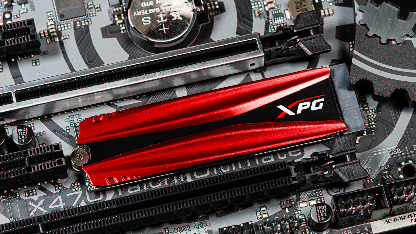
The ADATA XPG Gammix S5 256GB is the entry-level capacity in ADATA's budget Gammix NVMe line. Built on the Realtek RTS5763DL — a 4-channel DRAM-less PCIe 3.0 controller that uses Host Memory Buffer instead of dedicated DRAM — the Gammix S5 targets the price-sensitive segment where SATA SSDs once dominated. At 256GB it's positioned as a pure OS-and-essentials drive, delivering 2,100 MB/s read and 1,500 MB/s write — roughly 4x the throughput of a SATA SSD — at a price point that undercuts DRAM-equipped NVMe options. This review examines whether the DRAM-less RTS5763DL platform delivers enough performance to justify choosing it over a SATA SSD or a DRAM-equipped NVMe budget alternative.
Controller & Memory
The Realtek RTS5763DL is a 4-channel PCIe 3.0 x4 NVMe controller designed specifically for the DRAM-less budget segment. Unlike the 8-channel RTS5762 found in ADATA's SX8800 Pro, the RTS5763DL relies entirely on NVMe 1.3's Host Memory Buffer (HMB) to borrow a slice of system RAM — typically 32-64 MB — for the flash translation layer mapping table. This eliminates the cost of a dedicated DRAM chip but introduces a small latency penalty: every mapping-table lookup must traverse the PCIe bus to system memory rather than hitting a local DRAM on the SSD PCB.
At the 256GB capacity, the RTS5763DL's four NAND channels operate with reduced die-level parallelism, capping sequential write throughput at 1,500 MB/s. Sequential reads reach 2,100 MB/s — well below the PCIe 3.0 x4 ceiling but still 3-4x faster than any SATA SSD. For a drive whose primary job is loading Windows, launching applications, and booting games from a secondary library, the read-heavy workload profile means the RTS5763DL's architecture is well-matched to the task.
ADATA pairs the controller with 3D TLC NAND behind an SLC write cache. At 256GB the SLC cache is proportionally smaller than on higher-capacity models — typically 30-50 GB dynamically — but for an OS drive that rarely sees bulk writes, cache exhaustion is uncommon. The drive includes LDPC error correction, SLC caching with intelligent cache management, and supports NVMe 1.3 features including autonomous power state transitions. The single-sided M.2 2280 form factor ensures compatibility with any M.2 slot. ADATA backs the drive with a 5-year limited warranty.
Storage Comparisons:
XPG Gammix S5 Performance & Benchmarks
Rated sequential throughput of 2,100 MB/s read and 1,500 MB/s write puts the Gammix S5 256GB in the budget NVMe performance tier. Reads are roughly 4x faster than a SATA SSD's 550 MB/s ceiling; writes are about 2.7x faster. For an OS drive, where reads dominate and writes are mostly small random operations from background tasks and updates, the read-speed advantage over SATA is the headline number.
ADATA XPG Gammix S5 256 GB vs M.2 3.0 x 4 peers
Switch between sequential throughput and random IOPS to see how this drive stacks up against other M.2 3.0 x 4 SSDs in our database. The highlighted bar is the drive on this page — click any other bar to open that drive.
- ADATA SX 8800 Pro 512 GB: 3,500 MB/s read, 2,700 MB/s write
- ADATA SX 8800 Pro 1 TB: 3,500 MB/s read, 2,700 MB/s write
- ADATA XPG Spectrix S40G RGB 256 GB: 3,500 MB/s read, 3,000 MB/s write
- ADATA XPG Spectrix S40G RGB 512 GB: 3,500 MB/s read, 3,000 MB/s write
- ADATA XPG Gammix S5 256 GB (this drive): 2,100 MB/s read, 1,500 MB/s write
Random 4K performance at 250K/240K IOPS is adequate for a budget drive. The HMB-sourced mapping table keeps lightly-threaded random reads and writes responsive — Windows boots, application launches, and web browser sessions feel snappy. The DRAM-less architecture shows its limits under sustained mixed workloads: if you install a large application while simultaneously running a virus scan and compiling code, the HMB-based FTL can become a bottleneck, and latency spikes compared to a DRAM-equipped alternative. But for the single-task-at-a-time usage pattern typical of a budget build — boot, browse, launch a game — the RTS5763DL keeps up without complaint.
The 256GB capacity is the real constraint, not the controller. Windows 10/11 with a modest application suite (Office, browser, media player, a few utilities) occupies roughly 60-80 GB, leaving about 160 GB for games or files. One or two AAA titles at 80-100 GB each will fill the drive. The Gammix S5 256GB works best as a dedicated OS-and-applications drive paired with a secondary SATA SSD or hard drive for bulk storage. Thermally the RTS5763DL is well-behaved — its low power draw means it rarely if ever throttles even in passively cooled laptop M.2 slots.
ADATA XPG Gammix S5 vs Competitors
See how the XPG Gammix S5 stacks up against other M.2 3.0 x 4 drives in our database:
Compare with rival drives:
Endurance, TBW & Warranty
ADATA provides a 5-year limited warranty for the XPG Gammix S5 series. Endurance ratings are not publicly specified for the 256GB model — typical for budget drives at this capacity. The warranty is tied to the original purchaser and does not cover data recovery. ADATA's SSD Toolbox software provides drive health monitoring, firmware updates, and secure erase.
ADATA XPG Gammix S5 256 GB Specifications
| Category | Value |
|---|---|
| Capacity [?] | 256 GB |
| Interface [?] | M.2 3.0 x 4 |
| Controller [?] | Realtek RTS5763DL |
| Memory type [?] | Micron TLC |
| DRAM [?] | HMB |
| Read speed (MB/s) [?] | 2100 |
| Write speed (MB/s) [?] | 1500 |
| Read IOPS [?] | 250000 |
| Write IOPS [?] | 240000 |
| Endurance (TBW) [?] | 160 |
| MTBF (million hours) [?] | 2 |
| Warranty (years) [?] | 5 |
Verdict: Is the XPG Gammix S5 Worth It in 2026?
The ADATA XPG Gammix S5 256GB is an honest budget NVMe drive. It doesn't pretend to compete with DRAM-equipped flagships — the Realtek RTS5763DL is a purpose-built cost-reduction platform, and the 2,100/1,500 MB/s speeds reflect that. What it does deliver is a genuine NVMe experience at a price that competes with SATA SSDs, and the 4x read-speed advantage over SATA is immediately noticeable in boot times and application launches. The 256GB capacity is best suited to an OS-only role; for a single-drive build or a large game library, the 512GB or 1TB capacities are a better fit. For a budget desktop, a laptop rescued from a spinning hard drive, or a secondary boot drive in a multi-drive system, the Gammix S5 256GB does its job without fuss — just don't expect it to punch above its weight class.
+ Pros
- 2,100/1,500 MB/s — 4x SATA read speed, genuine NVMe experience
- Single-sided M.2 2280 — universal fit including thin laptops
- 5-year warranty — longer than many budget alternatives
- Cool and efficient — Realtek RTS5763DL draws minimal power
- ADATA SSD Toolbox support — firmware updates and health monitoring
- Aggressive pricing — often the cheapest NVMe option at 256GB
- Cons
- DRAM-less HMB design — latency penalty under mixed workloads
- 256GB capacity — tight for OS plus game library
- Realtek RTS5763DL is 4-channel — cannot match 8-channel Gen3 drives
- Endurance not publicly specified for 256GB model
- Post-cache TLC write speed drops to ~300-400 MB/s
- No hardware encryption support (TCG Opal / Pyrite)
Buy this or similar SSD Storage:



Video Review
Unboxing ADATA XPG Gammix S5 512GB NVMe SSD PCIe Gen3x4 M.2