Lexar NM700 256GB SSD — In-Depth Review & Specs (2026)
Quick answer
The Lexar NM700 256GB is a competent PCIe 3.0 NVMe SSD for a specific use case: a budget boot drive in an older system that needs a DRAM-equipped NVMe drive rather than a DRAM-less alternative.
Read: 3500 MB/s Write: 2000 MB/s Endurance: 150 TBW Warranty: 5 years Interface: M.2 3.0 x 4
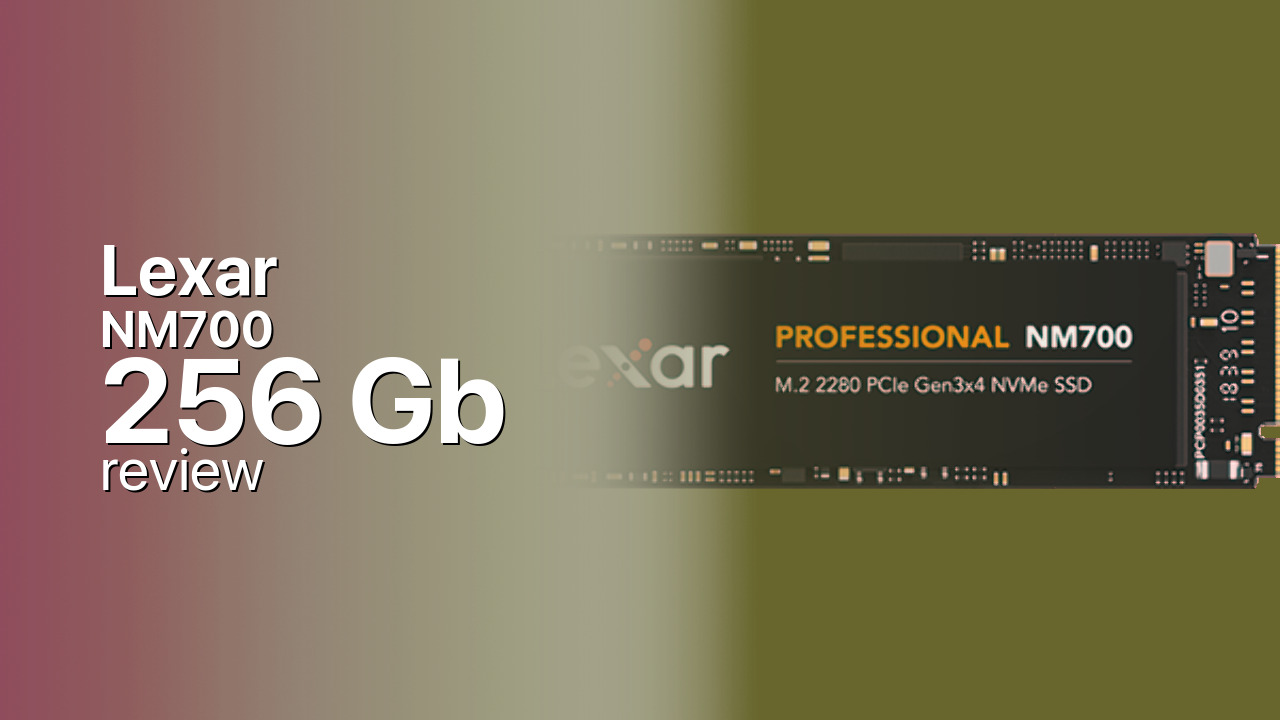
The Lexar Professional NM700 256GB is an entry-level capacity in Lexar's PCIe 3.0 NVMe lineup. Powered by the Marvell 88SS1092 — a triple-core ARM Cortex R5 controller with 8 NAND channels and a dedicated DDR3 DRAM buffer — it delivers up to 3,500 MB/s sequential reads and 2,000 MB/s writes. For users upgrading from a SATA SSD or hard drive in an older system, the NM700 256GB offers a genuine NVMe experience at a modest price, though the 256 GB capacity is tight by modern standards.
Controller & Memory
The Marvell 88SS1092 is a mature PCIe 3.0 x4 controller built around three ARM Cortex R5 cores running at up to 500 MHz. Unlike many budget SSDs that use DRAM-less HMB architectures, the 88SS1092 is a full-featured 8-channel design that includes a dedicated DDR3 DRAM chip for the flash translation layer (FTL) mapping table. On the 256GB model, Lexar outfits the drive with a proportionally sized DRAM buffer (typically 256–512 MB of Nanya DDR3-1866). The NAND is 3D TLC, though Lexar does not publicly disclose the flash supplier — the chips are packaged by Longsys, Lexar's parent company.
Lexar is a well-established brand in the memory and storage market, owned by Longsys (a major Chinese flash storage manufacturer). The NM700 was Lexar's mainstream PCIe 3.0 offering, positioned below the faster NM800 (PCIe 4.0) series. The drive uses a standard single-sided M.2 2280 form factor and is compatible with any PCIe 3.0 (or newer) M.2 slot.
At 256 GB, the NM700 is best suited as a boot drive for a budget build or a secondary fast-storage device. It provides enough room for Windows or Linux and core applications, but game libraries and media collections will quickly outgrow it. The 150 TBW endurance rating works out to roughly 82 GB of writes per day over 5 years — tight but adequate for an OS-only workload.
Storage Comparisons:
NM700 Performance & Benchmarks
Sequential throughput reaches 3,500 MB/s read and 2,000 MB/s write on the 256GB model — the read speed hits the PCIe 3.0 x4 ceiling, while the write speed is limited by the reduced NAND die count at this capacity. The 1TB sibling reaches 2,000 MB/s write or higher. Random 4K performance benefits from the dedicated DRAM buffer: expect roughly 200,000–300,000 IOPS read and 250,000–350,000 IOPS write. The DRAM keeps random I/O latency consistent under mixed workloads, an advantage over DRAM-less designs that can stutter when multitasking.
Lexar NM700 256 GB vs M.2 3.0 x 4 peers
Switch between sequential throughput and random IOPS to see how this drive stacks up against other M.2 3.0 x 4 SSDs in our database. The highlighted bar is the drive on this page — click any other bar to open that drive.
- Lexar NM700 256 GB (this drive): 3,500 MB/s read, 2,000 MB/s write
- ADATA SX 8800 Pro 512 GB: 3,500 MB/s read, 2,700 MB/s write
- ADATA SX 8800 Pro 1 TB: 3,500 MB/s read, 2,700 MB/s write
- ADATA XPG Spectrix S40G RGB 256 GB: 3,500 MB/s read, 3,000 MB/s write
- ADATA XPG Spectrix S40G RGB 512 GB: 3,500 MB/s read, 3,000 MB/s write
The SLC write cache on the 256GB model is relatively small — approximately 15–25 GB — reflecting the limited over-provisioning and free space at this capacity. Post-cache native TLC writes settle around 500–700 MB/s. For a boot drive handling OS updates, browser caches, and application writes, the cache is rarely stressed. Large sustained writes will push past it quickly, but that is not the expected use case for a 256GB drive. Thermal performance is good: the Marvell controller runs at moderate temperatures, and the drive rarely exceeds 65°C without a heatsink. Power consumption peaks at roughly 4–5 W under load.
Lexar NM700 vs Competitors
See how the NM700 stacks up against other M.2 3.0 x 4 drives in our database:
Compare with rival drives:
Endurance, TBW & Warranty
Lexar provides a limited warranty on the NM700 series, though the exact duration varies by region. The 256GB model is rated at 150 TBW endurance. Lexar's warranty service is administered through regional distributors — verify coverage terms with the seller before purchasing, especially in regions where Lexar's retail presence is limited.
Lexar NM700 256 GB Specifications
| Category | Value |
|---|---|
| Capacity [?] | 256 GB |
| Interface [?] | M.2 3.0 x 4 |
| Controller [?] | Marvell 88SS1092 |
| Memory type [?] | 3D TLC |
| DRAM [?] | DDR3 DRAM |
| Read speed (MB/s) [?] | 3500 |
| Write speed (MB/s) [?] | 2000 |
| Read IOPS [?] | 293000 |
| Write IOPS [?] | 272000 |
| Endurance (TBW) [?] | 150 |
| MTBF (million hours) [?] | 1.5 |
| Warranty (years) [?] | 5 |
Verdict: Is the NM700 Worth It in 2026?
The Lexar NM700 256GB is a competent PCIe 3.0 NVMe SSD for a specific use case: a budget boot drive in an older system that needs a DRAM-equipped NVMe drive rather than a DRAM-less alternative. The Marvell 88SS1092 controller is a proven performer with consistent latency thanks to its dedicated DRAM, and the 3,500 MB/s read speed saturates the PCIe 3.0 interface. The 256 GB capacity is the main limiting factor — it is too small for a primary drive in most 2026 workloads. If you can stretch to the 512GB or 1TB NM700, you will get both more space and higher write throughput. If you must live within this capacity, the NM700 is a solid step up from a SATA SSD.
+ Pros
- Marvell 88SS1092 with dedicated DDR3 DRAM — no HMB compromises
- 3,500 MB/s reads — PCIe 3.0 x4 saturation
- Consistent random I/O latency under mixed workloads
- Single-sided M.2 2280 fits any compatible slot
- Lexar/Longsys brand with established global distribution
- Cons
- 256 GB capacity is very tight for modern use cases
- Write speed (2,000 MB/s) limited by low NAND die count
- Small SLC cache (~15-25 GB) fills quickly under sustained writes
- NAND supplier not publicly disclosed
- Warranty terms vary by region — verify before purchase
Buy this or similar SSD Storage:



Video Review
Lexar NM700 Gen 3x4 NVMe M.2 - Is It The One to Get?