Patriot Viper VPN100 256GB PCIe 3.0 NVMe SSD (2026)
Quick answer
The Patriot Viper VPN100 256 GB is a capable PCIe 3.0 NVMe SSD with a distinctive oversized heatsink that keeps thermals in check on desktop builds.
Read: 3000 MB/s Write: 1000 MB/s Endurance: 200 TBW Warranty: 3 years Interface: M.2 3.0 x 4
The Patriot Viper VPN100 256 GB is the entry capacity of Patriot's heatsink-equipped PCIe 3.0 NVMe line, pairing a Phison E12 controller with Toshiba TLC NAND and a large built-in aluminum heatsink for 3,400 MB/s reads.
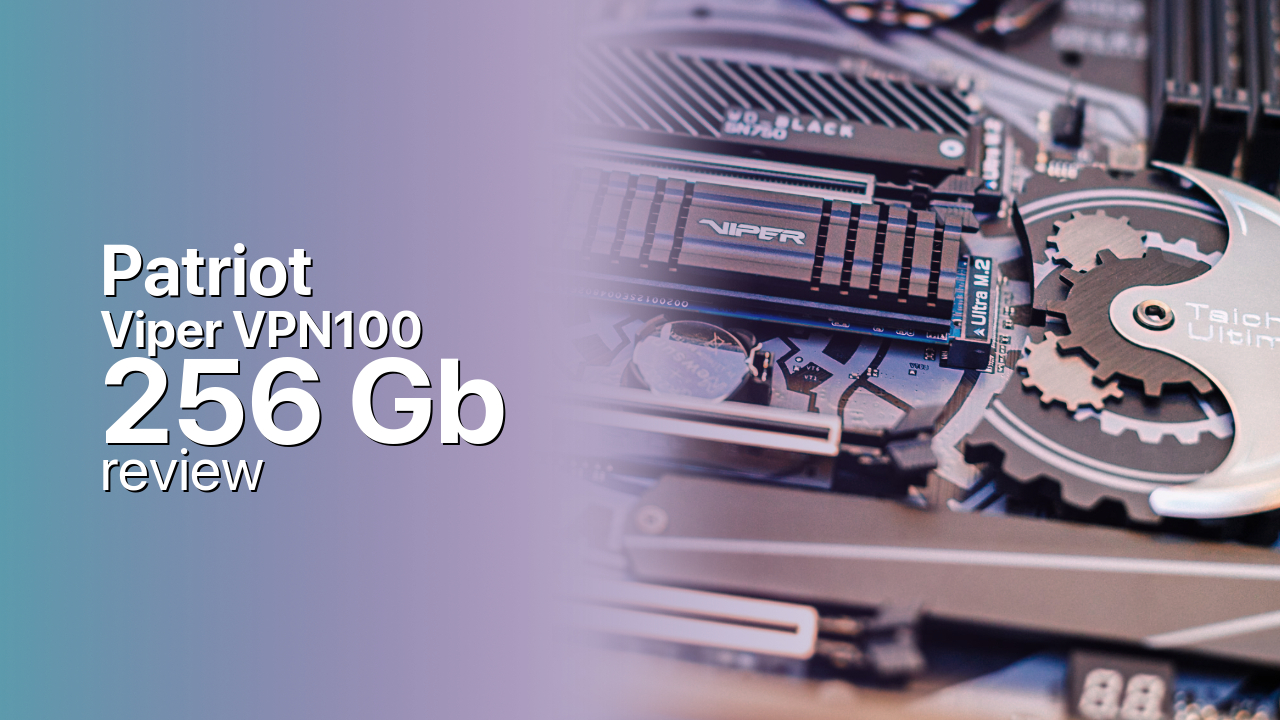
Controller & Memory
The VPN100 series was Patriot's performance NVMe line before the PCIe 4.0 VP4100 and VP4300 arrived. Built around the Phison PS5012-E12 eight-channel controller and Toshiba 3D TLC NAND, the VPN100 ships in four capacities: 256 GB, 512 GB, 1 TB, and 2 TB. The 256 GB model is the smallest, with 512 MB of DDR4 DRAM cache.
The standout physical feature is the large integrated aluminum heatsink with six thermal fins, which is among the biggest factory heatsinks fitted to a consumer M.2 SSD. The heatsink makes the VPN100 too tall for laptop M.2 slots, but for desktop builds it provides effective passive cooling that prevents thermal throttling under sustained loads. Patriot also added an external temperature sensor alongside the standard internal one, allowing more precise thermal management.
The VPN100's Phison E12 platform is well-proven, powering popular drives from Corsair, Sabrent, and others. The 256 GB capacity is best suited as a boot drive or cache drive, since 256 GB fills quickly with modern software and games. Competitors include the Samsung 970 EVO, WD Black SN750, and ADATA XPG SX8200 Pro, all PCIe 3.0 NVMe drives in the same performance class. The VPN100 differentiates with its oversized heatsink, which most rivals do not include.
Storage Comparisons:
Viper VPN100 Performance & Benchmarks
Patriot rates the VPN100 256 GB at up to 3,400 MB/s sequential reads and up to 3,000 MB/s sequential writes, with up to 500,000 random read and write IOPS. These are competitive PCIe 3.0 x4 speeds that saturate a large portion of the interface's theoretical bandwidth.
Patriot Viper VPN100 256 GB vs M.2 3.0 x 4 peers
Switch between sequential throughput and random IOPS to see how this drive stacks up against other M.2 3.0 x 4 SSDs in our database. The highlighted bar is the drive on this page — click any other bar to open that drive.
- ADATA SX 8800 Pro 512 GB: 3,500 MB/s read, 2,700 MB/s write
- ADATA SX 8800 Pro 1 TB: 3,500 MB/s read, 2,700 MB/s write
- ADATA XPG Spectrix S40G RGB 256 GB: 3,500 MB/s read, 3,000 MB/s write
- ADATA XPG Spectrix S40G RGB 512 GB: 3,500 MB/s read, 3,000 MB/s write
- Patriot Viper VPN100 256 GB (this drive): 3,000 MB/s read, 1,000 MB/s write
The Phison E12 controller delivers consistent performance across a range of workloads. The integrated heatsink keeps the controller well below thermal throttling thresholds, even during extended write operations. For boot-drive duty, OS and application launches are noticeably faster than SATA SSDs and competitive with other PCIe 3.0 NVMe drives. The 256 GB model has fewer NAND dies than larger capacities, which means sustained writes after the SLC cache exhaust will be slower than on the 1 TB or 2 TB variants. For typical desktop use, this is rarely noticeable.
Patriot Viper VPN100 vs Competitors
See how the Viper VPN100 stacks up against other M.2 3.0 x 4 drives in our database:
Compare with rival drives:
Endurance, TBW & Warranty
The VPN100 series carries a 3,200 TBW endurance rating with a 3-year warranty. This endurance rating appears to be a family-level figure across all capacities, though larger drives typically have higher per-capacity endurance. At a typical 10 GB per day write workload for a 256 GB boot drive, the endurance would last many decades. The Phison E12 platform includes LDPC error correction and end-to-end data path protection. Patriot's 3-year warranty covers manufacturing defects and premature failure.
Patriot Viper VPN100 256 GB Specifications
| Category | Value |
|---|---|
| Capacity [?] | 256 GB |
| Interface [?] | M.2 3.0 x 4 |
| Controller [?] | Phison E12 |
| Memory type [?] | Toshiba TLC |
| DRAM [?] | SK Hynix 512MB() DDR4 |
| Read speed (MB/s) [?] | 3000 |
| Write speed (MB/s) [?] | 1000 |
| Read IOPS [?] | 250000 |
| Write IOPS [?] | 100000 |
| Endurance (TBW) [?] | 200 |
| MTBF (million hours) [?] | 2 |
| Warranty (years) [?] | 3 |
Verdict: Is the Viper VPN100 Worth It in 2026?
The Patriot Viper VPN100 256 GB is a capable PCIe 3.0 NVMe SSD with a distinctive oversized heatsink that keeps thermals in check on desktop builds. The 256 GB capacity works as a boot drive or cache drive, but fills up fast with modern games and applications. Builders who want the VPN100's heatsink and reliable Phison E12 performance should consider stepping up to the 512 GB or 1 TB model for more practical storage. For the same money, non-heatsink PCIe 3.0 drives may offer more capacity, but the VPN100's cooling solution is a genuine advantage for builds without motherboard M.2 heatsinks.
+ Pros
- 3,400 MB/s sequential reads on PCIe 3.0
- Large integrated aluminum heatsink with six fins
- External temperature sensor for precise thermal management
- Phison E12 controller with 512 MB DDR4 DRAM cache
- No thermal throttling under sustained loads
- Cons
- 256 GB capacity is too small for game libraries
- Large heatsink does not fit laptops
- 3-year warranty is shorter than competitors
- Heatsink cannot be removed safely
Buy this or similar SSD Storage:
Video Review
✅Patriot Viper VPN100 512GB M.2 NVMe SSD Review