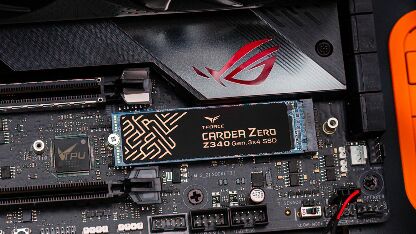
Team Group MP34 256GB NVMe SSD — Budget Review (2026)
Quick answer
The Team Group MP34 256GB is an honest budget NVMe SSD that delivers DRAM-cached Phison E12 performance at a price typically reserved for DRAM-less drives.
Read: 2700 MB/s Write: 850 MB/s Endurance: 380 TBW Warranty: 3 years Interface: M.2 3.0 x 4
The Team Group MP34 256GB is a budget PCIe 3.0 NVMe SSD built on the proven Phison E12 platform with Toshiba BiCS3 64L TLC and a DRAM cache — a rare combination at its price point.
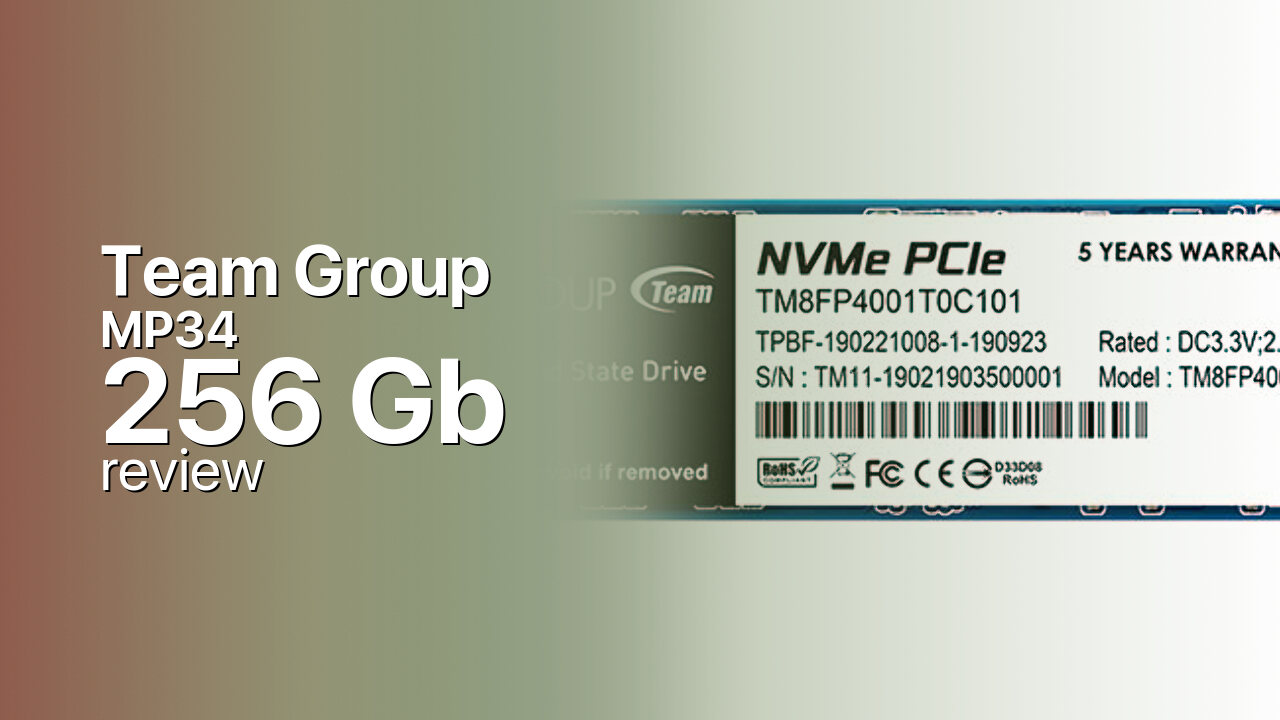
Controller & Memory
The MP34 uses the Phison PS5012-E12-27 controller — a variant of the well-established E12 platform — paired with Toshiba BiCS3 64-layer 3D TLC NAND and Nanya DDR3L DRAM for the flash translation layer. Most competing E12 drives use DDR4, but Team Group opted for DDR3L to reduce cost without materially impacting performance.
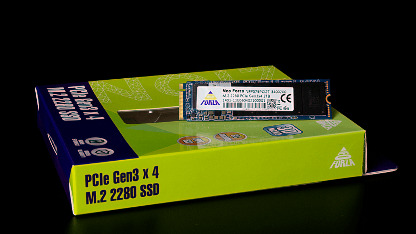
At 256GB, the MP34 is rated at 2,700 MB/s sequential read and 850 MB/s sequential write with 190,000 random read and 160,000 random write IOPS. These figures are significantly lower than the 512GB and 1TB models, which hit 3,000 MB/s read and up to 2,600 MB/s write. The reduced speed is a direct consequence of fewer NAND dies for parallelism — the 256GB capacity has half the die count of the 512GB. The drive is single-sided and uses an M.2 2280 form factor with a blue PCB.
The MP34 competes with other budget NVMe drives like the Crucial P1, WD Blue SN550, and Kingston A2000. Where the MP34 differentiates is the combination of DRAM cache and high TBW endurance — most budget drives in this price range are DRAM-less QLC or TLC with lower endurance ratings.
Storage Comparisons:
MP34 Performance & Benchmarks
The MP34 256GB is rated at 2,700 MB/s sequential read and 850 MB/s sequential write. Tom's Hardware tested the 512GB model and found it significantly outperformed its own rated specs (3.5 GB/s actual vs 3.0 GB/s rated on the 512GB), suggesting the 256GB may also exceed its rating. However, at 256GB, the limited NAND parallelism caps write performance well below the 1TB model's 2,600 MB/s.
Team Group MP34 256 GB vs M.2 3.0 x 4 peers
Switch between sequential throughput and random IOPS to see how this drive stacks up against other M.2 3.0 x 4 SSDs in our database. The highlighted bar is the drive on this page — click any other bar to open that drive.
- ADATA SX 8800 Pro 512 GB: 3,500 MB/s read, 2,700 MB/s write
- ADATA SX 8800 Pro 1 TB: 3,500 MB/s read, 2,700 MB/s write
- ADATA XPG Spectrix S40G RGB 256 GB: 3,500 MB/s read, 3,000 MB/s write
- ADATA XPG Spectrix S40G RGB 512 GB: 3,500 MB/s read, 3,000 MB/s write
- Team Group MP34 256 GB (this drive): 2,700 MB/s read, 850 MB/s write
The 850 MB/s write speed is barely above SATA SSD territory and is the weakest metric for this capacity. For a boot drive or lightweight application drive, read speed matters more, and 2,700 MB/s is competitive with PCIe 3.0 drives at this price. Random performance at QD1 is solid thanks to the DRAM cache, ensuring responsive OS and application use. The Phison E12 platform has mature firmware, and Tom's Hardware found the 512GB sample traded blows with the over-provisioned MyDigitalSSD BPX Pro.
Team Group MP34 vs Competitors
See how the MP34 stacks up against other M.2 3.0 x 4 drives in our database:
Compare with rival drives:
Endurance, TBW & Warranty
Team Group rates the MP34 256GB at 380 TBW endurance with a 3-year warranty — notably shorter than the 5-year warranties on premium NVMe drives. The 380 TBW is generous for a budget drive at this capacity and reflects the TLC flash and Phison E12's LDPC error correction. At 20 GB of writes per day, the endurance would last roughly 52 years. The MTBF is rated at 1.8 million hours. Some Amazon listings and a commenter on Tom's Hardware noted that Team Group later extended the MP34 warranty to 5 years, but the original specification and the DB entry list 3 years.
Team Group MP34 256 GB Specifications
| Category | Value |
|---|---|
| Capacity [?] | 256 GB |
| Interface [?] | M.2 3.0 x 4 |
| Controller [?] | Phison PS5012-E12-27 |
| Memory type [?] | Toshiba BiCS3 64L TLC |
| DRAM [?] | SK Hynix 2GB DDR4-2400 |
| Read speed (MB/s) [?] | 2700 |
| Write speed (MB/s) [?] | 850 |
| Read IOPS [?] | 190000 |
| Write IOPS [?] | 160000 |
| Endurance (TBW) [?] | 380 |
| MTBF (million hours) [?] | 1.8 |
| Warranty (years) [?] | 3 |
Verdict: Is the MP34 Worth It in 2026?
The Team Group MP34 256GB is an honest budget NVMe SSD that delivers DRAM-cached Phison E12 performance at a price typically reserved for DRAM-less drives. The 850 MB/s write speed at 256GB is the trade-off — it is barely faster than SATA for writes. For a boot and application drive where reads dominate, the 2,700 MB/s read speed is a genuine upgrade over SATA. For any write-heavy use case, stepping up to the 512GB or 1TB model dramatically improves write speed. Competitors at 256GB include the Crucial P1 (QLC, slower) and Kingston A2000 (similar TLC E12 platform).
+ Pros
- DRAM cache at a budget price point
- 380 TBW endurance is generous for budget
- Single-sided M.2 fits laptops and desktops
- Mature Phison E12 platform with reliable firmware
- Cons
- 850 MB/s write speed is barely above SATA
- 256GB capacity fills up quickly
- 3-year warranty (some competitors offer 5)
- Blue PCB is aesthetically unappealing
Buy this or similar SSD Storage:



Video Review
Team Group MP32 M.2 256GB NVMe SSD - Fast and Cheap SSD?