Inland Performance Plus 1TB — PCIe 4.0 NVMe SSD Review (2026)
Quick answer
The Inland Performance Plus 1 TB is the house-brand Phison E18 drive done right.
Read: 7000 MB/s Write: 6800 MB/s Endurance: 700 TBW Warranty: 5 years Interface: M.2 4.0 x 4
The Inland Performance Plus 1TB is Micro Center’s house-brand Phison E18 drive, delivering second-generation PCIe 4.0 throughput at a price that routinely undercuts the Samsung and WD flagships.
Controller & Memory
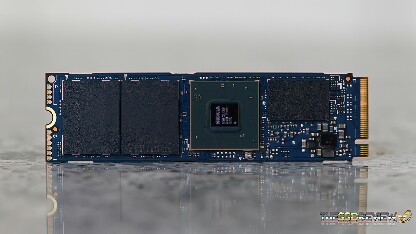
Inland is Micro Center's store brand, and the Performance Plus is its flagship PCIe 4.0 offering — a full-fat Phison PS5018-E18 implementation that brings second-generation PCIe 4.0 performance to a house-brand price point. The E18 is an eight-channel controller fabricated on TSMC's 12 nm process, a significant shrink from the 28 nm E16 that preceded it, and it pairs with Micron 3D TLC NAND (96-layer or 176-layer B47R, depending on production batch) and a dedicated DDR4 DRAM cache. Inland rates the 1 TB model at up to 7,000 MB/s sequential read and 6,800 MB/s sequential write, with random performance of up to 1,000,000 IOPS in both directions. These figures place the Performance Plus squarely in the second-generation PCIe 4.0 performance tier, competing directly with the Samsung 980 PRO, WD Black SN850, and Sabrent Rocket 4 Plus.
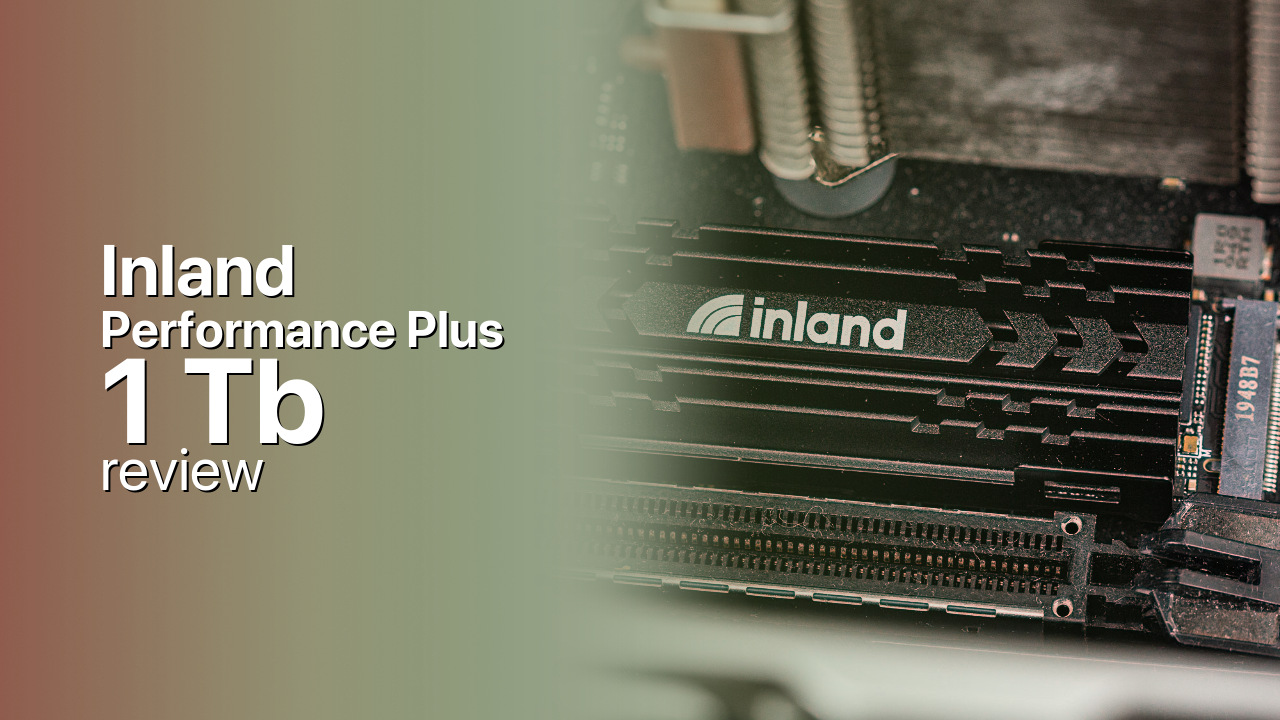
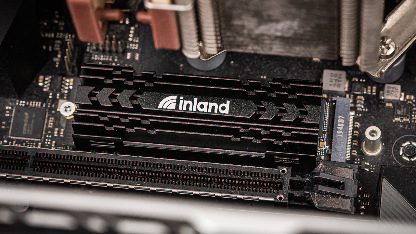
Micro Center ships two versions of the Performance Plus 1 TB: a bare drive and a version with a pre-installed aluminium heatsink. The heatsink variant is marketed as PS5-ready and carries a small price premium, but the heatsink itself is a straightforward finned aluminium block that performs well — Tom's Hardware measured controller temperatures in the mid-50s °C under sustained writes, with zero throttling. The bare-drive version relies on the standard graphene-coated label for passive cooling and will thermally throttle under sustained writes in still air, as all E18 drives do, though the 12 nm node runs substantially cooler than the 28 nm E16. The endurance rating of 700 TBW at 1 TB is the standard Phison E18 reference figure — lower than the 1,800 TBW of the E16 generation because the E18's more aggressive pSLC caching strategy generates higher write amplification, but still well above the 600 TBW that Samsung and WD rate their own PCIe 4.0 flagships at 1 TB. Inland backs the drive with a 5-year warranty, matching the industry standard for premium TLC drives.
As a Micro Center house brand, the Performance Plus's primary advantage is pricing. It has historically been among the cheapest ways to get a full Phison E18 drive with DRAM, routinely undercutting the Sabrent Rocket 4 Plus and Corsair MP600 Pro by $20–40 at the 1 TB capacity. The downside is availability: Inland SSDs are sold exclusively through Micro Center's physical stores and website, with no distribution through Amazon, Newegg, or other retailers. For buyers within driving distance of a Micro Center or willing to order from their web store, the Performance Plus offers flagship-tier E18 performance at a budget-tier markup. For everyone else, functionally identical E18 drives with broader retail availability are available from Sabrent, Corsair, and Seagate.
Storage Comparisons:
Performance Plus Performance & Benchmarks
The Performance Plus 1 TB delivers exactly what the Phison E18 reference design promises. In CrystalDiskMark, sequential reads land between 6,980 and 7,050 MB/s — effectively saturating the PCIe 4.0 x4 interface after protocol overhead. Sequential writes under the pSLC cache hit 6,750–6,850 MB/s, consistent with Inland's 6,800 MB/s rating. QD1 4K random reads sit in the 80–88 MB/s range — a meaningful step up from the E16's 65–70 MB/s and competitive with the Samsung 980 PRO's Elpis controller. QD1 4K random writes land at 250–280 MB/s, reflecting the E18's improved write buffering and the 12 nm node's lower latency.
Inland Performance Plus 1 TB vs M.2 4.0 x 4 peers
Switch between sequential throughput and random IOPS to see how this drive stacks up against other M.2 4.0 x 4 SSDs in our database. The highlighted bar is the drive on this page — click any other bar to open that drive.
- Patriot Viper PV593 1 TB: 14,500 MB/s read, 14,000 MB/s write
- Patriot Viper PV593 2 TB: 14,500 MB/s read, 14,000 MB/s write
- Patriot Viper PV593 4 TB: 14,500 MB/s read, 14,000 MB/s write
- Patriot Viper PV573 2 TB: 14,000 MB/s read, 12,000 MB/s write
- Inland Performance Plus 1 TB (this drive): 7,000 MB/s read, 6,800 MB/s write
Sustained write behaviour follows the E18 reference profile for 1 TB of Micron TLC. The pSLC cache absorbs roughly 90–110 GB of writes at the full 6,800 MB/s before the controller begins folding data into TLC at approximately 1,300–1,600 MB/s. This cache size is smaller in relative terms than the E16 generation (which allocated less NAND to SLC caching), but the peak cached speed is ~55% higher, so the net throughput for any given transfer size is substantially better. A full-drive sequential fill of the 1 TB model completes at an average of approximately 2,200–2,500 MB/s. Thermal performance with the included heatsink is excellent: sustained writes keep the controller in the low-to-mid 50s °C, well below the ~75 °C throttle threshold. Without the heatsink, the controller reaches the low 70s °C and engages a mild throttle of 5–8%, which is largely invisible in real-world use since the post-throttle speed still exceeds 1,200 MB/s.
Inland Performance Plus vs Competitors
See how the Performance Plus stacks up against other M.2 4.0 x 4 drives in our database:
Compare with rival drives:
Endurance, TBW & Warranty
Inland warranties the Performance Plus 1 TB for 5 years from the date of purchase, with an endurance ceiling of 700 TBW. This translates to approximately 385 GB of host writes per day over the warranty period, or roughly 0.38 drive writes per day. For comparison, the Samsung 980 PRO 1 TB carries 600 TBW, the WD Black SN850 1 TB carries 600 TBW, and the Crucial P5 Plus 1 TB carries 600 TBW. The Performance Plus's 700 TBW gives it a modest endurance advantage over all three, though the difference is unlikely to be meaningful for typical consumer use — 600 TBW already represents decades of writes for gaming and general productivity. The endurance figure reflects the Phison E18's firmware architecture: the controller allocates a larger share of the TLC array to pseudo-SLC caching than the E16 generation, which improves burst-write throughput but increases write amplification (data written to SLC cache must later be folded into TLC, effectively writing the same data twice). This trade-off is why the E18 platform's endurance ratings are lower than the E16's despite using similar TLC NAND. Warranty claims are handled through Micro Center's in-store and online customer service, which is generally well-regarded in the US but does not extend internationally.
Inland Performance Plus 1 TB Specifications
| Category | Value |
|---|---|
| Capacity [?] | 1 TB |
| Interface [?] | M.2 4.0 x 4 |
| Controller [?] | Phison PS5018-E18 |
| Memory type [?] | Micron 3D TLC |
| DRAM [?] | DDR4 Cache |
| Read speed (MB/s) [?] | 7000 |
| Write speed (MB/s) [?] | 6800 |
| Read IOPS [?] | 650000 |
| Write IOPS [?] | 700000 |
| Endurance (TBW) [?] | 700 |
| MTBF (million hours) [?] | 1.7 |
| Warranty (years) [?] | 5 |
Verdict: Is the Performance Plus Worth It in 2026?
The Inland Performance Plus 1 TB is the house-brand Phison E18 drive done right. It delivers the full second-generation PCIe 4.0 experience — 7,000/6,800 MB/s throughput, 1M IOPS random performance, and a 12 nm controller that runs cool under a basic heatsink — at a price that is almost always lower than the identically-specced Sabrent Rocket 4 Plus and Corsair MP600 Pro. The 700 TBW endurance rating narrowly edges out Samsung and WD's 600 TBW flagships, and the option of a pre-installed heatsink makes the PS5-ready SKU a turnkey upgrade for console owners. The trade-offs are exclusivity and brand recognition: the Performance Plus is only available through Micro Center, which limits its audience to the US retail footprint, and the Inland brand carries none of the marketing cachet of Samsung, WD, or even Sabrent. If you live near a Micro Center and want a DRAM-backed, full-speed PCIe 4.0 drive for the lowest possible price, the Performance Plus is consistently one of the best values in the category. If you need a drive shipped to your door from a major online retailer, the functionally identical Sabrent Rocket 4 Plus or the faster (but warranty-shorter) Samsung 980 PRO are the practical alternatives.
+ Pros
- Full Phison E18 performance at a house-brand price
- 7,000/6,800 MB/s saturates PCIe 4.0 for most workloads
- 700 TBW endurance edges out Samsung/WD flagships
- Pre-installed heatsink option is PS5-ready out of the box
- 12 nm E18 controller runs cool and efficient
- 5-year warranty with in-store Micro Center support
- Cons
- Sold exclusively through Micro Center in the US
- No international warranty or distribution
- Brand recognition lags behind Samsung, WD, Sabrent
- 700 TBW is lower than the E16 generation’s endurance
- Heatsink version costs extra and may not fit all slots
Buy this or similar SSD Storage:
Video Review
2TB Inland Premium NVME SSD Review