Sabrent Rocket Q 1TB Review (2026)
Quick answer
The Sabrent Rocket Q 1TB is a good value QLC NVMe drive that delivers TLC-matching peak speeds at a lower cost per GB.
Read: 3400 MB/s Write: 3000 MB/s Endurance: 1665 TBW Warranty: 5 years Interface: M.2 3.0 x 4
The Sabrent Rocket Q 1TB uses QLC NAND to deliver high sequential speeds at a lower cost per GB, trading sustained write performance for capacity value.
Controller & Memory
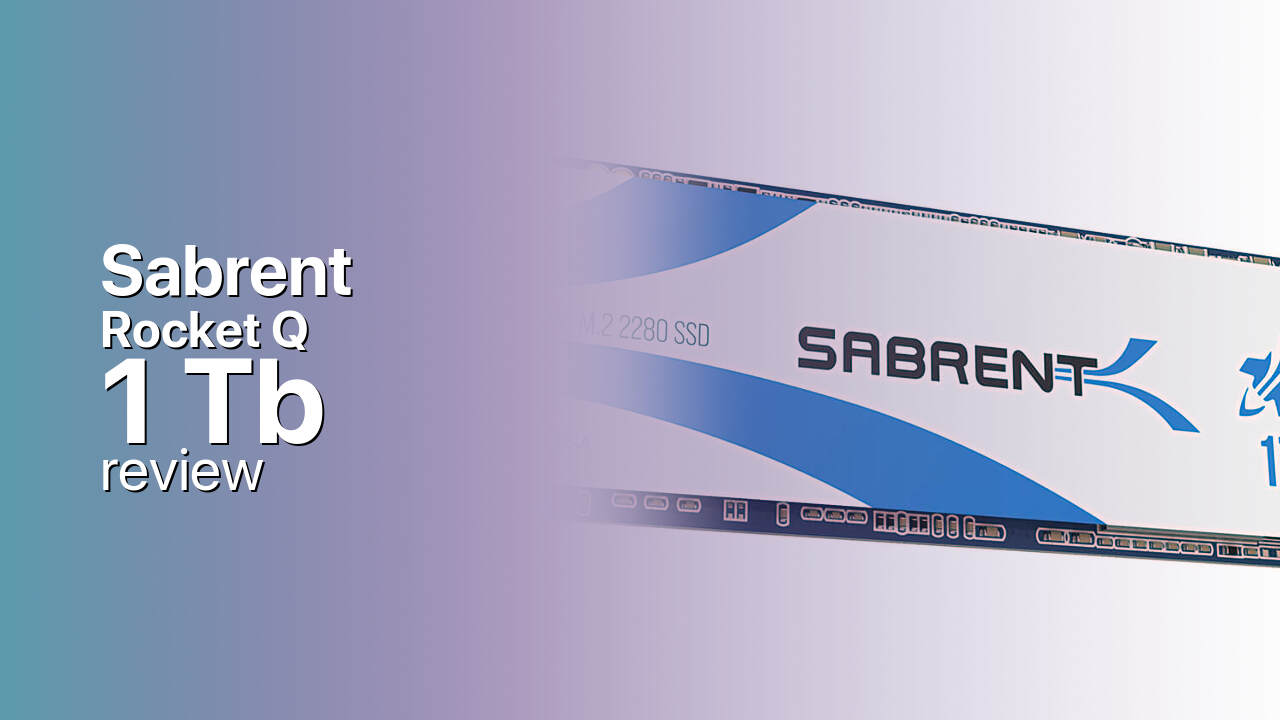
Sabrent designed the Rocket Q series for users who want maximum capacity at minimum cost per GB. The Q in the name stands for QLC (quad-level cell) NAND, which stores four bits per cell compared to three on TLC. This increases density and reduces cost but comes with lower endurance and slower sustained write speeds after the SLC cache is exhausted.
The 1TB model uses the Phison E12S controller with DDR4 DRAM and QLC NAND, rated at 3,400 MB/s sequential reads and 3,000 MB/s writes. These peak speeds are impressive for a QLC drive and match many TLC competitors on paper. The difference becomes apparent during sustained writes where QLC native speeds are significantly slower than TLC.
The drive carries a 1,665 TBW endurance rating with a 5-year warranty. The M.2 2280 form factor fits standard NVMe slots. The Rocket Q 1TB competes with the Corsair MP400 1TB and Intel 665p 1TB in the QLC NVMe segment.
Storage Comparisons:
Rocket Q Performance & Benchmarks
The Sabrent Rocket Q 1TB is rated at 3,400 MB/s sequential reads and 3,000 MB/s sequential writes with 650,000 IOPS for both random reads and writes. These peak speeds are competitive with TLC-based PCIe 3.0 drives, and the Rocket Q 1TB actually writes faster than some TLC alternatives like the Corsair MP400 1TB which peaks at 1,880 MB/s writes.
Sabrent Rocket Q 1 TB vs M.2 3.0 x 4 peers
Switch between sequential throughput and random IOPS to see how this drive stacks up against other M.2 3.0 x 4 SSDs in our database. The highlighted bar is the drive on this page — click any other bar to open that drive.
- ADATA SX 8800 Pro 512 GB: 3,500 MB/s read, 2,700 MB/s write
- ADATA SX 8800 Pro 1 TB: 3,500 MB/s read, 2,700 MB/s write
- ADATA XPG Spectrix S40G RGB 256 GB: 3,500 MB/s read, 3,000 MB/s write
- ADATA XPG Spectrix S40G RGB 512 GB: 3,500 MB/s read, 3,000 MB/s write
- Sabrent Rocket Q 1 TB (this drive): 3,400 MB/s read, 3,000 MB/s write
The key performance consideration with QLC is what happens after the pseudo-SLC cache is exhausted. QLC NAND native write speed is slower than TLC, typically dropping to 100-300 MB/s for sustained transfers that exceed the cache. The SLC cache on the 1TB model handles typical consumer write bursts of 20-40 GB before this transition occurs. For everyday use like OS booting, application launches, web browsing, and gaming, the Rocket Q feels fast because these workloads fit within the SLC cache and read performance.
For users who regularly transfer large files exceeding the SLC cache, the QLC write cliff will be noticeable. Tasks like copying a 100 GB video file or downloading a large game will see speed drops partway through. The Phison E12S controller and DDR4 DRAM help maintain the peak speeds within the cached region and manage the transition gracefully.
Sabrent Rocket Q vs Competitors
See how the Rocket Q stacks up against other M.2 3.0 x 4 drives in our database:
Compare with rival drives:
Endurance, TBW & Warranty
Sabrent backs the Rocket Q with a 5-year warranty. The 1TB model is rated at 1,665 TBW endurance, which is surprisingly generous for QLC NAND. Writing 50 GB per day would take over 91 years to reach 1,665 TBW. The high TBW rating is possible because the 1TB capacity spreads writes across many NAND die.
Sabrent requires product registration on their website for full warranty coverage. The 5-year warranty matches TLC-based competitors, though QLC NAND has inherently lower program/erase cycle endurance per cell. The warranty provides consumer protection regardless of NAND type. For typical consumer workloads, the endurance is more than adequate.
Sabrent Rocket Q 1 TB Specifications
| Category | Value |
|---|---|
| Capacity [?] | 1 TB |
| Interface [?] | M.2 3.0 x 4 |
| Controller [?] | Phison E12S |
| Memory type [?] | QLC |
| DRAM [?] | DDR4 |
| Read speed (MB/s) [?] | 3400 |
| Write speed (MB/s) [?] | 3000 |
| Read IOPS [?] | 650000 |
| Write IOPS [?] | 650000 |
| Endurance (TBW) [?] | 1665 |
| MTBF (million hours) [?] | 1.8 |
| Warranty (years) [?] | 5 |
Verdict: Is the Rocket Q Worth It in 2026?
The Sabrent Rocket Q 1TB is a good value QLC NVMe drive that delivers TLC-matching peak speeds at a lower cost per GB. The 3,400/3,000 MB/s rated speeds are excellent, and the DDR4 DRAM cache provides consistent random I/O. Buy it if you want maximum storage per dollar and your workloads are primarily reads with occasional writes that fit within the SLC cache.
Skip it if you regularly write large files, do video editing, or need consistent sustained write performance. TLC drives like the Samsung 970 EVO Plus or Sabrent Rocket (non-Q) handle sustained writes much better for a small price premium. The Rocket Q 1TB is best for budget gaming builds, media storage, and general desktop use where the QLC write cliff rarely matters.
+ Pros
- 3,400/3,000 MB/s peak speeds match TLC drives
- DDR4 DRAM for consistent random I/O
- 1,665 TBW endurance generous for QLC
- Lower cost per GB than TLC alternatives
- 5-year warranty
- Cons
- QLC NAND — slow sustained writes after SLC cache exhausts
- QLC native write speed can drop to 100-300 MB/s
- Lower per-cell endurance than TLC
- Not ideal for write-heavy workloads
- SLC cache smaller relative to drive capacity
Buy this or similar SSD Storage:



Video Review
Sabrent Rocket Q - Fast and Affordable