Intel SSD 660P 2TB QLC NVMe Review (2026)
Quick answer
The Intel 660P 2TB is a budget bulk-storage NVMe SSD best suited for read-heavy use cases like media libraries, game archives, and general file storage.
Read: 1800 MB/s Write: 1800 MB/s Endurance: 400 TBW Warranty: 5 years Interface: M.2 3.0 x 4
The Intel 660P 2TB is the largest capacity in Intel's first-generation QLC NVMe line, offering the most generous SLC cache and the highest endurance of the series for bulk NVMe storage at budget pricing.
Controller & Memory
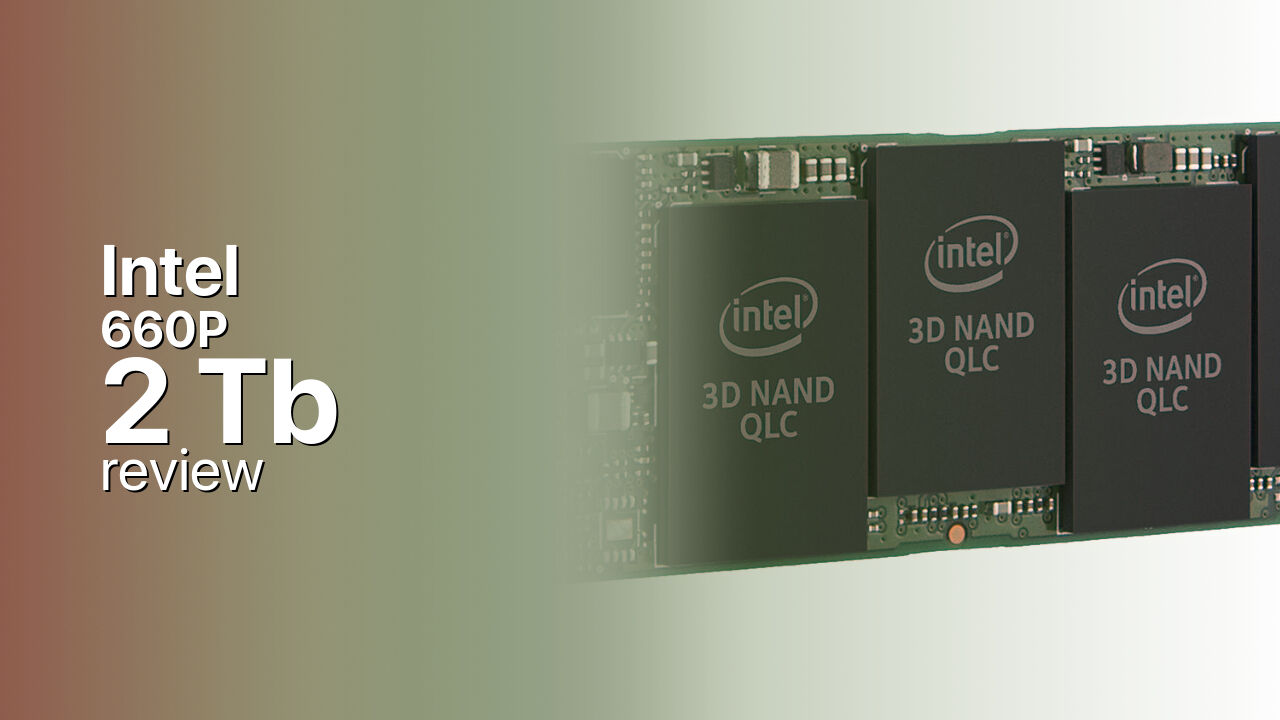
The 660P 2 TB uses the same Silicon Motion SM2263 4-channel controller and Intel 64-layer 1 Tbit 3D QLC NAND as the smaller capacities. A 256 MB Nanya DDR3 DRAM chip handles the flash translation layer. Despite the 2 TB capacity, the single-sided M.2 2280 form factor is maintained thanks to the SM2263's compact package, which leaves room for four NAND packages on one side of the PCB.
Like all 660P capacities, the 2 TB is rated at up to 1,800 MB/s sequential reads and writes with 220,000 random IOPS for both reads and writes. Endurance is 400 TBW over a 5-year warranty, double the 1 TB model. The variable SLC cache scales from 24 GB minimum up to 280 GB on an empty drive -- the largest in the series.
The 2 TB 660P competes with high-capacity budget QLC drives like the Crucial P1 2 TB and entry-level TLC options. Its appeal is cost per GB; its limitation is the aging SM2263 controller and QLC's write behavior.
Storage Comparisons:
660P Performance & Benchmarks
The 2 TB 660P shares the same 1,800 MB/s rated read and write speeds as the rest of the series. The advantage of the 2 TB model is its large SLC cache (up to 280 GB on an empty drive), which means most consumer write workloads stay within the cached region and never hit native QLC speed. When the cache does fill, AnandTech measured roughly 100 MB/s sustained writes on the 1 TB model, and the 2 TB should be similar or slightly better due to more NAND dies.
Intel 660P 2 TB vs M.2 3.0 x 4 peers
Switch between sequential throughput and random IOPS to see how this drive stacks up against other M.2 3.0 x 4 SSDs in our database. The highlighted bar is the drive on this page — click any other bar to open that drive.
- ADATA SX 8800 Pro 512 GB: 3,500 MB/s read, 2,700 MB/s write
- ADATA SX 8800 Pro 1 TB: 3,500 MB/s read, 2,700 MB/s write
- ADATA XPG Spectrix S40G RGB 256 GB: 3,500 MB/s read, 3,000 MB/s write
- ADATA XPG Spectrix S40G RGB 512 GB: 3,500 MB/s read, 3,000 MB/s write
- Intel 660P 2 TB (this drive): 1,800 MB/s read, 1,800 MB/s write
The SM2263 controller's 667 MT/s flash interface caps maximum throughput at around 2.4 GB/s, which is why the 660P cannot reach the PCIe 3.0 x4 theoretical limit of roughly 3.9 GB/s. This is a hardware limitation that no firmware update can overcome.
Random IOPS of 220,000 are cached figures. In real-world desktop use, the large cache means the 2 TB model performs closer to its rated numbers than the smaller capacities, because it is less likely to exhaust the cache during normal operations.
Intel 660P vs Competitors
See how the 660P stacks up against other M.2 3.0 x 4 drives in our database:
Compare with rival drives:
Endurance, TBW & Warranty
Intel rates the 660P 2 TB at 400 TBW over its 5-year warranty period, which equals roughly 219 GB of writes per day. At 0.1 drive writes per day, this is still below the 0.3 DWPD typical of TLC drives, but 400 TBW on a 2 TB drive is adequate for most consumer workloads. The 1.6 million hour MTBF is a population-level reliability metric. Intel handles warranty claims through its standard RMA process.
Intel 660P 2 TB Specifications
| Category | Value |
|---|---|
| Capacity [?] | 2 TB |
| Interface [?] | M.2 3.0 x 4 |
| Controller [?] | Silicon Motion 2263 |
| Memory type [?] | Intel QLC |
| DRAM [?] | Nanya 256MB DDR3 |
| Read speed (MB/s) [?] | 1800 |
| Write speed (MB/s) [?] | 1800 |
| Read IOPS [?] | 220000 |
| Write IOPS [?] | 220000 |
| Endurance (TBW) [?] | 400 |
| MTBF (million hours) [?] | 1.6 |
| Warranty (years) [?] | 5 |
Verdict: Is the 660P Worth It in 2026?
The Intel 660P 2TB is a budget bulk-storage NVMe SSD best suited for read-heavy use cases like media libraries, game archives, and general file storage. The 400 TBW endurance and large SLC cache make it the best value in the 660P lineup. For write-intensive workloads, a TLC NVMe drive or the newer Intel 670P 2TB (740 TBW, faster controller) is the better investment. At the right price, the 660P 2TB works well as secondary storage, but it should not be the primary drive for a system that sees frequent large writes.
+ Pros
- 2 TB capacity at low cost per GB
- 400 TBW endurance rating
- Up to 280 GB SLC cache on empty drive
- DRAM cache (256 MB Nanya DDR3)
- Single-sided M.2 2280 fits thin laptops
- 5-year warranty
- Cons
- QLC native write speed around 100 MB/s
- SM2263 controller capped at ~2.4 GB/s
- 0.1 DWPD, a third of TLC endurance
- Older 64-layer QLC, surpassed by 670P
- PCIe 3.0 only
Buy this or similar SSD Storage:



Video Review
Intel 660p NVMe SSD — Should You Buy One? — Review