PNY XLR8 CS3030 2TB NVMe SSD Review (2026)
Quick answer
The PNY XLR8 CS3030 2TB is a standout value NVMe SSD for users who need high capacity with strong endurance.
Read: 3500 MB/s Write: 3000 MB/s Endurance: 3115 TBW Warranty: 5 years Interface: M.2 3.0 x 4
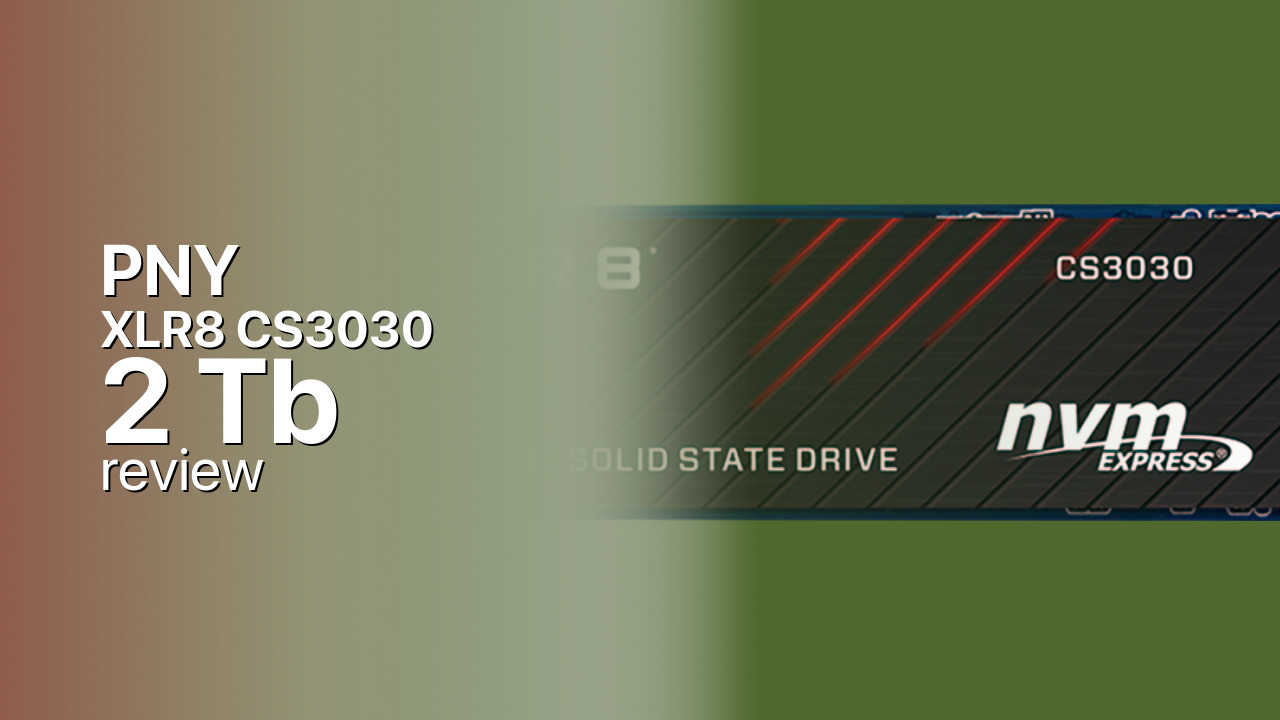
The PNY XLR8 CS3030 2TB is the flagship capacity of PNY's value NVMe line — 3,500/3,000 MB/s speeds, a Phison E12 controller with LPDDR4 DRAM, and a remarkable 3,115 TBW endurance rating.
Controller & Memory
The CS3030 2TB uses the Phison PS5012-E12 controller paired with Toshiba 64-layer BiCS3 TLC NAND and LPDDR4 DRAM. The 2TB model upgrades from the LPDDR3 found on the 250GB and 500GB models to LPDDR4, providing faster access to the flash translation tables. The drive uses a double-sided PCB to distribute the large number of NAND packages across both sides of the board for thermal management.
The 2TB capacity achieves the full 3,500 MB/s read and 3,000 MB/s write speeds that the CS3030 platform is capable of. The 3,115 TBW endurance rating is exceptional — firmly in the petabyte range and well above most consumer NVMe drives at any capacity. The drive is backed by a five-year warranty. The CS3030 line spans 250GB, 500GB, 1TB, and 2TB.
This capacity targets users who need large, fast storage — game libraries, media collections, and content creation scratch disks. Competitors include the Samsung 970 EVO 2TB, Sabrent Rocket 2TB, and ADATA XPG SX8200 Pro 2TB. The CS3030 typically undercuts these on price while offering similar hardware.
Storage Comparisons:
XLR8 CS3030 Performance & Benchmarks
PNY rates the CS3030 2TB at up to 3,500 MB/s sequential reads and 3,000 MB/s sequential writes. PNY does not publish random IOPS numbers for the CS3030 series. The Phison E12 controller in the 2TB model has access to LPDDR4 DRAM and a large pool of NAND dies for write parallelism.
PNY XLR8 CS3030 2 TB vs M.2 3.0 x 4 peers
Switch between sequential throughput and random IOPS to see how this drive stacks up against other M.2 3.0 x 4 SSDs in our database. The highlighted bar is the drive on this page — click any other bar to open that drive.
- PNY XLR8 CS3030 2 TB (this drive): 3,500 MB/s read, 3,000 MB/s write
- ADATA SX 8800 Pro 512 GB: 3,500 MB/s read, 2,700 MB/s write
- ADATA SX 8800 Pro 1 TB: 3,500 MB/s read, 2,700 MB/s write
- ADATA XPG Spectrix S40G RGB 256 GB: 3,500 MB/s read, 3,000 MB/s write
- ADATA XPG Spectrix S40G RGB 512 GB: 3,500 MB/s read, 3,000 MB/s write
TweakTown's testing of the CS3030 platform found the E12 delivering excellent burst sequential write speeds — the 1TB model set a new record for consumer SSDs in their sequential burst write test at over 3,000 MB/s at QD2. The 2TB model, with even more NAND dies, should perform similarly or better. Sustained write consistency was improved over early E12 products, though the SLC buffer is slightly smaller. In PCMark 8 real-world benchmarks, the CS3030 performed well but did not differentiate itself from other E12-based drives.
PNY XLR8 CS3030 vs Competitors
See how the XLR8 CS3030 stacks up against other M.2 3.0 x 4 drives in our database:
Compare with rival drives:
Endurance, TBW & Warranty
The PNY XLR8 CS3030 2TB carries a 3,115 TBW endurance rating backed by a five-year limited warranty. This is firmly in the petabyte range — roughly 1.7 TB of writes per day over the five-year warranty period. For context, most 2TB NVMe drives rate between 1,200 and 2,400 TBW, making the CS3030 well above average. The 2 million hour MTBF is standard for consumer NVMe drives. The five-year warranty is strong for a value-oriented NVMe SSD.
PNY XLR8 CS3030 2 TB Specifications
| Category | Value |
|---|---|
| Capacity [?] | 2 TB |
| Interface [?] | M.2 3.0 x 4 |
| Controller [?] | Phison PS5012-E12 |
| Memory type [?] | Toshiba TLC |
| DRAM [?] | LPDDR3 or LPDDR4 |
| Read speed (MB/s) [?] | 3500 |
| Write speed (MB/s) [?] | 3000 |
| Read IOPS [?] | 300000 |
| Write IOPS [?] | 500000 |
| Endurance (TBW) [?] | 3115 |
| MTBF (million hours) [?] | 2 |
| Warranty (years) [?] | 5 |
Verdict: Is the XLR8 CS3030 Worth It in 2026?
The PNY XLR8 CS3030 2TB is a standout value NVMe SSD for users who need high capacity with strong endurance. Its 3,115 TBW rating is among the best in the consumer PCIe 3.0 segment, and the five-year warranty provides peace of mind. Buyers who need maximum real-world application performance should look to the Samsung 970 EVO 2TB, which posts higher benchmark scores. For raw capacity-per-dollar with DRAM cache and petabyte-class endurance, the CS3030 2TB is one of the best values available.
+ Pros
- 3,500 MB/s reads, 3,000 MB/s writes on PCIe 3.0
- 3,115 TBW endurance — petabyte class
- LPDDR4 DRAM cache
- Toshiba 64L BiCS3 TLC NAND
- Five-year warranty
- Exceptional endurance-per-dollar ratio
- Cons
- Double-sided PCB limits laptop compatibility
- PNY does not publish random IOPS specs
- Trails Samsung 970 EVO in real-world benchmarks
- No bundled software or heatsink
Buy this or similar SSD Storage:



Video Review
PNY XLR8 CS3030 review: An incredibly fast M.2 NVMe drive | TotallydubbedHD